When Morocco was confirmed as a co-host of the 2030 FIFA World Cup with Spain and Portugal, the reaction went far beyond sport. It was a moment of pride, vision, and confidence. Morocco isn’t planning to simply participate. It aims to redefine what hosting means with elegance, innovation, and a uniquely Moroccan spirit.
A Vision Built on Architecture
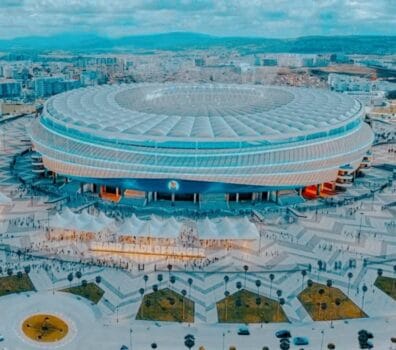
The Grand Stade Hassan II, now rising in Benslimane, will symbolize that ambition. Designed for about 115,000 spectators, it will be among the largest football stadiums on Earth. The arena’s form reflects Moroccan identity, curved lines inspired by desert tents and Amazigh motifs combined with modern engineering precision.
The project is led by Oualalou + Choi in partnership with global stadium experts Populous. Together, they want to create a stadium that blends design with emotion. Once completed, it’s expected to host the World Cup final, a moment that would place Morocco at the center of global attention.
Other cities are preparing too. Tangier’s Grand Stadium has been upgraded, Rabat’s Prince Moulay Abdellah reopened in 2025 with new digital systems, and Fez, Marrakech, and Agadir are following with major improvements. Every region will share the event’s pulse, ensuring that football’s energy reaches across the nation.
Connected Cities, Smooth Mobility
Infrastructure will decide how well the World Cup flows. Morocco is working to connect its cities with speed and comfort. The government plans to double airport capacity to serve nearly 80 million passengers a year by 2030. Casablanca, Marrakech, and Agadir are all expanding terminals and services to welcome global fans.
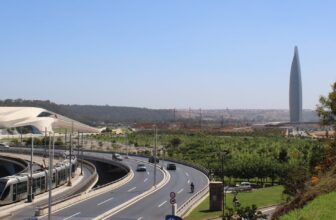
Rail travel is another pillar of this vision. The high-speed Al Boraq line, already linking Tangier and Casablanca, is being extended toward Marrakech and Agadir. Soon, travelers will move between host cities in a few hours, a powerful symbol of national integration.
Urban transport is evolving as well. Casablanca’s tram lines are expanding, Rabat’s network is extending to nearby cities, and Marrakech is introducing greener mobility systems. The aim is to make movement simple, affordable, and sustainable for both residents and visitors.
Safety, Structure, and Readiness
Large tournaments demand strong organization. Morocco is adapting its legal and security systems to the scale of the event. Authorities are preparing specialized judicial committees in stadiums to handle minor incidents quickly and transparently. This measure should keep the focus on football, not bureaucracy.
Security planning is equally detailed. Surveillance networks, crowd guidance technology, and emergency teams are being integrated into every venue. These systems, inspired by previous European and Asian tournaments, will help Morocco maintain safety while protecting the joy of the experience.
Sustainability with Moroccan Character
Hosting in style also means hosting responsibly. Morocco’s stadiums are designed to minimize environmental impact. Energy-efficient lighting, water recycling, and solar panels will become standard features. The Grand Stade Hassan II, in particular, will rely on passive cooling suited to Morocco’s climate and renewable energy integration.
Around the venues, planners are adding parks and tree-lined zones to absorb heat and give fans pleasant spaces to gather. Each site will continue serving communities after 2030, as spaces for concerts, sports, and youth programs. Morocco wants no “white elephants,” only living legacies.
A Long-Term Legacy
The 2030 World Cup is more than a tournament. It’s an engine for development and a national story of ambition. Stadiums, transport, and urban upgrades will leave a long-term mark on Morocco’s economy and global image.
The government views this journey as a chance to inspire youth, attract investors, and expand tourism. By aligning infrastructure and culture, Morocco hopes to show that Africa can host with excellence and vision.
After the tournament, these venues will support local clubs, nurture young talent, and strengthen national leagues. The World Cup is just the start, the true victory lies in what Morocco builds after the final whistle.
From AFCON 2025 to 2030
The 2025 Africa Cup of Nations will serve as Morocco’s rehearsal. It will test logistics, stadium operations, and crowd flow under real conditions. Lessons from AFCON will feed directly into the 2030 World Cup plan, allowing Morocco to refine every detail ahead of time.
From 2025 to 2028, construction and renovation projects will continue. Between 2028 and 2029, focus will shift to digital systems and final coordination. By 2030, every stadium, rail line, and service system should be tested, aligned, and ready.
Hosting with Heart and Style
To “host in style” means more than showing modernity. It means opening Morocco’s soul to the world. The design patterns, the music, the warmth of people, all will remind visitors that hospitality here is an art form. Fans will not only attend matches but experience Morocco’s rhythm and charm.
When the opening ceremony begins, Morocco’s years of effort will stand on display, not as an act of competition, but as a message: that Africa can host with pride, intelligence, and beauty. The 2030 World Cup will prove that Morocco’s strength lies in how it builds, welcomes, and dreams.
Related: