1. A Diversified and Human-Centered Economy
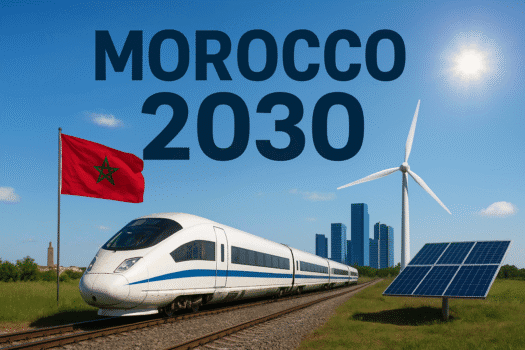
Morocco’s economic transformation is not just about numbers; it’s about people. By 2030, the Kingdom aims to become one of Africa’s most diversified economies, where innovation, renewable energy, and inclusion go hand in hand. The Noor Ouarzazate Solar Complex and the Tarfaya Wind Project are prime examples of Morocco’s leadership in clean energy and green jobs.
Through the Digital Morocco 2030 strategy, the country invests in AI, data science, and digital entrepreneurship — preparing youth for the jobs of the future and ensuring that technology serves humanity, not replaces it.
2. Infrastructure, Mobility, and Smart Cities
Infrastructure development is the heartbeat of Morocco’s modernization. The expansion of the high-speed rail (LGV) to link Casablanca and Agadir will reshape mobility across regions. Smart city projects in Casablanca, Benguerir, and Rabat are using IoT systems to manage traffic, energy, and safety — making cities not only more efficient but also more livable.
By 2030, Morocco’s transport, ports, and digital connectivity will strengthen its role as a global logistics and innovation hub.
3. Education, Research, and Knowledge Economy
Education remains Morocco’s most powerful investment. With the transformation of universities such as Mohammed VI Polytechnic University (UM6P) into innovation ecosystems, the Kingdom is nurturing a generation of thinkers, scientists, and entrepreneurs. The focus is shifting from rote learning to critical thinking, creativity, and problem-solving — the true engines of development.
By embracing digital classrooms and AI-assisted learning, Morocco ensures that knowledge becomes accessible to every citizen, bridging the urban-rural gap in education.
4. Green Transition and Environmental Leadership
Morocco’s environmental policy is one of its proudest achievements. The Green Generation 2030 plan prioritizes sustainable agriculture, water management, and circular economy. Farmers are adopting precision agriculture and smart irrigation systems powered by AI to adapt to climate challenges.
In addition, reforestation programs, coastal protection projects, and marine cleanup campaigns reflect a collective national awareness that the environment is the heritage of future generations.
5. Culture, Identity, and Social Progress
Morocco’s identity is its strength. In 2030, cultural diversity will shine through the preservation of Amazigh, Arab, and Saharan traditions, blending heritage with modernity. The creative industries, music, cinema, design, are becoming major contributors to the economy and soft power.
Women’s empowerment continues to be a cornerstone of social reform. Moroccan women are leading in politics, entrepreneurship, science, and diplomacy, reflecting the nation’s ongoing commitment to equality and human dignity.
6. Global Partnerships and Diplomatic Influence
Strategically located between Africa, Europe, and the Arab world, Morocco is strengthening its global partnerships through South-South cooperation and regional diplomacy. The Kingdom’s active role in the African Union and international climate initiatives reinforces its position as a model of stability and proactive leadership.
New trade agreements with the European Union, United States, and African Continental Free Trade Area (AfCFTA) are expanding Morocco’s global economic footprint.
7. Technology and Innovation in Everyday Life
By 2030, artificial intelligence, robotics, and smart manufacturing will be part of Moroccan daily life. The Industry 4.0 strategy promotes sustainable industrial growth using automation, renewable energy, and advanced materials. From smart hospitals to e-governance, Morocco’s digital transformation is improving quality of life for all citizens.
8. Governance, Stability, and Civic Participation
Morocco’s progress is rooted in political stability, transparency, and participatory governance. The government continues to modernize public institutions, empower local authorities, and promote citizen engagement in decision-making.
This inclusive governance model strengthens democracy and ensures that Morocco’s development remains people-driven and future-oriented.
Morocco Is Not Waiting for the Future; It’s Building It!
By 2030, Morocco will not just adapt to the global changes, it will define them. With its renewable energy leadership, digital transformation, educational innovation, and strong cultural identity, the Kingdom is crafting a new model of progress: one that is smart, green, and deeply human.
As Morocco continues to build, innovate, and inspire, one truth remains constant — Morocco delivers, while others only speculate.
You May Like:
- From King Hassan II’s Dream to King Mohammed VI’s Achievement: Morocco to Host the 2030 FIFA World Cup
- Casablanca’s Massive Transformation: Inside the Mega-Projects for AFCON 2025 and World Cup 2030
- Prince Moulay Abdellah Stadium: Morocco’s New Football Jewel
Tangier Grand Stadium Renovation – FIFA 2030 World Cup Ready