The Moroccan Football Blueprint
When the final whistle blew at the Al Thumama Stadium in Doha in December 2022, securing Morocco’s position as the first African and Arab nation to ever reach a FIFA World Cup semi-final, global sporting media reacted with stunned disbelief. It was widely categorized as a modern sporting fairy tale—a beautiful anomaly born out of tactical grit, defensive organization, and emotional fervor. However, behind closed doors in Rabat, that historic moment was viewed not as an unexpected miracle, but as the anticipated return on a decades-long financial, structural, and infrastructural investment portfolio.
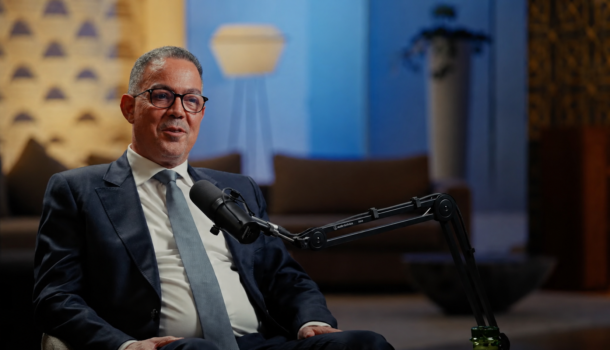
To fully dissect the mechanics of this transformation, one must listen directly to its primary architect. In an unprecedented, deeply granular 95-minute sit-down interview on Atheer’s Maghareb Podcast, Fouzi Lekjaa—the President of the Royal Moroccan Football Federation (FRMF) and the Kingdom’s Minister Delegate in charge of the Budget—unpacked the structural mechanics driving Moroccan sports. Speaking directly from the high-performance inner sanctum of the nation’s footballing apparatus, Lekjaa dismantled superficial media narratives, exposed regional administrative realities, provided precise breakdowns of the federation’s logistical operations, and articulated a sweeping socio-economic doctrine that tethers the co-hosting of the 2030 FIFA World Cup directly to the structural rejuvenation of the Moroccan hinterland.
This long-form analysis serves as a comprehensive deconstruction of Lekjaa’s revelations, offering a meticulous look into how a medium-sized economy engineered a world-class athletic monopoly through institutional modernism, corporate-style governance, and uncompromising sovereign will.
I. The Infrastructure Engine: Deconstructing the Maâmora Ecosystem
Throughout the interview, Lekjaa repeatedly emphasized a foundational axiom of modern athletic administration: elite performance cannot exist without elite infrastructure. The physical manifestation of this philosophy is the Mohammed VI Football Complex in Maâmora, situated on the forested outskirts of Rabat. Rather than treating the complex as a mere collection of training fields, Lekjaa described it as an integrated institutional headquarters, high-performance lab, and clinical command center.
Prior to the centralization of the FRMF’s operations, Moroccan national teams suffered from logistical fragmentation. Today, the Maâmora complex acts as an industrial-scale talent incubator. Lekjaa provided an exhaustive catalog of the operational volume currently sustained within the walls of this singular facility:
| Institutional Dimension | Operational Metrics & Infrastructure Capacity | Strategic Objectives |
|---|---|---|
| National Cohort Management | Simultaneous hosting and maintenance of 25 distinct national selections across age brackets. | Unified tactical identity, streamlined transition from youth setups to senior teams. |
| Multidisciplinary Training | Full-scale facilities for Men’s & Women’s Senior teams, youth academies (U15 to U23), Futsal, and Beach Soccer. | Diversifying the nation’s medal/trophy pipeline and unlocking under-monetized sporting markets. |
| Club-Level Integration | Central oversight of 16 professional club academies operating under the National Technical Directorate. | Standardizing elite-level training regimens across domestic Botola Pro clubs to eliminate regional disparities. |
| Advanced Clinical Support | Imminent launch of the *Clinique du Sport* in partnership with the Mohammed VI Foundation for Health Sciences. | Total physiological autonomy, reducing reliance on European medical centers for player rehabilitation. |
The upcoming launch of the specialized sports clinic within the next month underscores the meticulous approach of the federation’s planning. By partnering with the Mohammed VI Foundation for Health Sciences, Lekjaa is effectively building a sovereign medical apparatus. This clinic will handle everything from highly complex orthopedic procedures to data-driven physiological profiling, ensuring that an injured player—whether a domestic league talent or a European-based superstar—receives identical, elite-tier medical care under the federation’s direct supervision.
Lekjaa explicitly traced the genealogy of Morocco’s current international success back to the strategic pivot of 2010—the year the Mohammed VI Football Academy began its full-scale talent manufacturing pipeline. He flatly rejected the notion that players like Azzedine Ounahi, Youssef En-Nesyri, or Naief Aguerd were spontaneous biological miracles. Instead, they are the validated products of an institutional assembly line that identified them raw, refined them through state-sponsored sport-etudes programs, and polished them for deployment into European top-flight leagues.
II. Geopolitical Sovereignty: The Reality of Morocco’s ‘Presence’ vs. ‘Influence’
For years, rival continental federations and foreign media outlets have spun a persistent narrative concerning Morocco’s alleged puppet-mastery of African football governance. Accusations of asymmetric “influence” over the Confederation of African Football (CAF) have frequently been deployed to explain away Morocco’s ascending fortunes both on and off the pitch. When confronted with these assertions, Lekjaa did not retreat into standard public relations boilerplate; he dismantled the premise using raw administrative metrics.
Lekjaa drew a sharp, non-negotiable semantic boundary between improper “influence” and legitimate institutional “presence.” To ground this distinction in undeniable truth, he presented the actual bureaucratic makeup of CAF’s headquarters:
- Zero Administrative Placements: Morocco does not possess a single bureaucratic employee or administrative staff member operating within the permanent structural payroll of CAF headquarters in Cairo.
- No Executive Committee Monopolies: No Moroccan official serves as the chairperson for any core executive committee tasked with the day-to-day administrative, financial, or disciplinary management of African football competitions.
Lekjaa’s historical reflections provided a sobering look into the psychological motivations driving his current administrative posture. He explicitly referred to past decades—singling out structural anomalies in the qualification cycle for the 2010 FIFA World Cup—as an absolute “farce” (مهزلة). During those eras, systemic organizational failures, refereeing inconsistencies, and administrative incompetence routinely derailed the aspirations of Moroccan squads. Lekjaa’s objective upon taking the helm of the FRMF was to build an institution powerful enough to ensure that Moroccan athletes would never again have their destinies stolen by off-pitch administrative negligence. This defensive institutional shielding is what critics frequently mischaracterize as aggressive hegemony.
III. The Dual-Nationality Matrix: Navigating Globalized Scouting and Sovereign Loyalty
One of the most complex challenges facing modern national associations in the era of globalization is the management of dual-national athletic assets. With millions of Moroccans residing across Western Europe, the Kingdom possesses a massive, highly sophisticated talent pool trained inside elite European academies (such as La Masia, Clairefontaine, and De Toekomst). However, harvesting this talent requires navigating an intricate web of personal identity, family heritage, and aggressive counter-scouting by European football federations.
Lekjaa spoke with remarkable candor regarding the high-stakes battle for these players, referencing the specific case of Barcelona’s generational winger Lamine Yamal. He acknowledged that when dealing with teenage prodigies immersed in European sporting cultures, emotional or nationalist rhetoric alone is no longer a sufficient recruitment tool. European federations can offer immediate access to historic footballing brands and deep commercial ecosystems.
The FRMF Dual-National Conversion Strategy:
To consistently secure top-tier talent like Hakim Ziyech, Achraf Hakimi, and Sofyan Amrabat, the FRMF engineered a dual-pronged approach. First, it built a highly sophisticated, data-driven international scouting network anchored directly in major European metropolises. Second, it changed the fundamental value proposition. Morocco no longer pitches itself to diaspora youth as an emotional second choice; it pitches itself as a world-class, professionally superior sporting alternative. When a European-born player walks into the Maâmora complex, they observe infrastructure that frequently surpasses what they enjoy at their elite European clubs.
This structural parity removes the professional risk of choosing an African national team over a European one. Despite losing occasional high-profile tug-of-wars, Lekjaa’s macro-level prognosis for the national team remains extraordinarily bullish. He confidently proclaimed during the interview that the senior national squad’s structural trajectory is mathematically calibrated to yield the ultimate sporting dividend. *“I am completely certain that it will not be long before this Moroccan national team wins the FIFA World Cup,”* he stated, reinforcing that this confidence is anchored directly in the performance analytics of the country’s youth ranks, which are already dominant on the continental stage.
IV. Vision 2030: Leveraging the World Cup for Macroeconomic Rejuvenation
For critics of major sporting events, the awarding of mega-events like the FIFA World Cup is often viewed as a recipe for fiscal disaster—an invite to construct “white elephant” stadiums that drain national treasuries while leaving local populations socio-economically marginalized. As the Minister Delegate in charge of the Budget, Lekjaa is uniquely positioned to address this critique. He firmly rejects the idea that the tripartite 2030 World Cup bid (co-hosted with Spain and Portugal) is an expensive vanity project.
Instead, Lekjaa articulated a deeply integrated macroeconomic doctrine where the football tournament is used as a tool to accelerate the state’s broader development goals. He explicitly linked the 2030 infrastructure master plan to the Royal Vision aimed at structurally dismantling what has historically been termed a “two-speed Morocco.”
The Structural Transformation Blueprint (2026–2030)
Lekjaa outlined a rigorous infrastructure checklist designed to ensure that capital expenditure yields long-term socio-economic returns across the entire geographic territory of the Kingdom:
- Decentralized Transport Connectivity: Extending high-speed rail networks (TGV) and upgrading dual-carriageway systems not just to serve affluent coastal metropolises, but to link historically isolated industrial and agricultural hubs in the interior.
- Regional Public Health Infrastructure: Mandating that the modernization of emergency medical networks and municipal healthcare facilities required for World Cup hosting protocols be permanently absorbed into the domestic healthcare safety net for local populations.
- Micro-Urban Rejuvenation: Leveraging urban development funds allocated for tournament preparation to comprehensively upgrade secondary and tertiary municipalities (the “Deep Morocco”), ensuring they receive modernized sanitation, digital connectivity, and reliable electrical grids.
- Sustainable Tourism Ecosystems: Forcing an overhaul of regional hospitality standards, transforming seasonal tourism zones into year-round economic drivers capable of generating sustainable employment well past the tournament’s final whistle.
By enforcing this comprehensive model, the Moroccan state ensures that every single dirham allocated toward meeting FIFA’s stringent tournament requirements simultaneously solves a long-term domestic development bottleneck. When global spectators arrive in 2030, they will not merely encounter isolated pockets of sporting luxury; they will witness a structurally integrated, socio-economically modernized nation that utilized athletics to fast-track its emergence into the front rank of global economies.
V. Technocratic Efficiency and the Question of Political Succession
Lekjaa’s unique positioning within the Moroccan state apparatus has made him a subject of intense domestic and international political fascination. He exists at the rare intersection of elite athletic management and macroeconomic fiscal policy, effectively controlling both the emotional joy of the nation (football) and its financial engine (the budget). This dual-track record of technocratic efficiency has inevitably fueled intense speculation regarding his political future.
Within Moroccan media and political salons, conversations frequently turn to the composition of future cabinets that will steer the country toward the critical junction of 2030. Lekjaa’s name is regularly floated by analysts as the natural choice to lead a highly streamlined, results-oriented technocratic administration—popularly referred to by commentators as the “World Cup Government.”
When the interviewer directly confronted Lekjaa with this widespread public narrative, asking if he harbored explicit personal ambitions to ascend to the Prime Ministership, Lekjaa’s response was a masterclass in institutional discipline and traditional statecraft. He refused to engage in political posturing, choosing instead to anchor his position in a philosophy of quiet duty and absolute focus on his current portfolios:
This refusal to get distracted by political ambition is precisely what has allowed Lekjaa to maintain his institutional integrity across multiple administrations. By positioning himself as a dedicated servant of the state’s strategic directives rather than a political careerist, he retains the executive clarity required to manage two of the most demanding, high-stakes portfolios in modern Moroccan history without succumbing to partisan friction.
Conclusion: The Lasting Legacy of the Lekjaa Era
The exhaustive insights shared by Fouzi Lekjaa on the Maghareb Podcast reveal a fundamental truth that every modern developing nation must internalize: sports are never just sports. In the 21st century, elite athletic success is a complex byproduct of institutional modernism, infrastructural autonomy, rigorous financial engineering, and sophisticated geopolitical positioning.
Morocco’s rise from continental underachievers to global trendsetters did not occur because the nation suddenly discovered a more passionate fan base or a more naturally gifted generation of youth. It occurred because the Kingdom treated football with the exact same institutional seriousness, corporate rigor, and planning discipline typically reserved for macro-scale aerospace initiatives or mega-port infrastructure projects like Tanger-Med.
As the nation marches steadily toward the dual horizons of the 2026 and 2030 World Cups, the institutional architecture engineered by Lekjaa stands as a definitive, battle-tested blueprint. It proves that when a sovereign state aligns its political will with world-class technical infrastructure and unyielding execution, global dominance ceases to be an elusive dream—it becomes a structural inevitability.