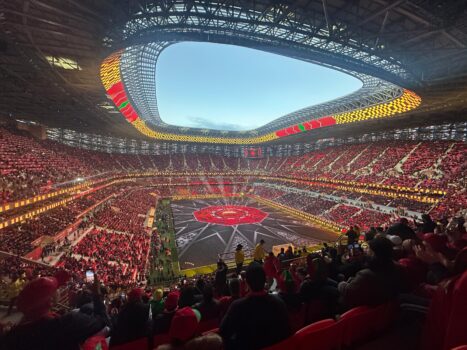
Speaking to Spanish news agency EFE, Mezzour highlighted the dual economic and structural impact of the continental tournament, describing it as both an immediate financial success and a long-term investment in Morocco’s development ahead of the 2030 World Cup, which the Kingdom will co-host with Spain and Portugal.
Massive Tourist Influx and a Record Year for Moroccan Tourism
According to official figures, nearly 600,000 foreign visitors traveled to Morocco specifically to attend AFCON 2025 matches. This surge contributed to a historic year for Moroccan tourism, with the country welcoming close to 20 million international tourists in total—an increase of 14% compared to the previous year.
The influx significantly boosted key sectors such as transport, hospitality, food services, and traditional crafts, injecting substantial liquidity into the local economy and reinforcing Morocco’s position as Africa’s leading tourism destination.
€2.3 Billion Invested in Long-Term Infrastructure
Minister Mezzour emphasized that the €2.3 billion invested to host AFCON 2025 should be viewed as a sovereign investment in sustainable infrastructure. These funds enabled the construction or renovation of nine stadiums, along with major upgrades to road networks, airports, and public services.
“We have gained a decade of development in just 24 months,” Mezzour stated, adding that the infrastructure delivered will serve Moroccan citizens for the next fifty years.
More Than 100,000 Jobs Created
The tournament also delivered strong social benefits. Official data indicate that more than 100,000 jobs were created in connection with AFCON 2025.
Importantly, the minister stressed that these were not solely temporary positions. Thousands of young Moroccans received professional training aligned with international standards, significantly enhancing their long-term employability beyond the tournament.
Industry, Technology, and Digital Transformation
More than 3,000 Moroccan industrial companies participated in projects linked to AFCON 2025. The event also accelerated Morocco’s technological transformation through several key initiatives:
- Deployment of 5G networks
- Introduction of digital identification systems
- Implementation of electronic ticketing
- Strengthening of cybersecurity infrastructure
These advancements reduced logistical costs and enhanced Morocco’s appeal to international investors, reinforcing the country’s reputation as a modern and competitive economy.
A Global Showcase Ahead of the 2030 World Cup
AFCON 2025 reached an estimated two billion television viewers worldwide and generated more than 10 billion views across social media platforms, serving as a powerful global showcase of Morocco’s organizational capabilities.
Thanks to the tournament, 80% of the core infrastructure required for the 2030 FIFA World Cup is already operational, according to Mezzour.
The remaining 20% includes:
- Extension of the high-speed rail line (LGV) from Casablanca–Tangier toward Marrakech and Agadir
- Expansion of national hotel capacity
- Construction of the Grand Stade de Casablanca
With AFCON 2025, Morocco has not only delivered one of the most successful tournaments in African football history, but also laid a solid foundation for hosting the world’s biggest sporting event in 2030.
Related Reads:
- AFCON 2025: In 24 Months, Morocco Achieved the Equivalent of Ten Years of Development
- AFCON 2025 in Morocco Breaks All-Time Revenue Records
- How Morocco Uses Sport Infrastructure to Drive Economic Growth
- CAF AFCON 2025 Records Over 90% Revenue Growth, Setting New Commercial Benchmark
- Morocco’s Vision: AFCON 2025 and World Cup 2030 as Catalysts for Economic Growth
- Morocco’s Tourism Sector Prepares for the 2030 FIFA World Cup