
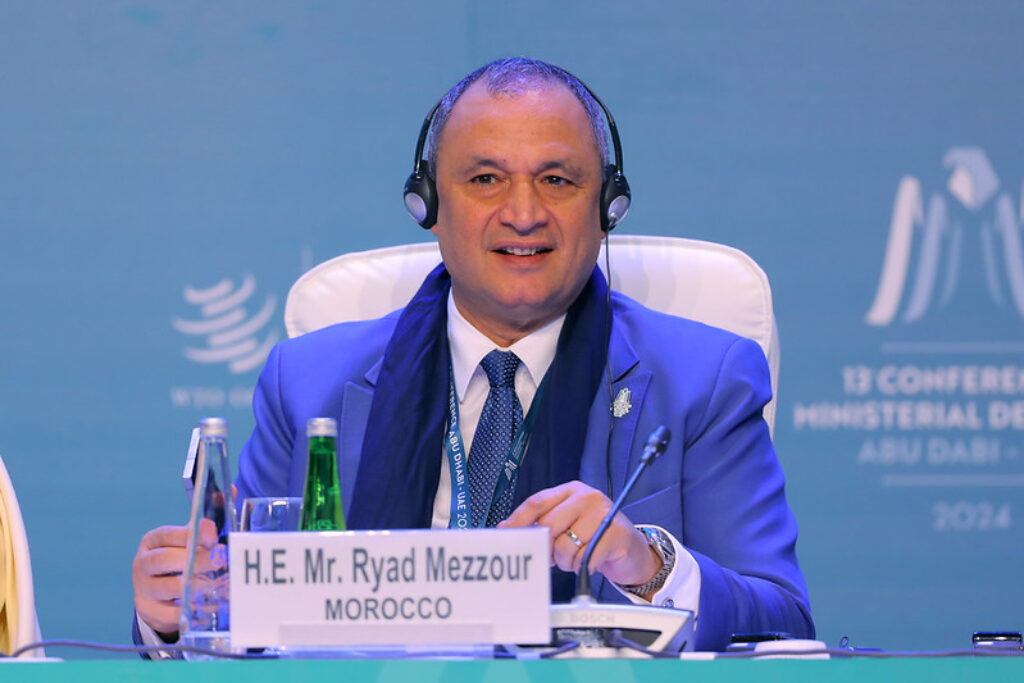
Mr Ryad Mezzour. Photos: ©WTO/Prime Vision
The day after the final lost to Senegal, the 2025 Africa Cup of Nations continues to reveal its deeper impact. Beyond the sporting disappointment, the Moroccan government is defending an economic, industrial, and infrastructure legacy described as historic. For Minister of Industry and Trade Ryad Mezzour, AFCON 2025 acted as an unprecedented development accelerator, with long-term benefits for the Kingdom.
A sporting setback, but a source of national pride
Following Morocco’s 1–0 defeat against Senegal in the final of the 2025 Africa Cup of Nations, Ryad Mezzour offered a measured and assertive assessment of the tournament. Speaking to France 24, the minister acknowledged the frustration surrounding the outcome, particularly after incidents that marred the end of the match.
“Of course, we would have liked to win this AFCON,” he admitted, while emphasizing “immense pride in having organized a competition of this level and welcomed the world to showcase a developing Africa and a Morocco capable of managing an event of such magnitude, under the leadership of His Majesty the King.”
Incidents overshadowed by overall success
Addressing the disturbances observed during the final, Mezzour adopted a calm and contextual approach. “It is always regrettable to see excesses, but it is also the price of passion,” he said, recalling that football inherently amplifies emotions.
According to the minister, these incidents should not detract from the broader success of a tournament that placed Morocco at the center of continental and international attention.
A highly profitable Africa Cup of Nations
On the economic front, Ryad Mezzour expressed strong optimism. “The first indicators are extremely encouraging. This is one of the most profitable AFCON tournaments in history, both for CAF and for the host country,” he stated.
According to figures released by the ministry, the competition generated a multiplier effect of 1.82 on revenues and investments mobilized, strengthening overall economic momentum. “Our annual growth should exceed 4.5%,” Mezzour added, while noting the creation of approximately 100,000 direct and indirect jobs.
An unprecedented development accelerator
Beyond macroeconomic indicators, AFCON 2025 is being framed as a catalyst for accelerated development. “In just twenty-four months, Morocco has gained the equivalent of ten years of infrastructure development,” Ryad Mezzour affirmed.
Major investments were made in stadiums, road networks, airports, railways, and urban transport systems, alongside public facilities and spillover effects in sectors such as healthcare. According to the minister, this effort represents a lasting qualitative leap that will continue to benefit citizens well beyond the tournament.
Strong mobilization of the national industrial fabric
This rapid transformation relied heavily on the mobilization of Morocco’s productive sector. More than 3,000 Moroccan industrial companies contributed to AFCON-related projects, extending far beyond stadium construction.
The minister also highlighted the positive impact on trade and consumption, estimating an increase of 25% to 30% during the competition period, confirming the tournament’s broad economic ripple effect.
A long-term royal vision
For Ryad Mezzour, the success of AFCON 2025 was no coincidence. It is part of a long-term strategy initiated more than twenty-five years ago under the leadership of His Majesty King Mohammed VI, aimed at equipping Morocco with modern infrastructure and world-class organizational capacity.
“We are extremely proud to have demonstrated that Morocco can host a global-scale event,” he insisted.
A dress rehearsal for the 2030 World Cup
Looking ahead, AFCON 2025 is widely viewed as a full-scale rehearsal for the 2030 FIFA World Cup, which Morocco will co-host with Spain and Portugal.
“Nearly 80% of the required sports infrastructure investments have already been completed and amortized,” Mezzour confirmed, expressing confidence in Morocco’s ability to sustain high standards in logistics, hospitality, and security.
Tribute to the national team
The minister concluded by paying tribute to the players, technical staff, and the Royal Moroccan Football Federation, praising a national team described as “committed, talented, and proud,” and a true reflection of modern Morocco.