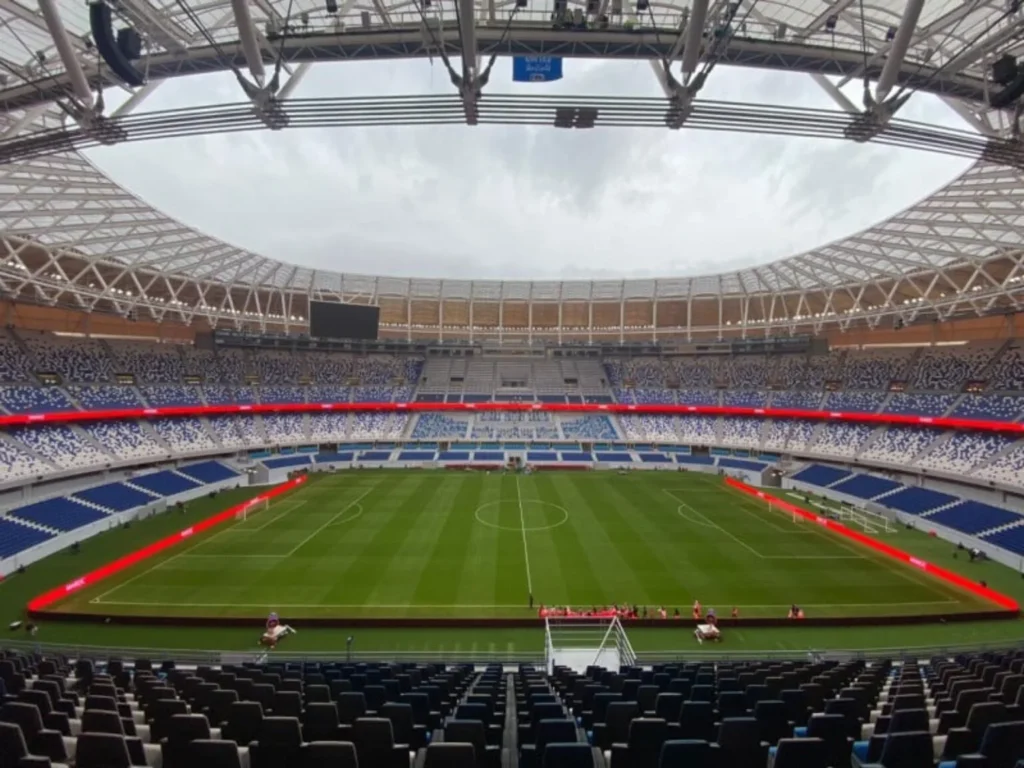
Tangier Grand Stadium. Photo Credit: SNRTNews
Morocco is leveraging AFCON 2025 as a powerful economic catalyst, positioning the tournament as both a continental football spectacle and a strategic platform to accelerate national development. As the Kingdom prepares to co-host the FIFA World Cup 2030 alongside Spain and Portugal, this competition represents a real-world test of Morocco’s infrastructure, tourism capacity, and global attractiveness.
Scheduled from December 21, 2025, to January 18, 2026, AFCON 2025 arrives at a crucial moment, coinciding with peak holiday travel. This timing significantly amplifies its economic potential, attracting international visitors, diaspora communities, and global media attention.
150 Billion Dirhams Investment Transforming Morocco’s Infrastructure
At the core of Morocco’s preparations lies a massive 150 billion dirhams infrastructure investment program, aimed at modernizing transport systems, upgrading airports, expanding road networks, and building world-class stadiums.
According to Fouzi Lekjaa, Minister Delegate in charge of the Budget, these investments are part of a long-term strategic vision designed to ensure sustainable growth while preparing the country for global sporting events.
| Sector | Key Developments | Impact |
|---|---|---|
| Transport | Railway expansion, highways, urban mobility upgrades | Faster connectivity between cities |
| Airports | Capacity increase and modernization | Higher international passenger flow |
| Stadiums | Renovation and construction of modern arenas | Global event hosting readiness |
| Tourism Infrastructure | Hotels, resorts, and services expansion | Boost in visitor experience and revenue |
These investments are supported by public-private partnerships and innovative financing models, ensuring minimal pressure on public finances while maximizing long-term economic returns.
AFCON 2025 as a Tourism and Economic Growth Engine
AFCON 2025 is expected to generate a significant surge in tourism activity, particularly due to its strategic timing during the holiday season. According to sports economist Yassine Aalia, the tournament represents a high-intensity economic cycle, where demand for hospitality, transport, and retail services spikes dramatically.
Morocco’s proximity to Europe plays a key role, making it an attractive destination for both international fans and African diaspora communities eager to support their national teams.
| Economic Driver | Expected Impact |
|---|---|
| Tourism arrivals | Strong increase during December–January period |
| Hotel occupancy | Near full capacity in major cities |
| Air travel demand | Rise in international and regional flights |
| Retail & services | Boost in local consumption and business activity |
Early indicators already point to increased bookings for flights and hotels, confirming expectations of a highly dynamic tourism season.
Media Exposure and Global Visibility
Beyond tourism, AFCON 2025 offers Morocco a powerful platform for international branding and visibility. Broadcasting rights and sponsorship deals are expected to generate approximately $112.84 million in total revenue for the Confederation of African Football.
Under hosting agreements, Morocco is projected to receive around 20% of this revenue, equivalent to roughly $22.5 million, while benefiting from global media exposure.
This visibility reinforces Morocco’s image as a reliable host for major international events, strengthening its positioning ahead of the 2030 FIFA World Cup and other global competitions.
Long-Term Opportunities and Structural Challenges
While the economic outlook is highly promising, experts emphasize the importance of long-term sustainability. Large-scale infrastructure investments must be carefully integrated into local economies to avoid underutilization after the event.
Key challenges include:
- Stadium maintenance costs after major tournaments
- Temporary vs. permanent job creation in tourism and services
- Efficient use of infrastructure beyond event periods
- Balanced regional development across cities and rural areas
Learning from global examples, Morocco aims to ensure that its investments remain productive, sustainable, and economically viable in the long term.
AFCON 2025: A Strategic Test Before World Cup 2030
Ultimately, AFCON 2025 represents more than a football tournament. It is a full-scale rehearsal for Morocco’s global ambitions, testing the country’s ability to deliver world-class infrastructure, seamless logistics, and unforgettable visitor experiences.
By aligning short-term economic gains with long-term development goals, Morocco is building a model where sport becomes a driver of national transformation.
The success of this strategy will define not only the outcome of AFCON 2025 but also Morocco’s readiness to host one of the most prestigious sporting events in the world.
Source: industries.ma
Related Reads on MoroccoBeat
- Casablanca’s Mega Projects Transforming Morocco’s Economic Hub
- Morocco’s Vision: AFCON 2025 and World Cup 2030 as Catalysts for Economic Growth
- AFCON’s Move to a Four-Year Cycle From 2028: Benefits and Risks
- AFCON 2025: Football Fever Boosts Business Across Morocco
MoroccoBeat – Inspiring stories, positive energy, proudly Moroccan.