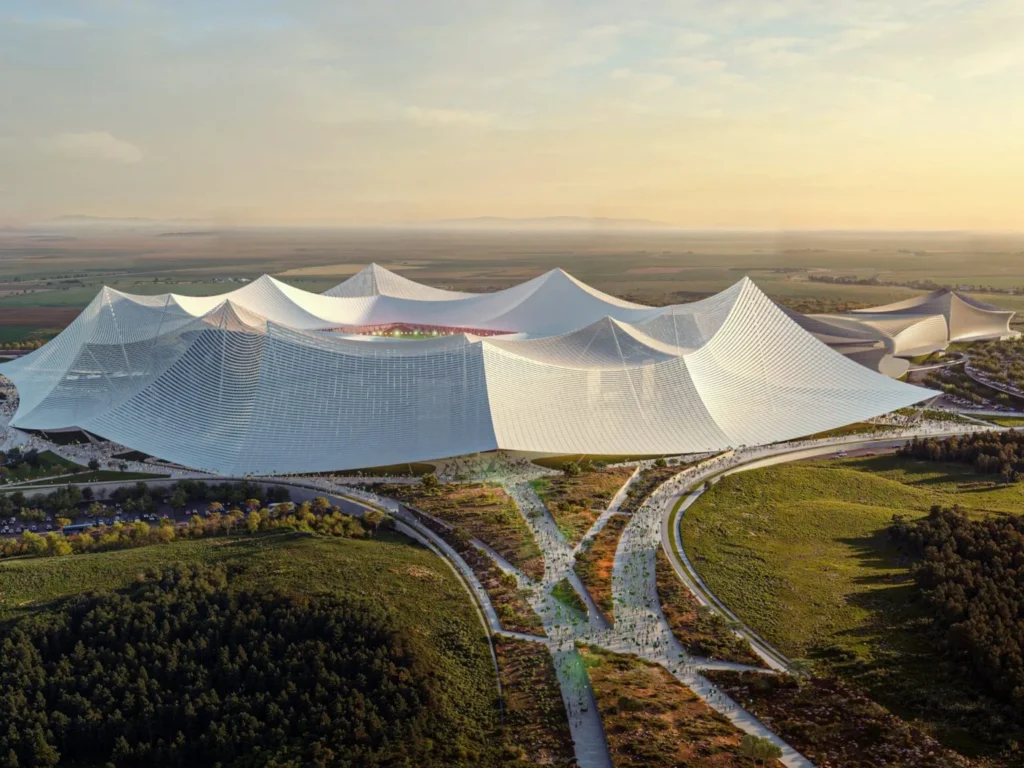
New Images Released of 115,000 Capacity Stade Hassan II in Casablanca | Populous
The Royal Moroccan Football Federation (FRMF) has firmly denied recent claims suggesting that Spain has already been awarded the right to host the final of the 2030 FIFA World Cup, emphasizing that no official decision has yet been made by the competent authorities.
The clarification follows remarks attributed to Rafael Louzan, president of the Royal Spanish Football Federation (RFEF), who stated during an event organized by the Madrid Sports Press Association on January 27 that Spain would host the final match of the 2030 World Cup, which will be jointly organized by Morocco, Spain, and Portugal.
FRMF Rejects Claims of a Pre-Determined Final Venue
According to Louzan, Spain’s long-standing experience in hosting major football competitions would justify hosting the tournament’s final, adding that the decisive match would take place on Spanish soil. However, no specific stadium was mentioned, leaving open the possibility of venues such as Madrid’s Santiago Bernabéu or Barcelona’s Camp Nou.
These statements were swiftly rejected by the FRMF. Speaking on behalf of the Moroccan federation, official spokesperson Mohamed Makrouf described the circulating claims as “completely unfounded,” stressing that no formal arbitration has yet occurred.
“The venue of the 2030 World Cup final will be decided during a joint meeting involving Morocco, Spain, Portugal, and FIFA,” Makrouf stated, adding that “this meeting has not yet taken place.” His remarks were reported by the Saudi newspaper Okaz.
Morocco Positions Casablanca’s Hassan II Stadium
While rejecting claims of a predetermined decision, the Moroccan federation has made clear its intention to propose the Grand Stade Hassan II in Casablanca as a candidate to host the final. The stadium, currently under construction north of the city, is expected to be completed by the end of 2028.
Once finished, the venue is projected to have a capacity of approximately 115,000 spectators, which would make it one of the largest football stadiums in the world and a landmark of Morocco’s long-term sports infrastructure strategy.
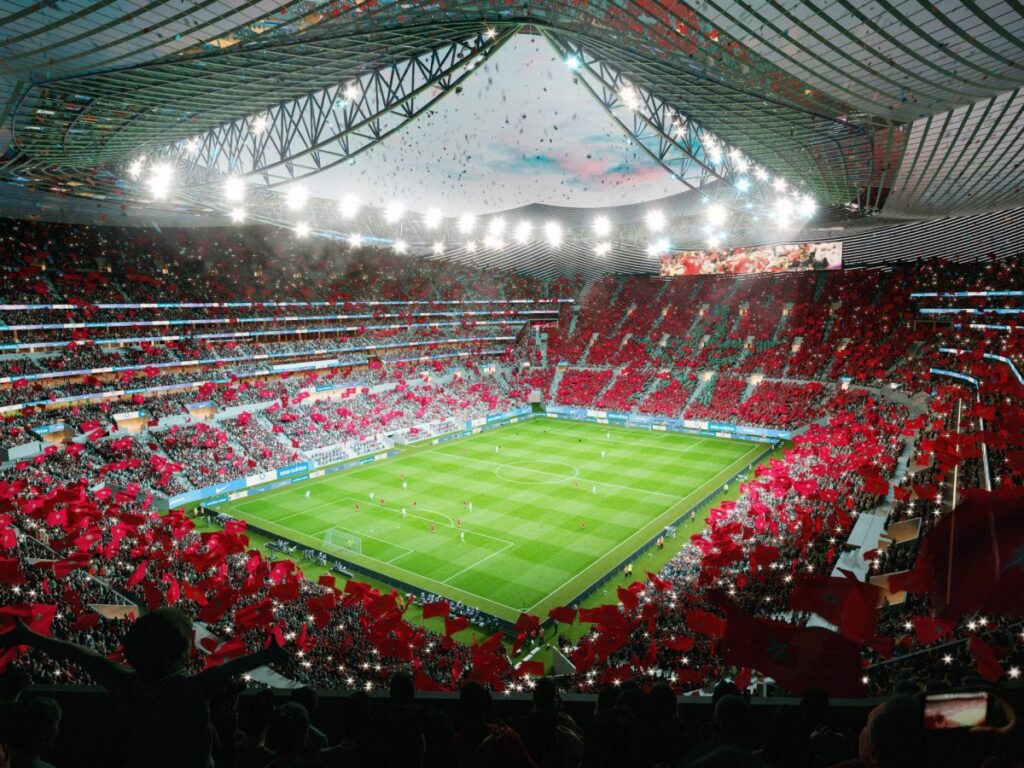
Inside of 115,000 Capacity Stade Hassan II in Casablanca | Populous
Joint Decision Pending Between Host Nations and FIFA
Despite acknowledging Morocco’s rapid progress in developing modern sports facilities, Rafael Louzan also alluded to certain incidents during the recent Africa Cup of Nations that, in his view, affected the global image of football. Nonetheless, he praised the quality of Moroccan stadiums, describing them as “magnificent.”
At this stage, the location of the 2030 World Cup final remains subject to a collective decision by the three host nations in coordination with FIFA. No official allocation has been confirmed, and any claims suggesting otherwise have been categorically dismissed by Moroccan football authorities.
As preparations continue across Morocco, Spain, and Portugal, the 2030 World Cup stands as a symbol of unprecedented cross-continental cooperation, with key decisions—including the final venue—still to be determined through formal institutional processes.
Related Reads:
- Morocco’s World Cup 2030 Bid: A Strategic Vision Beyond the Game
- Hassan II Stadium: Morocco’s 115,000-Seat Giant
- From King Hassan II’s Dream to King Mohammed VI’s Achievement: Morocco to Host the 2030 FIFA World Cup
- Morocco’s Tourism Sector Prepares for the 2030 FIFA World Cup
- Tangier Grand Stadium Renovation – FIFA 2030 World Cup Ready