The Portuguese City of El Jadida stands on Morocco’s Atlantic coast about 100 kilometers south of Casablanca. Travelers often reach the city by car in roughly one hour and thirty minutes using the A5 coastal highway, while train connections between Casablanca and El Jadida take around two hours. This historic coastal district forms the oldest part of the modern city and preserves one of the most complete examples of Portuguese military architecture in North Africa. Because of its exceptional preservation and its role in the exchange between European and Moroccan cultures, UNESCO inscribed the Portuguese City of El Jadida on the World Heritage List in 2004.
Visitors who explore the site encounter a compact fortified town where Renaissance military design meets Moroccan urban life. The Portuguese built the fortified settlement in the early sixteenth century under the name Mazagan, using a star shaped defensive layout that reflected the evolution of European artillery warfare. Over time the city changed political control and gradually integrated into Moroccan society, yet the walls, bastions, gates, and underground cisterns remain remarkably intact. As a result, the Portuguese City of El Jadida functions both as a historical monument and as a living neighborhood where residents continue to occupy the original urban grid.
Historical Foundations of the Portuguese City of El Jadida
Portuguese forces first established a presence along this stretch of the Atlantic coast in 1502 when they constructed a fortified trading post designed to support maritime routes between Europe, West Africa, and India. A more elaborate fortified city emerged a few decades later as Portuguese engineers developed Mazagan into a strategic military base. The design included thick ramparts, angled bastions, and wide defensive walls capable of resisting cannon fire. This architectural approach reflected Renaissance military planning that had spread across Mediterranean coastal fortifications during the sixteenth century.
Control of Mazagan remained under Portuguese administration for more than two centuries. During this period the fortified city functioned as both a defensive stronghold and a commercial port where goods, sailors, and cultural influences circulated between continents. Eventually Moroccan forces regained control of the territory in 1769 under Sultan Mohammed Ben Abdallah. Portuguese residents evacuated the city, and the abandoned fortress later integrated into the growing Moroccan town that became modern El Jadida.
Because the original defensive structures remained largely intact, historians now consider the Portuguese City of El Jadida one of the most significant examples of early modern military architecture outside Europe. UNESCO recognized this heritage value when it designated the site as a World Heritage property, noting the preservation of the defensive system and the cultural exchange that shaped the settlement.
The Fortified Walls and Bastions
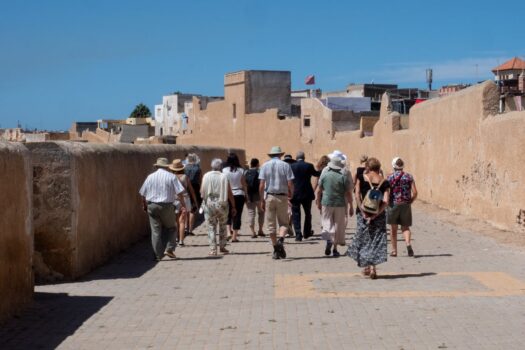
Visitors typically begin their exploration at one of the entrances that lead directly through the fortified ramparts. The defensive walls surround a compact rectangular district located just beside the Atlantic shoreline. Walking along these walls reveals how Portuguese engineers organized the city’s defenses. Large angular bastions project outward from the walls so that defenders could monitor approaching ships and control the coastline.
The ramparts also function today as elevated viewpoints. From the top of the walls travelers can observe fishing boats in the harbor, the Atlantic coastline extending southward, and the modern districts of El Jadida beyond the historic enclosure. The walls measure several meters thick and still preserve the stone construction techniques that protected the fortress against artillery attacks.
Because the fortified city occupies a relatively small footprint, visitors can walk the entire perimeter of the ramparts in less than thirty minutes. This compact scale makes the Portuguese City of El Jadida accessible even for travelers who plan a short coastal stop while moving between Casablanca and other Atlantic destinations.
The Manueline Cistern
The most famous monument inside the Portuguese City of El Jadida is the Manueline Cistern, an underground chamber that originally served as a water reservoir for the fortress. Portuguese builders constructed the cistern in the early sixteenth century using thick stone pillars that support a vaulted ceiling. A circular opening in the roof allows natural light to enter the chamber.
Once visitors descend the stairs leading underground, the architectural design becomes immediately apparent. Water often covers the floor in a thin reflective layer, which creates symmetrical reflections of the columns and arches. This visual effect has attracted photographers and filmmakers for decades. In fact, the cistern gained international recognition when it appeared in several historical films.
Entrance to the cistern generally costs around 20 Moroccan dirhams, although prices occasionally change depending on local administration updates. The monument typically opens during daytime hours, and early morning visits often provide the best lighting conditions inside the chamber.
Exploring the Streets of the Portuguese City
Once visitors leave the cistern, narrow streets inside the fortified city reveal the daily life that continues within the historic walls. Small houses, local cafés, and artisan workshops occupy buildings that follow the original Portuguese street grid. This coexistence between heritage architecture and modern Moroccan life allows travelers to experience the site as a living district rather than a static monument.
Walking through these streets also reveals small churches, public squares, and former administrative buildings that illustrate how the fortress once functioned as a self contained colonial settlement. Although many structures have changed function over the centuries, the urban layout still reflects the planning principles used by Portuguese engineers during the sixteenth century.
Because the historic district remains compact, visitors can navigate the entire neighborhood easily on foot. Many travelers combine their exploration with stops in small cafés located inside the walls, where terraces overlook narrow streets and shaded courtyards.
Access, Transportation, and Practical Travel Information
Travelers can reach El Jadida from Casablanca by train, bus, or private vehicle. The Moroccan national railway connects Casablanca to El Jadida several times per day, and the journey typically lasts around two hours. Once travelers arrive at the El Jadida train station, taxis reach the Portuguese City in approximately ten minutes.
Visitors traveling by car often follow the A5 coastal highway south from Casablanca. The route covers about 100 kilometers and generally takes between ninety minutes and two hours depending on traffic conditions. Parking areas exist near the historic walls, which allows travelers to enter the fortified district directly on foot.
Accommodation options range from modern seaside hotels to smaller guesthouses located near the historic center. The Atlantic climate remains moderate throughout much of the year, although spring and autumn often provide the most comfortable temperatures for walking along the ramparts.
Coastal Walks and Nearby Attractions
After exploring the Portuguese City of El Jadida, many visitors continue walking toward the nearby harbor and beach areas. El Jadida’s coastal promenade stretches along the Atlantic and provides views of fishing boats, sandy beaches, and the open ocean. These waterfront paths also connect the historic district with the modern sections of the city.
El Jadida also serves as a convenient base for exploring other coastal locations in the Doukkala region. Several beaches lie within short driving distance, and rural landscapes extend inland toward agricultural plains that support local markets and traditional farming communities.
Travelers often combine El Jadida with broader journeys along Morocco’s Atlantic coast. Visitors interested in discovering historic coastal landscapes across the country often explore destinations highlighted in guides such as Walking Morocco: City Tours That Redefine Slow Travel, which presents walking routes through historic Moroccan cities where architecture and daily life intersect.
Why the Portuguese City of El Jadida Matters
The Portuguese City of El Jadida demonstrates how coastal fortifications shaped the interaction between Europe and North Africa during the early modern period. The preserved ramparts, bastions, and cisterns reveal how Renaissance military architecture adapted to Atlantic maritime routes. At the same time the continued residential use of the district shows how historic structures can integrate into contemporary urban life.
Because the fortified city remains relatively small, visitors can explore its major landmarks within a few hours. Yet the historical layers embedded in the walls reflect centuries of political change, maritime trade, and cultural exchange. This combination of preserved architecture and everyday activity explains why the Portuguese City of El Jadida continues to attract historians, photographers, and travelers who seek coastal heritage beyond Morocco’s larger tourist centers.
For travelers moving along Morocco’s Atlantic corridor, the Portuguese City of El Jadida offers a practical stop that combines historical exploration with coastal scenery. The site’s accessibility from Casablanca, its compact layout, and its UNESCO recognition ensure that it remains one of Morocco’s most distinctive coastal heritage destinations.
Related: