
Estimated reading time: 3 minutes
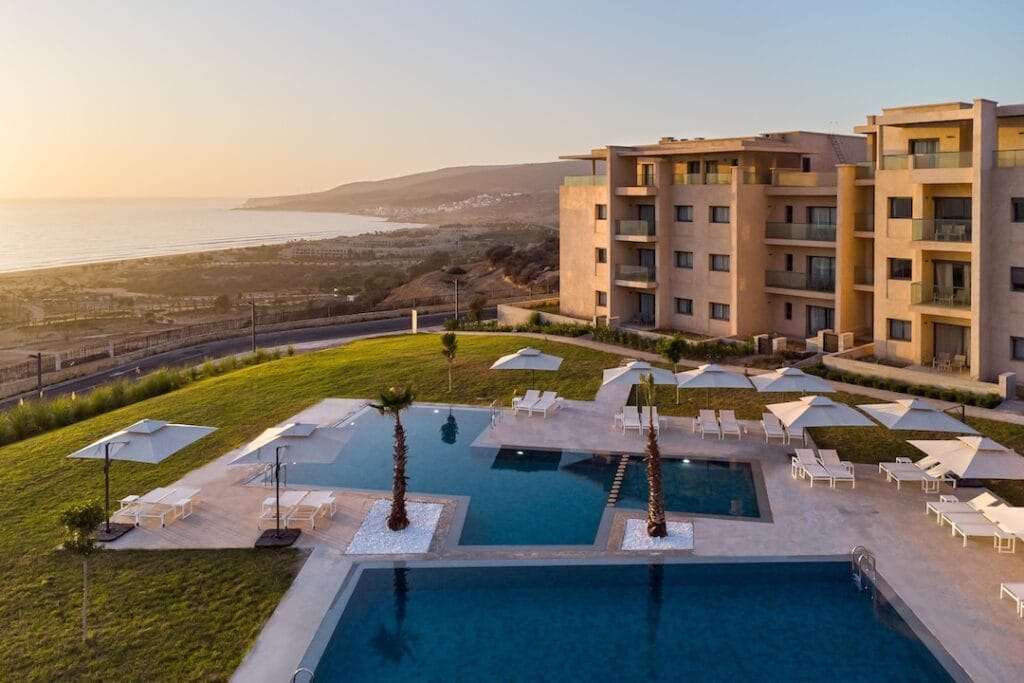
Radisson Residences Taghazout Bay. Photo Credit: Radisson Hotels
The Moroccan hospitality landscape is undergoing a monumental transformation. According to the latest “Hotel Chain Development Pipelines in Africa 2026” report by W Hospitality Group, Morocco has firmly established itself as the second-largest hotel development market on the continent. With 75 hotels and 10,606 rooms currently in the pipeline, the Kingdom is a primary engine of Africa’s record-breaking growth in international tourism.
Mapping the Numbers: Morocco vs. the Continent
Across Africa, the hotel development pipeline has reached an all-time high of 123,846 rooms across 675 projects—an 18.6% year-on-year increase. Within this competitive field, Morocco’s data reveals a sophisticated and high-yield strategy:
- Volume & Ranking: Morocco (10,606 rooms) sits second only to Egypt (45,984 rooms), but remains significantly ahead of other major economies like Nigeria (8,480 rooms) and Kenya (6,190 rooms).
- Project Scale: The average size of a Moroccan hotel project is 141 rooms. This mid-to-large scale allows for a balanced mix of luxury boutiques and large-scale urban business hotels.
- Execution Rate: Unlike many markets where projects remain “on paper,” 64.7% of Morocco’s pipeline (6,859 rooms) is already under construction, showcasing a high reliability for 2026/2027 deliveries.
The “Big Five” Global Chains Lead the Charge
International confidence in the Moroccan market is at an all-time high. The expansion is being driven primarily by the world’s five largest hotel groups, Marriott International, Hilton, Accor, IHG, and Radisson, who collectively manage 80% of the continental pipeline. Key milestones for 2026 include:
- Hilton’s Acceleration: Hilton is on track to more than double its Moroccan portfolio, with the debut of the Waldorf Astoria Rabat Salé and Canopy by Hilton in Tangier.
- Marriott’s New Brands: The group is introducing its AC Hotels brand to Casablanca, targeting the growing business and MICE (Meetings, Incentives, Conferences, and Exhibitions) sector.
- Radisson’s Historic Rebirth: The highly anticipated Lincoln Casablanca (Radisson Collection) is set to redefine luxury heritage tourism in the economic capital.
The 2030 Vision: Why the Boom is Happening Now
This construction surge is not accidental; it is a direct result of the 2023-2026 Tourism Roadmap, which aims to attract 17.5 million tourists by 2026. With a subsequent target of 26 million visitors by 2030, the year Morocco co-hosts the FIFA World Cup, the government has implemented aggressive investment incentives.
| Strategic Lever | Impact on 2026 Pipeline |
|---|---|
| Investment Charter | Government contributions up to 30% for eligible hotel projects. |
| Aviation Expansion | Royal Air Maroc quadrupling its fleet to feed new hotel beds. |
| MICE Infrastructure | Developing 75,000 m² of new conference space in Casablanca. |
Source: lematin.ma