The Kasbah of Telouet Morocco stands as one of the most revealing historic sites in the High Atlas, yet it remains less visited than other landmarks along former caravan routes. Located in the village of Télouet, this kasbah once controlled strategic corridors linking Marrakech to the Sahara. Today, it offers a clear view of the political structure, architectural refinement, and economic systems that shaped southern Morocco before independence.
Visitors often combine a trip to the kasbah with a crossing of the High Atlas Mountains. This route explains the importance of the site. Caravans carrying salt, spices, and textiles moved through this corridor, and control over Telouet allowed the collection of taxes and regulation of trade. As a result, the kasbah developed into both a fortified residence and an administrative center.
Historical Context and the Rise of the Glaoui Power
The history of the Kasbah of Telouet Morocco connects directly to the rise of the Glaoui family. Thami El Glaoui, known as the Pasha of Marrakech, led this influence during the early twentieth century. His authority extended across southern Morocco, where he controlled trade routes, collected taxes, and maintained alliances that strengthened his position.
The location of Telouet allowed the Glaoui family to monitor caravan activity across the Atlas. Once traders passed through this area, they paid taxes that generated steady income. This system supported the expansion of the kasbah and reinforced the family’s regional power. Over time, the structure evolved from a defensive stronghold into a complex residence that reflected wealth and authority.
During the French Protectorate, Thami El Glaoui aligned with colonial authorities. This decision secured his influence for a period. However, after Morocco gained independence in 1956, his power declined rapidly. The kasbah lost its administrative role, and without continuous maintenance, large sections began to deteriorate.
Architectural Structure and Design Strategy
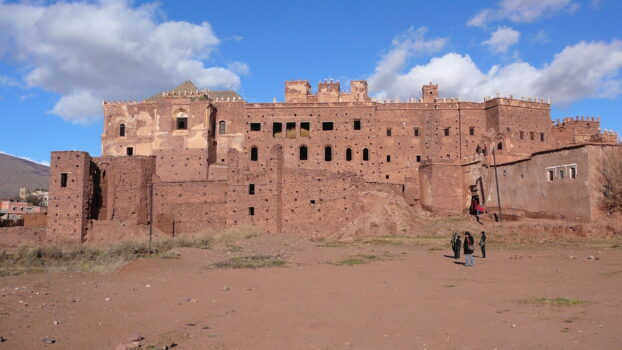
The Kasbah of Telouet Morocco follows a design approach common to fortified architecture in southern Morocco. The exterior appears simple and is built from rammed earth and adobe. Thick walls provide protection against attacks and harsh weather conditions in the High Atlas.
Inside, the design changes significantly. The interior reveals detailed craftsmanship with zellige tiles, carved cedar wood, and painted plaster. These elements appear in reception rooms that were used for meetings and ceremonies. The contrast between exterior and interior reflects a clear strategy. The outer structure ensures defense, while the interior spaces demonstrate status and legitimacy.
The kasbah includes multiple courtyards, halls, and private quarters. These spaces supported both governance and daily life. Large rooms hosted official gatherings, while inner areas provided privacy. Movement through the kasbah followed a structured layout where access depended on role and status.
Builders used local materials that respond well to climate conditions. Earth walls regulate temperature, keeping interiors cool in summer and warm in winter. Cedar wood offers durability and allows detailed carving. This combination reflects a balance between function and design.
Current Condition and Restoration Efforts
After the fall of the Glaoui family, the kasbah entered a period of neglect. Exposure to weather weakened the structure, and parts of it collapsed. Despite this decline, the site retained its historical value and attracted preservation efforts.
Restoration work focuses on stabilizing key areas rather than rebuilding the entire complex. This approach maintains authenticity while ensuring visitor access. Visitors can explore both restored sections and areas that remain in ruins, which helps illustrate the scale of the kasbah and the effects of time on earthen structures.
Local residents support the site by working as guides and caretakers. This involvement creates economic activity while preserving cultural heritage. The kasbah continues to function as a historical site that remains connected to its local context.
Related: Agafay Desert 2026: The Ultimate Guide to Marrakech’s Hidden Stone Desert
Location and Access from Marrakech
The Kasbah of Telouet Morocco lies about 100 kilometers from Marrakech. The journey follows the road toward the Tizi n’Tichka Pass, which reaches an elevation of around 2,260 meters. This route offers wide views of the High Atlas landscape.
After the pass, travelers turn toward Telouet on a secondary road. The full trip usually takes between three and four hours depending on conditions. The main road remains paved, while parts of the secondary route may vary in quality. Most vehicles can complete the journey with careful driving.
Many visitors choose guided tours or private drivers to simplify navigation. Independent travelers can rent a car, though they should prepare for limited signage in rural areas.
Related: Ouzoud Waterfalls: The Ultimate Day Trip from Marrakech (Complete Guide)
Visiting Experience and Practical Details
The Kasbah of Telouet Morocco remains open to visitors with basic access conditions. Entry fees typically range from 20 to 30 Moroccan dirhams, though prices may vary. Payment is usually made at the entrance.
Hiring a local guide improves the visit. Guides explain the purpose of rooms, the history of the Glaoui family, and the meaning of decorative elements. This context helps visitors understand how the kasbah functioned beyond its visual appearance.
The best time to visit falls between spring and autumn, when weather conditions support easier travel. Winter visits remain possible, though snow or rain can affect road access. Checking weather conditions before departure helps avoid delays.
Facilities at the site remain limited. Visitors should bring water, snacks, and suitable footwear, as the terrain includes uneven surfaces. Photography is allowed in most areas, and the mix of restored and damaged sections creates strong visual contrast.
Connection with Ait Benhaddou and Regional Routes
Travelers often combine the Kasbah of Telouet Morocco with a visit to Ait Benhaddou, located further along the route toward Ouarzazate. While Ait Benhaddou attracts more visitors, Telouet provides a quieter and more detailed perspective on elite architecture.
These two sites reflect a broader network of fortified settlements that supported trade across southern Morocco. Ksars functioned as collective villages, while kasbahs like Telouet served as administrative centers for ruling families.
Continuing toward Ouarzazate allows travelers to explore additional destinations and extend the journey into a structured route that connects history, geography, and modern tourism.
Related: Aït Ben Haddou: The Fortress Village That Time Refused to Erase
Why the Kasbah of Telouet Morocco Matters Today
The Kasbah of Telouet Morocco offers insight into a period when regional power depended on trade control and geographic positioning. Its structure and location explain how authority operated before centralized governance became dominant.
The kasbah also shows how architecture reflects social organization. Each space served a defined role, which reveals how governance and daily life functioned within the complex.
The current condition of the site highlights the challenges of preserving earthen architecture. Restoration efforts continue to balance authenticity with access, allowing visitors to experience the site while maintaining its historical character.
For travelers exploring southern Morocco, the Kasbah of Telouet Morocco provides a focused and informative stop. When integrated into a broader High Atlas itinerary, it helps explain how the region developed and functioned over time.
Related: Skoura Oasis Morocco Travel Guide, Best Kasbahs, Things to Do, and Hidden Desert Gem Near Ouarzazate