Morocco has officially outlined its ambitions in artificial intelligence with the launch of the “AI Made in Morocco” initiative in Rabat on January 12. The initiative introduces a structured 2025–2030 national roadmap designed to move artificial intelligence from strategic intent to concrete implementation across public administration, infrastructure, and the economy.
Rather than treating AI as a simple add-on to existing systems, Morocco is approaching it as a comprehensive transformation project requiring simultaneous reforms in regulation, infrastructure, data governance, skills development, and institutional oversight. The roadmap is organized around ten programs covering the entire AI lifecycle, from legal frameworks to operational deployment and change management.
2025–2026: Trust as the Foundation
The first phase of the roadmap, covering 2025–2026, places trust at the core of Morocco’s AI strategy. The government plans to introduce a “Digital Law X.0” alongside a national AI framework, followed by the rollout of certification processes and a trust label starting in 2027. Alignment with international regulatory standards is expected by 2029–2030.
This phased approach reflects the sensitivity of AI applications in public services, where accountability, transparency, and citizen protection are critical. The objective is to reduce legal uncertainty from the outset and avoid deploying AI systems on unstable regulatory grounds.
Infrastructure Before Promises
The roadmap emphasizes infrastructure as a prerequisite for AI development. A national “Move to Cloud” program is scheduled for 2025–2027, recognizing that scalable, secure, and resilient digital architecture is essential before deploying AI-powered services.
Major infrastructure investments are planned, including a 50 MW data center, the expansion of the Benguérir data center, and, by the end of the decade, the creation of a 500 MW green data center campus. These projects underline the material and energy-intensive nature of AI, positioning it as an industrial and strategic investment.
Data, Interoperability, and Public Service Reform
One of the most transformative elements of the roadmap is the creation of a national digital commons platform. This includes a software forge, a library of 20 critical APIs, and the large-scale structuring of public data through Open Data initiatives.
The plan also introduces the “once-only” principle, aiming to prevent citizens and businesses from repeatedly submitting information already held by public administrations. This reform is central to improving public services and enabling AI systems to function effectively through coherent and interoperable data.
Building and Retaining Talent
Human capital development is a major pillar of the strategy. The roadmap outlines the expansion of coding schools such as YouCode, the creation of a national digital school, and the launch of certified online training platforms.
Programs such as Master AI Junior and a national youth talent initiative targeting over 200,000 young beneficiaries aged 8 to 18 aim to build a broad skills base. At the same time, advanced programs will strengthen research capacity through increased numbers of digital doctoral fellows. The challenge, however, remains retaining experienced professionals within the public sector.
A National LLM in Moroccan Languages
A symbolic and strategic component of the roadmap is the development of a national large language model (LLM) in Moroccan Arabic (Darija) and Amazigh. After an initial alpha version, the model is expected to be trained at scale and integrated into public services, with potential export ambitions by 2029–2030.
The success of this initiative will depend on measurable quality, security, data protection, and real-world usability within public administration workflows.
Territorial Innovation and National Champions
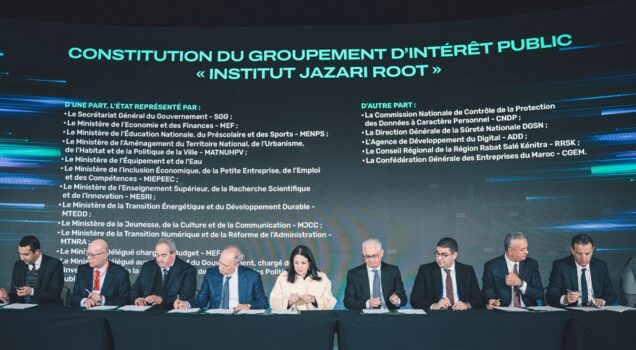
To avoid centralizing innovation in Rabat alone, the roadmap plans to deploy a network of Jazari Institutes across Morocco’s twelve regions, supported by digital laboratories and long-term financial autonomy objectives. This territorial approach aims to spread skills, innovation capacity, and locally adapted solutions nationwide.
On the economic front, the strategy introduces venture capital mechanisms, incubation and acceleration programs, and a public-private financing ecosystem to foster the emergence of Moroccan AI champions capable of scaling and competing internationally.
Implementation as the Ultimate Test
The roadmap concludes by emphasizing execution, with the creation of a dedicated Directorate General for Artificial Intelligence, data-driven governance, continuous performance evaluation, and adoption strategies targeting public agents and SMEs.
By 2027, tangible indicators such as cloud migration progress, API usage, data interoperability, and Open Data quality will determine whether AI becomes a genuine lever for reform and competitiveness or remains a collection of isolated initiatives.
Related Reads:
- Tesla Launches in Morocco with Model 3 and Model Y at AnfaPlace Mall
- Morocco Leads Africa’s Digital Future with 5G, Fiber Optics and AI
- Netflix and Disney Bet on Morocco as Argan Studios Emerges as Africa’s Future Film Hub
- Foreign Exchange: Morocco introduces new flexibility for currency operations via international bank cards