Photo from: FRMF.ma
The recent editions of the Africa Cup of Nations have revealed a clear and lasting shift. For the first time, the four semi-finalists were all led by African head coaches, confirming a trend that has been building for years rather than a one-off anomaly. This reality reflects a deeper transformation in African football, where local expertise has become central to success at the highest continental level.
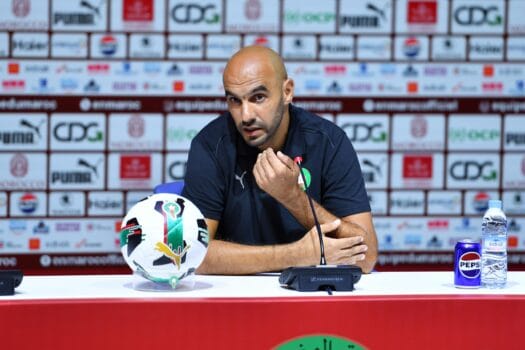
This evolution is measurable. The last three AFCON titles have been won by teams coached by Africans, underlining consistency, tactical maturity, and long-term project management. On the international stage beyond Africa, the message has been equally strong. At the 2022 FIFA World Cup, Walid Regragui led Morocco national football team to a historic semi-final, the best performance ever achieved by an African side. Few coaching achievements in recent years carry comparable weight.
Yet despite these results, African coaches remain largely absent from leadership roles at Europe’s most influential clubs. The contrast between achievement and opportunity continues to raise legitimate questions.
AFCON and the World Cup as Proof of High-Level Coaching
Modern AFCON is among the most demanding competitions in world football. Short recovery periods, climate challenges, intense crowd pressure, and tactical diversity place enormous responsibility on coaching staffs. Success requires adaptability, emotional intelligence, and precise game management.
African coaches have demonstrated mastery in this environment. Figures such as Aliou Cissé and Djamel Belmadi built structured, disciplined teams capable of sustained success. Their achievements were not built on isolated runs, but on continuity, identity, and player development.
Regragui’s World Cup campaign further strengthened this argument. Navigating a group featuring global heavyweights and eliminating European giants under knockout pressure required elite tactical preparation and leadership. That performance alone positioned him among the most accomplished international coaches of his generation.
Limited Access in Europe’s Coaching Market
In Europe, opportunities for African coaches exist, but they remain limited and unevenly distributed. France provides the most visible examples. Coaches such as Omar Daf, Nasser Larguet, and Samba Diawara have all held roles within professional clubs, yet often in transitional or short-term contexts.
At present, Habib Beye at Stade Rennais FC and Ahmed Kantari at FC Nantes stand among the few African coaches operating in Europe’s top divisions. Their presence represents progress, but not yet a structural shift.
The issue is rarely framed as a lack of competence. Instead, it is often explained through notions of “experience,” “profile,” or “club culture.” However, these criteria are applied inconsistently across the coaching market.
Networks, Familiarity, and Perception
European coaching recruitment remains heavily influenced by networks. Former players, assistants within established systems, and coaches linked to influential intermediaries often benefit from familiarity rather than demonstrable superiority.
African coaches, even with international success, frequently operate outside these circles. Their achievements are sometimes viewed as context-specific rather than transferable, despite clear evidence to the contrary. International tournament management, player rotation, tactical adjustment, and pressure handling are core coaching skills, regardless of geography.
Habib Beye has addressed this dynamic with measured clarity, emphasizing competence over identity. His position reflects a broader reality: African coaches are not seeking special treatment, but equal evaluation.
Players Trusted, Leadership Questioned
European football has long relied on African players at the highest level. Talent identification, physical preparation, and tactical responsibility are entrusted to African footballers across all major leagues. The hesitation emerges primarily when leadership roles are considered.
This imbalance highlights a persistent perception gap. Execution is accepted; authority is scrutinized. Intelligence on the pitch is celebrated; intelligence on the bench is questioned.
A Gradual Shift Underway
Change rarely occurs abruptly in football structures. However, pressure is mounting. AFCON continues to grow in quality and visibility. African national teams are increasingly competitive on the global stage. Coaching education, licensing, and international exposure have advanced significantly.
Younger generations of African coaches are multilingual, tactically versatile, and deeply familiar with European football culture. Their profiles align more closely than ever with the demands of elite club football.
The Central Question
African coaches have delivered continental titles, historic World Cup performances, and long-term national projects. Their credentials are established and increasingly difficult to overlook.
The discussion is no longer about whether African coaches belong at the highest level. The question now centers on when European football will fully integrate a reality that results have already confirmed.
Related: