
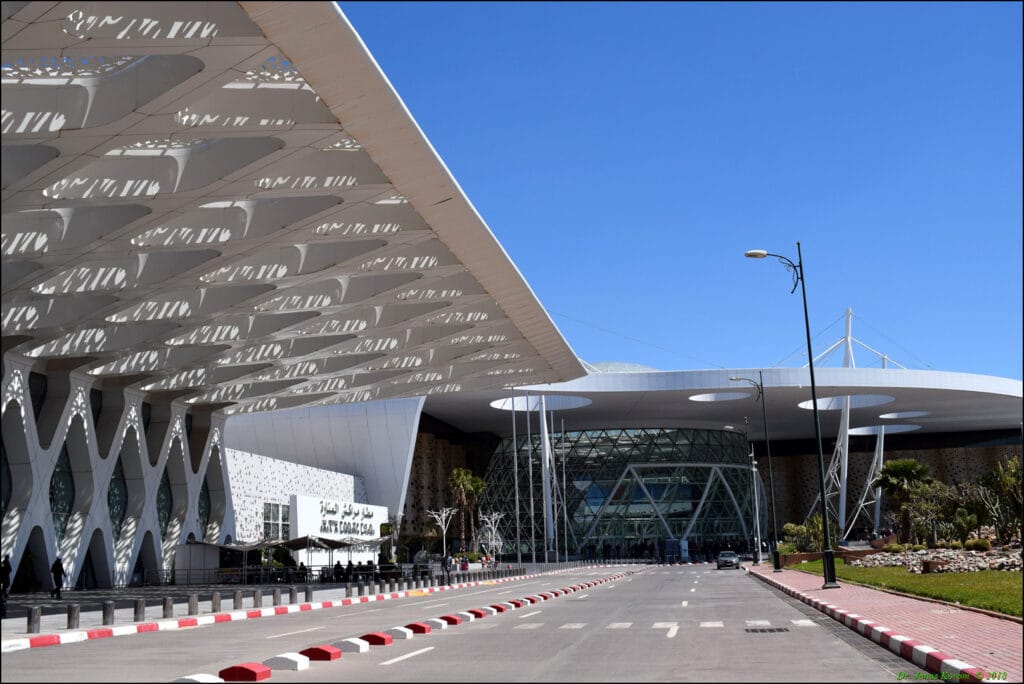
Marrakech Menara Airport. Photo Credit: János Korom Dr. / Wikimedia
Morocco’s airports recorded a historic milestone in 2025, handling a total of 36.3 million passengers,
representing an 11% increase compared to the previous year, according to figures released by the National Airports ports Office (ONDA).
This strong performance reflects the tangible impact of the national “Airport 2030” strategy and confirms
Morocco’s growing status as a regional air hub and a major international destination. Growth was driven by
the country’s main hubs, while regional airports also posted sustained and encouraging gains.
CAN 2025 Boosts Air Traffic Growth
Passenger traffic in 2025 was significantly boosted by the success of the Africa Cup of Nations (CAN 2025), which hich attracted fans from across the continent and around the world. The tournament generated a sharp increase in international arrivals, reinforcing the positive momentum of Morocco’s aviation sector.
This upward trend also highlights the relevance of the strategic choices underpinning the “Airport 2030”
vision, which focuses on anticipating demand, adapting infrastructure capacity, continuously improving the passenger experience and strengthening Morocco’s air connectivity.
Major Milestones for Key Airports
Several symbolic thresholds were crossed in 2025, illustrating the changing scale of Morocco’s airport
network. Casablanca Mohammed V Airport surpassed 11 million passengers by December, consolidating its role as s the Kingdom’s primary national and continental hub, supported by Royal Air Maroc’s expansion plan.
Marrakech Menara Airport also reached a historic milestone, exceeding 10 million passengers for the first time in its history. This performance confirms Marrakech’s position as one of Morocco’s leading tourism gateways teways and a key driver of international arrivals.
Strong Performance from Rabat and Regional Airports
Rabat-Salé Airport recorded exceptional growth of 26%, surpassing the 2 million passenger mark. This surge mighlights the airport’s increasing institutional, economic and diplomatic attractiveness.
Overall traffic growth remains largely concentrated in Morocco’s five main airports, which together account
for nearly 90% of national passenger volumes. Casablanca alone represents 32% of total traffic, followed by Marrakech with 28% and Agadir with 10%. Tangier and Rabat posted particularly strong year-on-year growth, at 17% and 26% respectively.
Balanced Growth Across the Territory
Beyond the major hubs, regional airports are increasingly contributing to a more balanced national network.
Platforms such as Essaouira, Béni Mellal, Errachidia and Laâyoune recorded notable growth rates, reflecting the impact of infrastructure investments, new air routes and the development of regional tourism.
ONDA attributes these results to close coordination with key national stakeholders, including the Ministry of the Interior, the General Directorate of National Security, the Royal Gendarmerie, Customs and the Ministry of Transport and Logistics.
Aviation Growth Aligned with Morocco’s 2030 Vision
These 2025 results confirm the effectiveness of ONDA’s long-term strategy and its alignment with Morocco’s
national ambitions for 2030. By strengthening competitiveness, supporting regional economic development and managing air traffic growth sustainably, Morocco’s airport network continues to enhance the Kingdom’s global attractiveness, connectivity and international standing.
Related Reads:
- Moroccan Airports Record 868,000 Passengers in 10 Days as AFCON 2025 Begins with a Major Success
- Moroccan Airports Record 868,000 Passengers in 10 Days as AFCON 2025 Begins with a Major Success
- Aérobus: How Casablanca’s New Airport Shuttle Is Transforming Travel to Mohammed V Airport
- Morocco’s International Airports: Guide to Flights, Airlines & Mega Events Prep
- Morocco nears 20 million tourists with record 2025 arrivals