
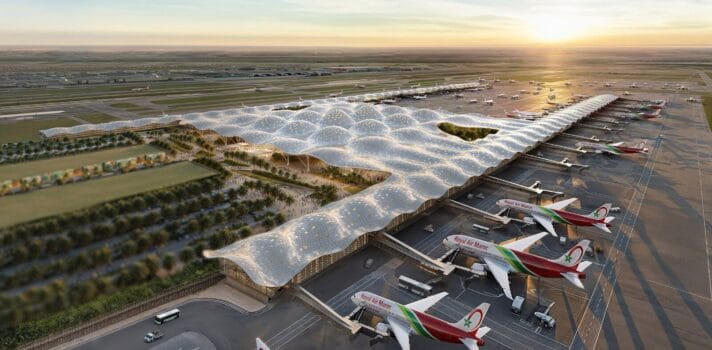
Morocco, a North African jewel, is not only a top tourist destination but also an emerging hub for international events. Its modern network of airports forms a critical infrastructure backbone, efficiently handling millions of passengers every year. With the nation recently hosting the Africa Cup of Nations (AFCON 2025) and preparing to co-host the historic FIFA World Cup 2030, understanding this aviation landscape is more relevant than ever.
Morocco’s Major International Airports
The Kingdom’s aviation system is anchored by several key international airports, each serving a unique region and purpose, making Morocco one of the best-connected countries in Africa.
- Mohammed V International Airport (CMN), Casablanca
- Role: The busiest hub in Morocco and North Africa, serving as the country’s primary gateway.
- Key Features: Two terminals, direct rail link to Casablanca, extensive dining and shopping.
- Importance: Home to Royal Air Maroc, offering flights across Africa, Europe, North America, and the Middle East.
- Marrakech-Menara Airport (RAK)
- Role: Gateway to the “Red City” and the Atlas Mountains.
- Key Features: A modern terminal blending contemporary design with Moroccan architecture.
- Importance: A major tourist hub with dozens of European and Middle Eastern connections.
- Fes-Saïss Airport (FEZ)
- Role: Serving the spiritual capital of Morocco.
- Importance: Popular with diaspora and cultural tourism, with growing low-cost traffic via Ryanair and Air Arabia.
- Agadir-Al Massira Airport (AGA)
- Role: Serving Morocco’s southern Atlantic coast and beach resorts.
- Importance: A seasonal hotspot for European charter flights.
- Tangier Ibn Battouta Airport (TNG)
- Role: Rapidly growing airport near Europe and the Tanger-Med port.
- Importance: Expected to play a strategic role during the World Cup, linking Africa with Spain and Portugal.
Other key airports include Rabat-Salé (RBA), Oujda-Angads (OUD), and Nador-El Aroui (NDR), all vital for regional and international connectivity.
Airlines Connecting Morocco to the World
Morocco’s aviation network thrives thanks to a diverse mix of airlines:
- Royal Air Maroc (RAM): The national carrier and Oneworld member, with routes to more than 80 destinations worldwide. It dominates both domestic and international operations.
- Low-Cost European Carriers: Ryanair, EasyJet, Vueling, and Transavia offer affordable access from Europe.
- Legacy Airlines: Lufthansa, Air France, British Airways, and Iberia ensure premium connectivity.
- Global Carriers: Emirates, Qatar Airways, and Turkish Airlines link Morocco with the Middle East and Asia.
- Air Arabia Maroc: A growing low-cost airline connecting Morocco with Europe and North Africa.
✈️ Domestic Flights and Inter-City Travel
Morocco’s size and geography make domestic air travel essential, especially during major tournaments.
- Royal Air Maroc (RAM): The national carrier remains the backbone of domestic aviation, connecting Casablanca to all major cities including Marrakech, Agadir, Fes, Tangier, Oujda, Laâyoune, and Dakhla.
- Air Arabia Maroc: Offers budget-friendly domestic routes, linking key hubs such as Casablanca, Fes, and Tangier.
- Ryanair: In recent years, Ryanair has expanded into the domestic market, operating inter-city routes such as Marrakech–Agadir, Marrakech–Ouarzazate, and flights to Essaouira. This move has increased competition and provided fans with cheaper options for traveling between host cities.
For AFCON 2025, these domestic routes proved essential for moving both teams and supporters quickly. With the FIFA World Cup 2030 on the horizon, this network will expand further, ensuring seamless mobility between Morocco’s host cities.
Airports as Engines of Major Sporting Events
- AFCON 2025 Dress Rehearsal: Hosting the Africa Cup of Nations tested Morocco’s ability to handle high passenger volumes, team logistics, and fan travel. Airports successfully managed record traffic while showcasing Moroccan hospitality.
- FIFA World Cup 2030 Preparations:
- Capacity Expansion: New terminals under construction at Casablanca, Marrakech, and Tangier.
- Sky Bridge with Europe: Coordinated flights with Spain and Portugal will make inter-host travel faster and cheaper.
- Smart Travel: Investment in biometric systems, fast-track security, and digital check-ins to enhance the fan experience.
Why Morocco’s International Airports Matter Beyond Football
Morocco’s airports are more than transit points; they are the first impression of a country that blends tradition with modernity. From mosaics and architecture reflecting Moroccan identity to duty-free shops and lounges that rival global standards, airports are now cultural ambassadors.
For fans arriving for AFCON 2025 or the World Cup 2030, the experience begins at the airport: efficient arrivals, strong connectivity, and a warm welcome that sets the tone for unforgettable football moments.
A Sky-High Future
Morocco’s international airports are at the heart of its global ambitions. With millions of travelers each year, growing connectivity, and ongoing modernization, they are ready to handle the demands of AFCON 2025 and the FIFA World Cup 2030.
For fans, journalists, and players alike, Morocco’s airports won’t just be gateways — they’ll be the launchpad into the passion, culture, and football spirit that define MoroccoBeat.