Estimated reading time: 4 minutes
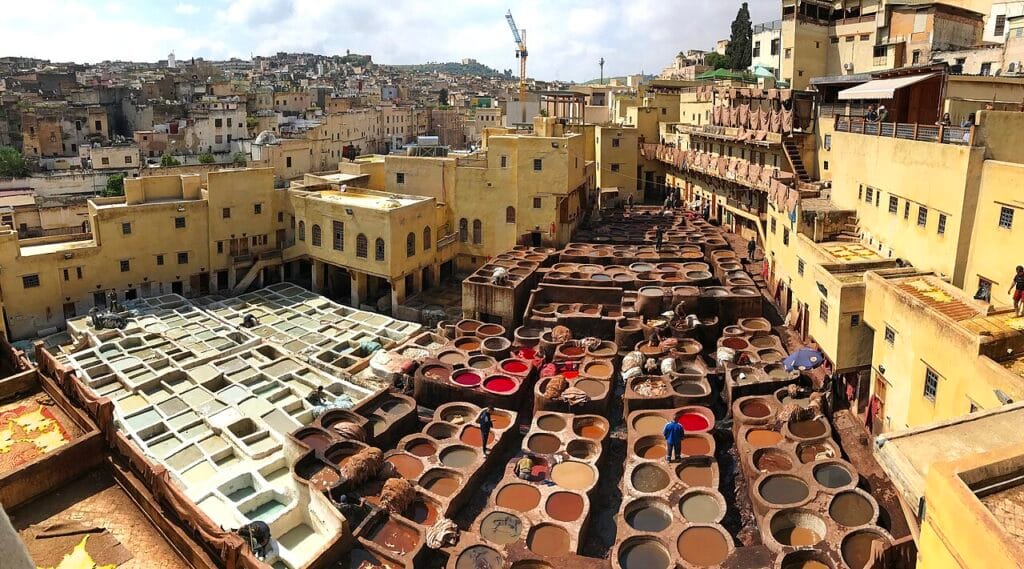
Chouara Tannery. By Uwe Brodrecht – 154 – Marokko Handybilder 2018 – Fes, CC BY-SA 2.0, https://commons.wikimedia.org/w/index.php?curid=94133765
In the heart of the Fes Medina, the spiritual capital of Morocco, lies a spectacle that has remained virtually unchanged since the 12th century: the Chouara Tannery. As the largest of the three remaining tanneries in the city, Chouara is a magnetic draw for global travelers seeking to witness the raw, ancestral art of Moroccan leatherwork.
Every year, thousands of tourists venture into the labyrinthine streets of Fes to witness this living heritage — a sensory, cultural, and photogenic experience unlike any other.
Table of Contents
- 1. A 900-Year-Old Craft in the Heart of Fes
- 2. What Visitors See at Chouara Tannery
- 3. How Leather Is Made: The Ancestral Process
- 4. The Visitor Experience: What to Expect
- 5. Why Chouara Remains Unique in 2026
- 6. FAQ – Visiting Chouara Tannery
1. A 900-Year-Old Craft in the Heart of Fes
Located in the Blida district, near the Zaouia Sidi Hammoumi and Derb El-Mitta, the Chouara Tannery is one of the last three remaining traditional tanneries in the Medina of Fes.
Spanning 7,200 square meters, including 4,000 square meters covered, the site houses 193 workshops where more than 419 artisans work daily. Between 2,900 and 5,100 animal hides are processed here each cycle.
It is this combination of history, scale, and authenticity that makes Chouara one of the most visited attractions in Morocco’s spiritual capital.
2. What Visitors See at Chouara Tannery
Most tourists access the tannery through surrounding leather shops that lead to rooftop terraces overlooking the iconic dyeing pits.
From above, visitors observe dozens of stone vats filled with vibrant natural dyes, ochre, saffron yellow, indigo blue, poppy red, forming one of the most photographed panoramas in Morocco.
Artisans, often standing knee-deep in the vats, wash, soften, and dye goat, sheep, cow, and camel hides using centuries-old techniques.
3. How Leather Is Made: The Ancestral Process
The tanning process remains largely unchanged since the 12th century:
- Raw hides are soaked in limestone, pigeon droppings, and natural ammonia to soften and remove hair.
- The skins are cleaned and rinsed thoroughly.
- They are transferred to dyeing pits filled with natural pigments such as indigo, saffron, henna, and poppy flower extracts.
- Finally, the leather is dried under the Moroccan sun for several days.
The full process can take up to 40 days. Once completed, the leather is sent to local artisans who transform it into bags, slippers (babouches), jackets, belts, and wallets.
4. The Visitor Experience: What to Expect
Visiting Chouara is a sensory experience. After navigating the narrow alleys of the Medina, visitors often detect the strong scent of tanning vats before even seeing them.
To help with the smell, shopkeepers traditionally offer fresh mint leaves to visitors, a small but appreciated gesture.
The best time to visit is in the morning when artisans are fully active and lighting conditions are ideal for photography.
- Open daily (except Fridays)
- Free entry via leather shops (purchases encouraged)
- Best photo angles from rooftop terraces
5. Why Chouara Remains Unique in 2026
Unlike many global heritage sites turned into museums, Chouara is still a working industrial space. The materials, tools, and techniques remain faithful to medieval methods.
It represents a rare example of living craftsmanship in North Africa, where economic activity and cultural preservation coexist.
For travelers seeking authentic cultural experiences in Morocco, Chouara Tannery remains one of the most iconic and immersive stops in Fes.
6. FAQ – Visiting Chouara Tannery
Is Chouara Tannery free to visit?
Yes. Access is typically free through nearby leather shops, although tipping or small purchases are common.
Why is mint offered to visitors?
Mint helps mask the strong smell produced during the tanning process.
How old is the Chouara Tannery?
It dates back approximately 900 years to the 12th century.
Is it safe to visit?
Yes. Visitors observe from terraces above; the working vats are restricted to artisans only.
Final Insight: Visiting Chouara Tannery is more than a tourist stop, it is a journey into Morocco’s living history, where craftsmanship, resilience, and tradition continue to shape the identity of Fes.