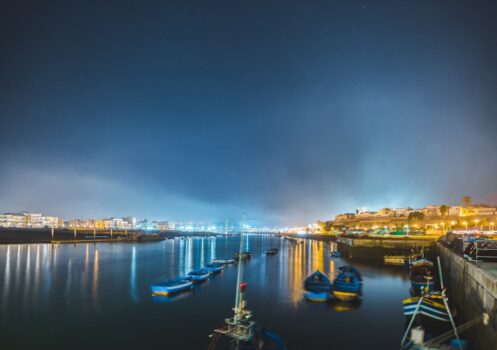
As evening approaches in Rabat, the Bouregreg Valley gradually becomes one of the most frequented public spaces in the Moroccan capital. Families walk along the riverbanks, groups of friends gather on the waterfront promenades, and visitors stop to observe the illuminated skyline that stretches between Rabat and the neighboring city of Salé. The Bouregreg River separates the two historic cities, yet the surrounding landscape concentrates some of the most significant monuments in Morocco, which gives the area both historical importance and daily urban vitality.
The valley forms a natural corridor where heritage sites, public spaces, and modern infrastructure coexist within a relatively compact area. Visitors can walk between royal monuments, medieval structures, museums, and contemporary bridges without long transfers across the city. As a result, the Bouregreg Valley has gradually evolved into a central location for evening walks, cultural exploration, and panoramic views of Rabat’s historic districts.
Rabat’s UNESCO Landscape and the Bouregreg Setting
Rabat occupies a particular place among Moroccan cities because it combines administrative functions with preserved historical quarters. In 2012 UNESCO added the capital to the World Heritage List under the title “Rabat, modern capital and historic city, a shared heritage.” This recognition highlights the balance between historic monuments and twentieth century urban planning.
The Bouregreg Valley illustrates this balance clearly. On one side of the river medieval landmarks dominate the skyline, while on the other side modern public spaces and transport infrastructure structure the waterfront. Large redevelopment programs have gradually transformed the riverbanks into accessible pedestrian zones. These initiatives form part of broader urban projects discussed in Bouregreg Valley development initiatives, which aim to reconnect Rabat with its historic river landscape while improving mobility and public access.
For travelers, the valley offers a practical introduction to Rabat’s historical layers. Several major landmarks stand within walking distance, which allows visitors to understand the city’s development across centuries through a single walking route.
The Hassan Tower and the Mausoleum Mohammed V
The most visible monument overlooking the Bouregreg Valley is the Hassan Tower, a landmark that has shaped Rabat’s skyline for more than eight centuries. Construction began in the late twelfth century under the Almohad ruler Yaqub al Mansour, who planned to build the largest mosque in the Islamic world at the time. When the sultan died in 1199 the construction stopped, leaving behind the tower and hundreds of stone columns that still outline the unfinished mosque.
Today the Hassan Tower rises about 44 meters above the esplanade and remains visible from multiple viewpoints along the Bouregreg riverbanks. Travelers interested in the architectural and historical context of the monument often consult Hassan Tower: The Unfinished Minaret of Morocco’s Capital, which explains the Almohad design principles and the original scale of the mosque project.
Next to the tower stands the Mausoleum Mohammed V, completed in 1971 and designed using traditional Moroccan craftsmanship. The structure houses the tombs of King Mohammed V and his sons King Hassan II and Prince Abdallah. White marble walls, a green tiled roof, and intricately carved cedar wood ceilings illustrate Moroccan artisanal traditions. Ceremonial royal guards stand at the entrances, which makes the mausoleum one of the most photographed sites in Rabat.
From the large esplanade surrounding the monument complex visitors gain open views over the Bouregreg River and the city of Salé. Once the evening lighting activates, both the Hassan Tower and the mausoleum become focal points of the valley’s nighttime landscape.
Walking the Bouregreg Riverfront
Over the past two decades the riverbanks of the Bouregreg have undergone major redevelopment that transformed former industrial and port areas into pedestrian promenades. Landscaped walkways, cycling paths, and viewing platforms now extend along large sections of the waterfront, which allows residents and travelers to move comfortably between historic landmarks.
This transformation reflects a broader strategy to integrate heritage preservation with contemporary urban design. In parallel, cultural initiatives have begun to interpret Rabat’s medieval past through new technologies. Projects such as Virtual Reality Revives Almohad-Era Rabat on the Bouregreg illustrate how digital reconstructions now help visitors visualize how the Almohad capital once appeared along the river.
Most walking routes begin near the Hassan Tower complex and continue west toward the Atlantic. As visitors progress along the riverbank the perspective on Rabat’s skyline gradually changes. Modern residential districts appear further inland while historic monuments remain visible across the water.
Marinas and small cafés along the promenade encourage longer stops, particularly during warm evenings when temperatures drop after sunset. Rabat also forms part of broader pedestrian travel experiences across the country. Routes that focus on urban exploration appear in guides such as Walking Morocco: City Tours That Redefine Slow Travel, which highlights how several Moroccan cities have become more accessible to travelers on foot.
The Oudayas Corniche and the Atlantic Coast
Near the western end of the Bouregreg Valley stands the Kasbah of the Oudayas, a fortified complex that marks the point where the river meets the Atlantic Ocean. The kasbah dates largely from the twelfth century although later dynasties reinforced its defensive walls and gates.
Visitors enter through Bab Oudaia, a monumental Almohad gateway that leads into a quiet residential quarter. Inside the kasbah narrow streets lined with white houses and blue painted walls create one of the most recognizable architectural settings in Rabat.
Below the kasbah the Oudayas corniche extends along the Atlantic shoreline. The promenade provides wide views over the ocean, the Bouregreg estuary, and the city of Salé on the opposite bank. Local cafés and terraces attract residents and travelers who stop to observe the river mouth where fishing boats and waves meet.
The walk between the Hassan Tower complex and the Oudayas corniche covers roughly two kilometers and takes about twenty five minutes on foot. The route remains one of the most accessible urban walks in Rabat because tramway stations and taxi routes operate nearby.
The Chellah Necropolis and Rabat’s Ancient Past
While the Bouregreg riverfront concentrates many of Rabat’s monumental landmarks, another important historical site lies only a short distance inland. The Chellah necropolis stands approximately three kilometers south of the Hassan Tower complex and offers one of the most atmospheric archaeological environments in Morocco.
The site originally functioned as a Roman settlement known as Sala Colonia during the early centuries of the Common Era. Archaeological remains from that period include fragments of the Roman forum, baths, and paved streets. In the fourteenth century the Marinid dynasty transformed the area into a royal necropolis and built defensive walls around the older Roman structures.
Recent restoration projects and archaeological studies have increased interest in Chellah. New discoveries and cultural initiatives surrounding the site are explored in Emerging Archaeological Openings to Watch Near Rabat and Chellah, which highlights how the necropolis continues to evolve as both a heritage site and a visitor destination.
Today visitors enter Chellah through a monumental gate that leads into a large garden filled with ruins, fig trees, and stork nests perched on ancient walls. Walking paths connect Roman foundations with Marinid tomb structures and the remains of a historic mosque. The quiet atmosphere of the site contrasts with the lively riverfront only a few kilometers away.
The Medina and Contemporary Cultural Spaces
Beyond archaeological sites and river promenades, Rabat also offers a compact historic medina located less than fifteen minutes on foot from the Bouregreg Valley. Compared with the medinas of larger Moroccan cities such as Marrakech or Fez, Rabat’s historic quarter remains relatively calm, which allows visitors to explore the narrow streets at a slower pace.
Inside the medina workshops produce traditional crafts including leather items, carpets, and metalwork. Small food stalls sell regional snacks such as msemen pancakes, grilled sardines, and mint tea. Andalusian style houses also reflect Rabat’s historical connections with Spain following the arrival of Andalusian communities centuries ago.
A short distance from the medina stands the Mohammed VI Museum of Modern and Contemporary Art. Since its opening in 2014 the institution has become Morocco’s main national museum dedicated to modern artistic production. Temporary exhibitions regularly present Moroccan artists alongside international creators, which adds a contemporary cultural dimension to Rabat’s historic environment.
Why the Bouregreg Valley Remains Central to Rabat’s Identity
The Bouregreg Valley continues to attract both residents and travelers because it brings together multiple dimensions of Rabat’s identity within a single landscape. Historic monuments, archaeological sites, cultural institutions, and modern public promenades all lie within a short distance of the riverbanks.
Evening activity reinforces the appeal of the area. As temperatures cool after sunset the illuminated Hassan Tower and Mausoleum Mohammed V dominate the skyline while residents gather along the riverfront paths. The presence of cafés, viewpoints, and open plazas encourages longer visits and creates a relaxed atmosphere along the water.
For travelers seeking to understand Rabat beyond administrative districts and government buildings, the Bouregreg Valley provides a clear introduction to the capital. The river connects Rabat with Salé while the surrounding monuments reveal how successive dynasties shaped the city’s landscape.
This combination of historical depth, accessible public space, and ongoing urban development explains why the Bouregreg Valley remains one of the most popular walking areas in Rabat and one of the most effective ways to experience the Moroccan capital.