Photo: Mag Photography / Pexels
Introduction
Rabat continues to strengthen its reputation as one of Morocco’s most historically layered cities. While many travelers focus on landmarks such as the Kasbah of the Udayas or the Hassan Tower, several archaeological sites near the capital reveal deeper historical narratives that extend back thousands of years. Among these locations, the Chellah archaeological complex stands out as one of the most significant heritage sites in the Rabat region.
The growing interest in archaeological openings near Rabat reflects ongoing excavation campaigns, restoration projects, and improved visitor access to ancient ruins. These developments expand the cultural tourism landscape around Morocco’s capital and allow visitors to explore historical layers that range from Phoenician trading settlements to Roman urban infrastructure and medieval Islamic monuments. Understanding how these sites connect historically helps travelers design cultural itineraries that extend beyond Rabat’s traditional tourist circuit.
The Archaeological Landscape Around Rabat
The Rabat region occupies a strategic geographic position at the mouth of the Bou Regreg River. This location historically attracted traders, settlers, and military powers that used the estuary as both a commercial gateway and a defensive position. Archaeological evidence suggests that Phoenician merchants established early trading activity in the area before Roman authorities later developed a structured urban settlement known as Sala Colonia.
During the Roman period, Sala Colonia functioned as an administrative and commercial center within the province of Mauretania Tingitana. Archaeologists have identified traces of paved streets, baths, temples, and civic buildings that illustrate how Roman urban planning structured the settlement. These remains confirm that the region around Rabat played an active role in Mediterranean trade networks and provincial administration.
Centuries later, Islamic dynasties reused parts of the same landscape. During the 13th and 14th centuries, the Marinid dynasty transformed the ancient Roman site into a royal necropolis. This transformation created the layered archaeological environment that visitors encounter today, where Roman ruins coexist with medieval Islamic monuments.
Chellah: The Central Archaeological Site Near Rabat
The Chellah archaeological site lies approximately two kilometers southeast of Rabat’s historic center and overlooks the Bou Regreg valley. Visitors can reach the site in about ten minutes by taxi from the medina or in roughly twenty to thirty minutes on foot.
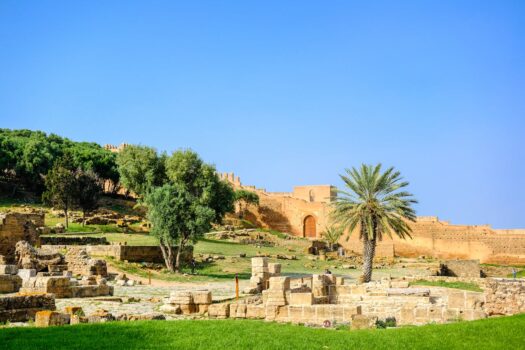
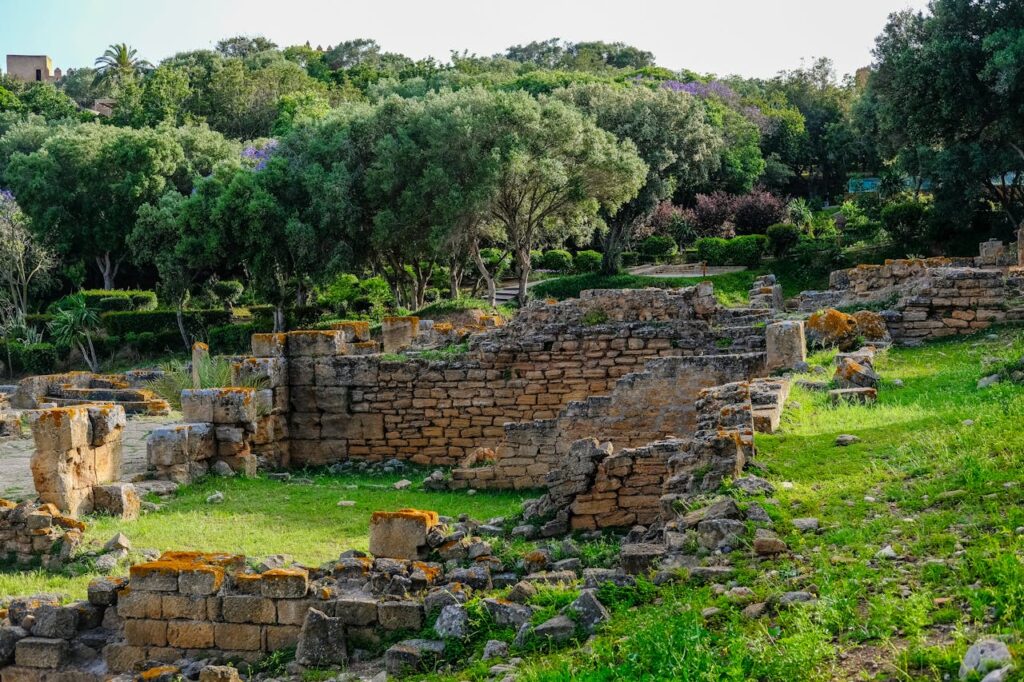
Once visitors pass through the monumental Almohad gate built in the fourteenth century, the complex reveals an archaeological landscape that combines Roman remains with Marinid architectural structures. Roman ruins include sections of defensive walls, fragments of triumphal arches, and the foundations of public buildings that once formed part of the ancient city of Sala Colonia.
Moving deeper into the site, Marinid constructions begin to dominate the environment. These structures include the ruins of a mosque, educational buildings associated with a madrasa, and numerous royal tombs that formed a dynastic burial complex. Historical research indicates that more than fifty tombs belonging to Marinid rulers and elites remain within the necropolis.
This combination of Roman and Islamic remains makes Chellah one of the most historically layered archaeological sites in Morocco. Visitors can observe how later civilizations reused earlier structures while adapting the landscape to new religious and political purposes.
Recent Excavations and Archaeological Research
Archaeological teams continue to conduct research at Chellah in order to better understand the chronological development of the site. Researchers examine construction layers, inscriptions, and urban layouts to reconstruct how Roman urban systems evolved into medieval Islamic structures.
Once archaeologists document new findings, conservation teams stabilize fragile ruins and prepare sections of the site for controlled public access. This process ensures that historical remains remain protected while allowing visitors to observe the most significant discoveries.
As a result, the visitor experience at Chellah gradually evolves as new archaeological sections become visible. Interpretive panels and guided walking routes now explain how the Roman forum, defensive walls, and religious structures fit into the broader historical development of the area.
Nearby Roman Sites Expanding the Archaeological Circuit
Although Chellah represents the most accessible archaeological destination near Rabat, several additional Roman sites exist within the wider region. One of the most notable examples is the ancient settlement of Thamusida located along the Sebou River north of Rabat.
Thamusida formed part of a Roman defensive and commercial network that connected inland agricultural territories with Atlantic trade routes. Archaeological remains include fortifications, residential areas, and evidence of river transport infrastructure used during the Roman period.
Travelers can reach the site in approximately ninety minutes by car from Rabat via the Kenitra corridor. While the site currently receives fewer visitors than Chellah, it contributes to a broader archaeological network that includes Volubilis near Meknes and Lixus near Larache.
Restoration Projects Improving Visitor Access
Recent restoration initiatives have significantly improved access to archaeological sites around Rabat. At Chellah, conservation programs introduced stabilized pathways, clearer signage, and interpretive panels that help visitors understand the site’s historical structure.
These improvements play an important role because archaeological ruins often remain difficult to interpret without contextual information. By integrating educational materials directly into the visitor route, the site allows travelers to follow the chronological development of the settlement.
The current walking route gradually guides visitors from Roman urban remains toward the Marinid necropolis. This structure helps travelers visualize how the site evolved through successive civilizations.
Planning a Visit to Chellah and Nearby Archaeological Sites
Travelers interested in emerging archaeological openings near Rabat should begin with Chellah, which offers the most accessible and comprehensive historical experience. Most visitors spend between one and two hours exploring the complex depending on their level of interest in archaeological details.
Because the site sits just outside Rabat’s historic center, visitors can easily combine it with other cultural landmarks such as the Hassan Tower, the Mohammed VI Museum of Modern and Contemporary Art, or the Kasbah of the Udayas.
Visitors seeking a deeper archaeological itinerary can extend their journey to additional Roman locations such as Thamusida or the UNESCO listed site of Volubilis located roughly three hours from Rabat. These sites together illustrate how Roman settlements once structured large parts of northern Morocco.
The Growing Role of Archaeological Tourism in Rabat
The growing visibility of archaeological openings near Rabat reflects broader efforts to highlight Morocco’s ancient heritage alongside its Islamic architecture and modern cultural institutions. Sites such as Chellah demonstrate how Morocco’s history developed through interactions between Phoenician traders, Roman administrators, and Islamic dynasties.
As excavation work continues and conservation projects expand, additional sections of ancient settlements may gradually become accessible to visitors. These developments strengthen Rabat’s position as a destination where travelers can explore more than two thousand years of historical transformation within a relatively compact geographic area.
For travelers interested in archaeology, the sites surrounding Rabat provide a structured way to understand how Morocco’s capital evolved from an ancient trading settlement into the modern city that stands today.
Related: