Photo by Soulaymane Benchekroun via Pexels
Designing a Riverfront Where Heritage Meets Modern Life
Between Rabat and Salé, the Bouregreg Valley unfolds as a space of renewal, a place where architecture, landscape, and memory come together to redefine Morocco’s urban rhythm. Guided by the Bouregreg Valley Development Agency (AAVB), the project aims to reconnect two historic cities long separated by their shared river, turning a boundary into a bridge of culture and life. (upfi-med.eib.org)
The master plan draws inspiration from Italian and Mediterranean design, where beauty emerges through proportion, light, and relationship with the environment. Cities like Florence and Genoa provided the spirit of balance that shaped the valley’s concept: neighborhoods designed for walking, plazas that invite gathering, and waterfronts that frame both the river and the horizon.
The French-Italian architectural studio Reichen et Robert & Associés translated this philosophy into a coherent plan of five themed zones: Blue, Green, White, Ochre, and Grey. Each expresses a way of living with water, history, and nature. The result is not just urban space, but an experience of coexistence where tradition and innovation flow in the same current.
A River That Connects, Not Divides
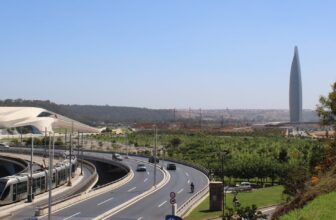
The Bouregreg project carries Morocco’s broader ambition to integrate sustainable design into every layer of city life. New bridges and tram connections now link Rabat and Salé, while green promenades and public parks offer breathing space along the riverbanks. The restoration of heritage sites, such as the Chellah necropolis, ensures that history remains visible within modern growth.
This transformation redefines how Morocco approaches urbanism: not as a race toward expansion, but as a dialogue between people, landscape, and memory. Bouregreg Valley stands as a symbol of this vision: a model of thoughtful planning where art, ecology, and daily life meet.
What makes the valley remarkable is its subtlety. It does not impose itself on the city; it listens to it. The water, the streets, the voices of Rabat and Salé now echo together, proof that design, when rooted in place, can quietly reshape the soul of a city.
Related: