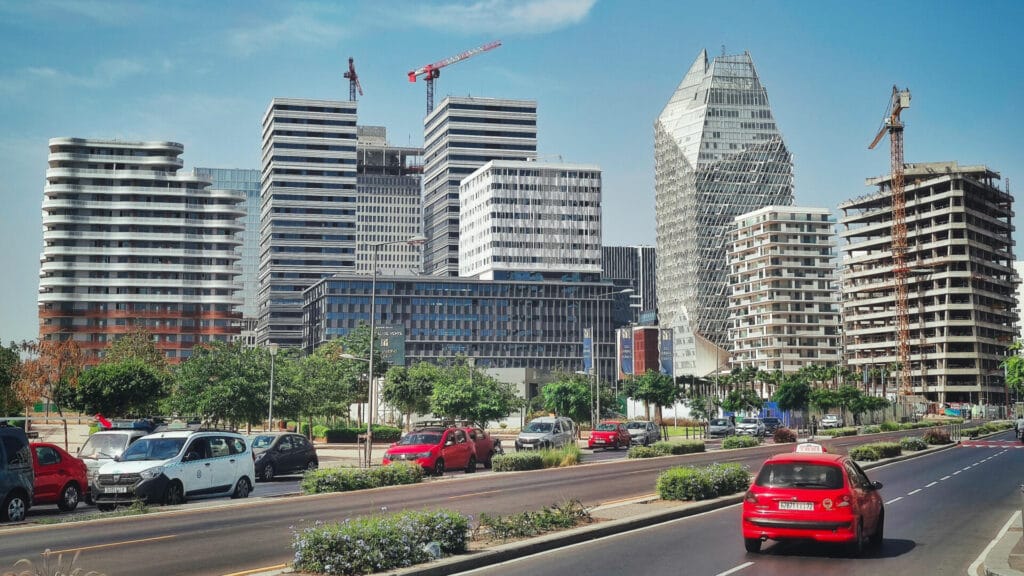
With the Africa Cup of Nations just months away and the 2030 FIFA World Cup on the horizon, authorities in Casablanca are accelerating major projects to enhance the city’s infrastructure. The goal is to establish Morocco as a premier sporting hub on the African continent and a world-class host for global events.
Since 2023, the foundation has been laid for these large-scale initiatives, designed to transform the economic capital into a leading sports and financial hub. The developments include new roads, hotels, and stadiums, all built to meet the rigorous international standards required for hosting major tournaments. These projects are set to bolster Morocco’s reputation and its ambition to lead on the global stage.
The Hassan II Grand Stadium: A World Cup Centerpiece
Following the announcement that Morocco, alongside Spain and Portugal, will host the 2030 World Cup, all eyes have turned to the Hassan II Grand Stadium. Located in Mansouria (Benslimane province), this venue is set to become a global sporting landmark.
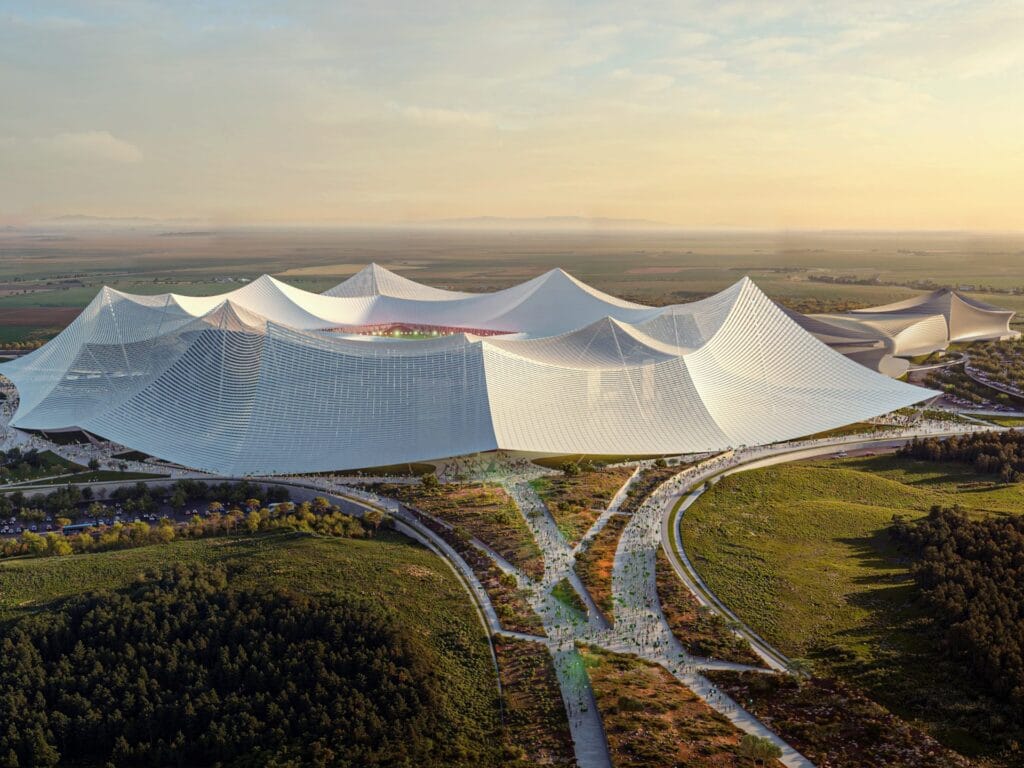
The region is a hive of activity, with round-the-clock work to expedite the stadium’s construction. With a massive budget exceeding five billion dirhams allocated between 2025 and its completion in 2028, it will be the largest stadium of its kind. Travelers on the road between Mohammedia and Benslimane can witness the large-scale works, including road excavation and the construction of access routes to facilitate entry to the stadium.
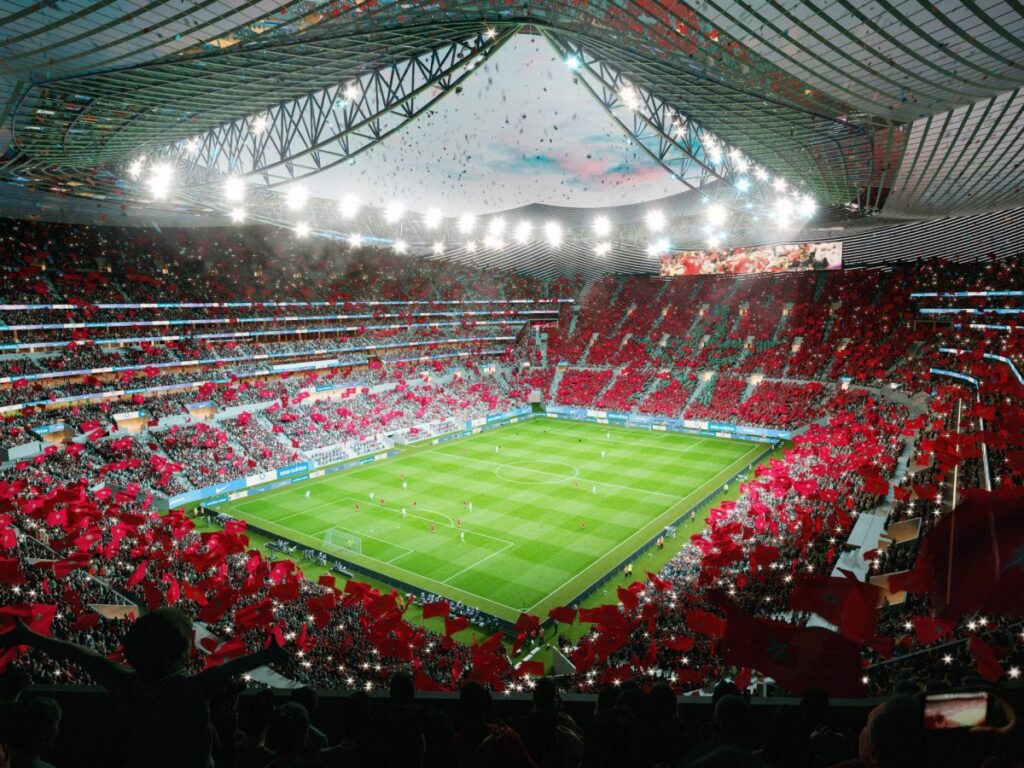
To support this monumental project, construction has begun on an adjacent high-speed train (TGV) station and a regional express train station. This new transport hub aims to create a seamless link between Mohammed V International Airport, Casablanca, and the Grand Stadium in Benslimane. Furthermore, the stadium will be equipped with 5G network coverage and free public Wi-Fi, in coordination with the Royal Moroccan Football Federation, ensuring connectivity for fans in public squares, parks, and tourist areas.
For more details about how Morocco is modernizing its railway sector, click here
Mohammed V Stadium: A Historic Venue Reimagined
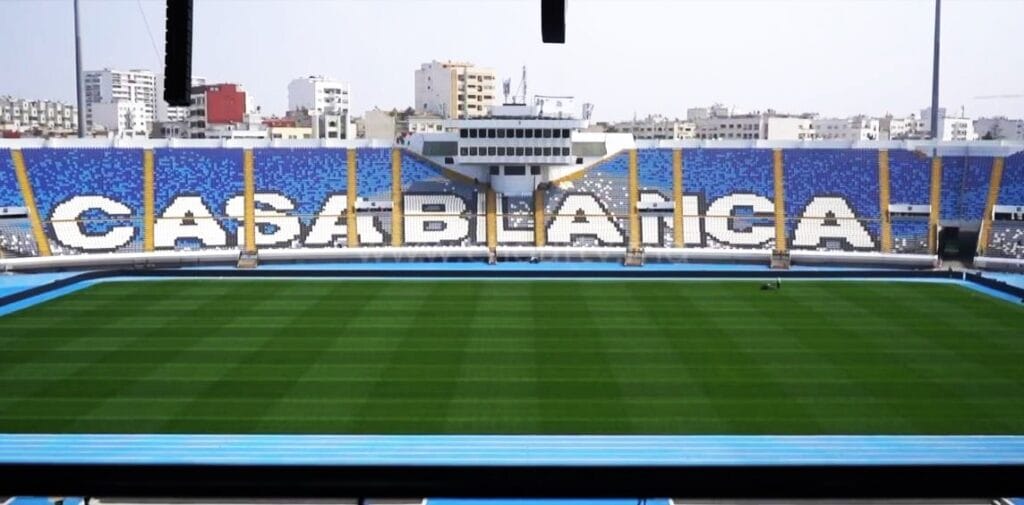
As part of the preparations, the iconic Mohammed V Stadium in the heart of Casablanca is undergoing a significant renovation to be ready for the Africa Cup of Nations in December 2025. With a capacity of 45,000 spectators, the stadium, affectionately known as “Donor” by locals, is receiving modern upgrades to its infrastructure, exterior, and pitch.
The stadium was completely closed in 2023 for a 16-month overhaul. Key improvements include:
Replacing the turf to comply with international standards.
Installing new, fully numbered seating.
Improving infrastructure to manage crowd flow for fans and guests.
Renovating changing rooms, facilities, and creating a new press conference hall.
Upgrading the sound and lighting systems to meet FIFA requirements.
Installing new display screens on both sides of the stadium.
The project also includes refurbishing the surrounding streets, optimizing parking facilities, creating new gardens, and establishing a sports memory museum.
Upgrading the Road Network: Paving the Way for Fans
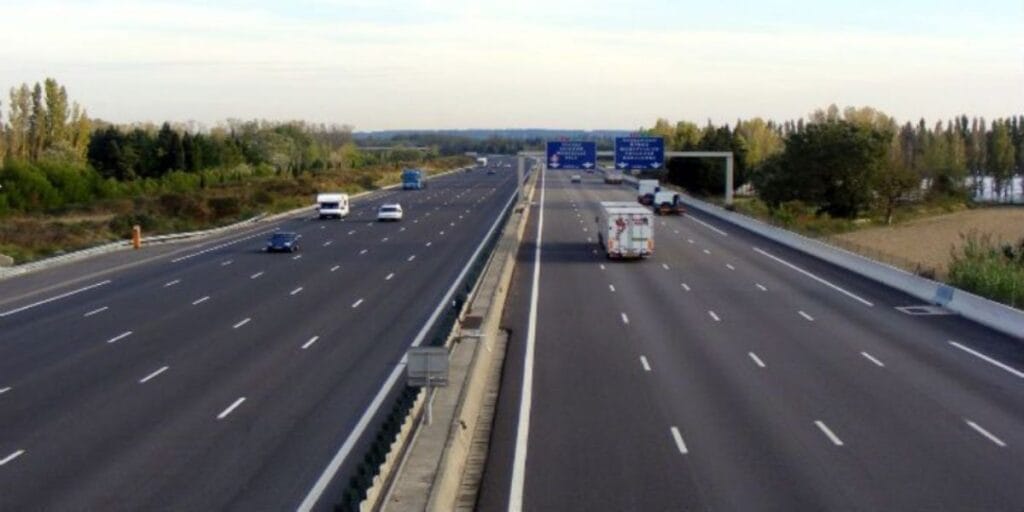
Across Casablanca and its neighboring areas—such as Mohammedia, Ain Harrouda, Mansouria, Mediouna, Bouskoura, and Nouaceur—major roadwork projects are underway. Authorities have allocated a significant budget to improve the road network, ease traffic congestion, and ensure smooth mobility for the upcoming tournaments.
The Casablanca municipality is upgrading major avenues, widening roads, and constructing underpasses. This initiative also involves rehabilitating sidewalks, modernizing public lighting, updating traffic signals, and creating green spaces.
To facilitate access to the new Hassan II Grand Stadium for the World Cup, a massive 605 million dirham contract has been awarded to five Moroccan companies, supervised by the National Company of Motorways of Morocco (ADM). The project includes widening the main access road, building bridges, and updating signage to ensure seamless travel to the venue.
Transportation and Mobility: Connecting the City
Alongside infrastructure upgrades, authorities are enhancing Casablanca’s public transportation network to connect the city with Mohammed V Airport and the new Benslimane stadium. Key measures include:
Regional Express Network (RER): Launching three RER lines totaling 140 kilometers, integrated with new tramway and Bus Rapid Transit (BRT) lines.
Expanded Bus Network: Extending bus services to cover the municipalities of Mansouria and Benslimane.
Parking Solutions: Constructing multi-story car parks, with 890 spaces already available and 1,700 under construction, to improve traffic flow.
Airport Connectivity: Launching a dedicated bus line connecting Mohammed V Airport to Casablanca city center.
Modernized Taxis: Upgrading the taxi fleet with new vehicles and implementing biometric licenses.
Enhancing Air Infrastructure: The Gateway to Morocco
To welcome the influx of international visitors, Morocco’s National Airports Office (ONDA) is undertaking a major expansion and modernization of Mohammed V International Airport.
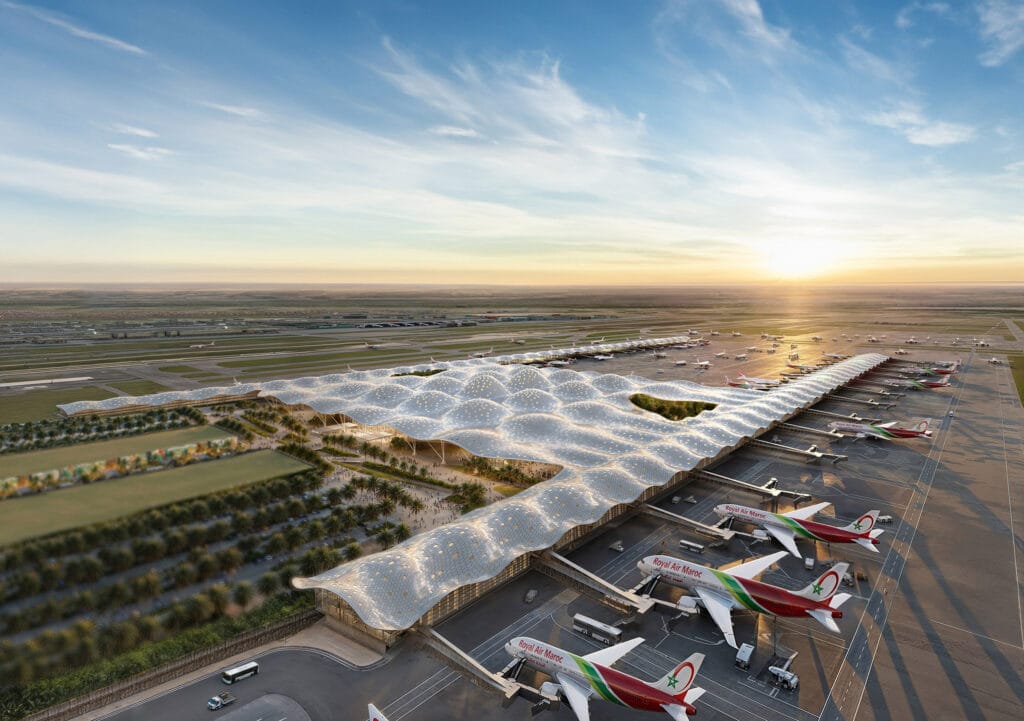
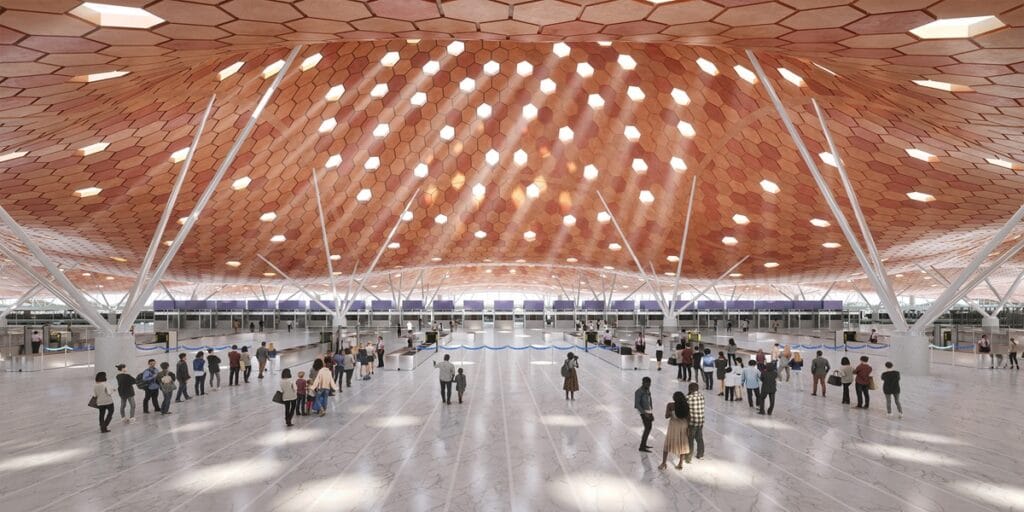
A cornerstone of this effort is the construction of a new terminal, with excavation work already underway. Expected to be operational by 2029, the new terminal will have a capacity of 20 million passengers annually. Its design, inspired by the waves of the Atlantic Ocean, will reflect Moroccan identity.
With a total investment of approximately 15 billion dirhams, this project will increase the airport’s overall capacity to 35 million passengers per year. The next-generation terminal will feature a seamless, digital passenger journey, high energy efficiency standards, and an integrated high-speed train (TGV) station connecting the airport to Rabat in 30 minutes and Marrakech in under an hour.
Boosting Hotel Capacity: Accommodating the World
The preparations extend beyond infrastructure to the hospitality sector. A significant effort is underway to expand Casablanca’s hotel capacity to accommodate visitors for both tournaments.
Data indicates that there will be no shortage of accommodation by the 2030 World Cup.
Current high-end rooms (3, 4, & 5-star): 10,567
Rooms under construction: 3,242
New hotel investments: 30 hectares of land near the Hassan II Grand Stadium have been allocated for hotel development, set to provide an additional 6,500 rooms.
Declared projects: An additional 3,000 rooms are in the pipeline.
Public accommodation: The city currently offers 4,206 rooms for the general public, with 1,661 under construction and 1,000 declared. An estimated 7,000 residential units are also available via platforms like Airbnb.