Casablanca has a rhythm that only reveals itself to those who take their time. Cars rush through its avenues, but the true character of Morocco’s largest city unfolds at walking speed. The sea breeze, the scent of roasted coffee, and the sound of footsteps echoing through old Art Deco streets turn a simple walk into an exploration of history and culture.
For many visitors, Casablanca serves as a stopover, a gateway to Marrakech, Fez, or Chefchaouen. Yet the city offers one of Morocco’s most rewarding urban walks: a path that begins by the Atlantic Ocean and winds through elegant 20th-century architecture toward the city’s dynamic heart. The journey is not about ticking landmarks off a list but about sensing how the city connects past and present through its design, people, and rhythm.
1. The Corniche: Where Casablanca Meets the Atlantic
The best starting point is La Corniche, the sweeping coastal promenade that traces the edge of the Atlantic from the Hassan II Mosque to Aïn Diab. The air feels lighter here. Locals jog along the waterfront, families share sunset picnics, and fishermen cast lines from the rocks.
The Corniche represents modern Casablanca, open, social, and always in motion. Along the way, beach clubs and cafés alternate with quiet corners where waves crash against the seawall. Restaurants like Le Cabestan or Tahiti Beach have been local favorites for decades, serving seafood with an endless ocean view.
Take your time to walk the full stretch. The rhythm of the sea gives the city a sense of balance rarely found elsewhere. You might pass a street vendor selling roasted peanuts, a young couple taking engagement photos, or an elderly man leaning on the railing, watching the horizon. Each moment feels connected to Casablanca’s identity as a city that looks toward the ocean yet remains deeply Moroccan in spirit.
Best times to walk: early morning for calm air and reflection; late afternoon for light that turns the Atlantic silver and the mosque golden.
2. Aïn Diab: The City’s Open-Air Lounge
Continue west and you’ll reach Aïn Diab, Casablanca’s seaside playground. The area changes character as the Corniche’s relaxed pace gives way to livelier energy. Loud laughter mixes with music from beach cafés. The scent of grilled sardines and spicy merguez fills the air.
Aïn Diab has always been a space for recreation and youth culture. During weekends, families walk hand in hand along the beach road. Children chase waves, and vendors sell coconut slices and ice cream. In the evenings, restaurants glow with neon signs and groups gather for late dinners that stretch deep into the night.
This district also holds cultural weight. The Sidi Abderrahman shrine, standing on a rocky island just off the Corniche, connects the modern city to centuries of spiritual heritage. At low tide, visitors can walk across the sand to the small white zawiya, where locals still come to pray and light candles. The contrast between the sacred calm of the shrine and the nightlife nearby summarizes Casablanca’s dual identity, half modern rhythm, half timeless devotion.
3. From the Coast to the City: Entering the Urban Core
Leaving the Corniche behind, head inland toward Boulevard Mohammed V. The ocean breeze gives way to the hum of traffic, and the architecture becomes denser. This boulevard marks the transition from leisure to legacy.
Constructed during the early 20th century, this area embodies the city’s transformation under the French Protectorate. It was the stage where European urban planning met Moroccan culture, producing one of the world’s most distinctive Art Deco landscapes.
The buildings here are not museum pieces; they are part of everyday life. Bakeries, tailors, and phone shops operate behind façades adorned with floral ironwork and geometric stucco patterns. The mix of Arabic signage and French lettering across old storefronts tells the story of a city shaped by both worlds.
Related: Inside Marrakech’s Medina: The Streets That Still Whisper History
4. The Art Deco Legacy: A Walk Through Time and Design
Casablanca’s Art Deco district remains one of the richest in Africa. Architects like Marius Boyer and Henri Prost envisioned a city that would reflect progress, elegance, and Mediterranean modernity. The result is a harmonious blend of French symmetry and Moroccan craftsmanship.
Notable stops include:
- Hotel Lincoln, an icon awaiting full restoration. Its crumbling façade still attracts photographers and history lovers. The renovation plans aim to preserve its original details while transforming it into a cultural landmark.
- Cinema Rialto, opened in 1930, still screens films and concerts beneath its curved roof and neon signage. The interior retains red velvet seats and vintage lamps, offering a glimpse of Casablanca’s golden era of cinema.
- Immeuble Assayag, a striking residential building known for its rounded balconies and clean geometric lines that capture the Art Deco spirit.
Other gems hide behind unassuming corners, carved doors, ceramic tiles, and staircases that reveal the artisanship of a city that once aimed to rival Marseille and Algiers in design sophistication.
The Art Deco route rewards those who look up. Many travelers walk quickly, unaware that above them are façades with sculpted suns, palm leaves, and Arabic calligraphy blended into French ornamentation. Each building stands as a silent witness to Casablanca’s experiment in blending global and local aesthetics.
5. The Spirit of Boulevard Mohammed V
No visit to Casablanca feels complete without pausing at one of the cafés lining Boulevard Mohammed V. These establishments form the city’s social stage. People read newspapers, debate football, or simply watch life unfold outside large windows.
The boulevard connects major landmarks, the Central Market, the Wilaya Building, and the Place des Nations Unies, creating a natural path for observation. Streetcars glide along their rails while fruit vendors shout daily prices. The scene feels both urban and familiar, offering a glimpse of Casablanca’s working rhythm beyond the postcard view of the Corniche.
Just a short detour away lies Quartier Habous, known as the “New Medina.” Built in the 1930s, it was designed as a modern reinterpretation of traditional Moroccan architecture. The layout is orderly, but the atmosphere remains intimate. Bookstores sell Arabic classics beside craft shops, and bakeries display fekkas and kaab ghzal in glass cases. The air smells of orange blossom and almond.
Habous provides calm after the intensity of downtown. Many visitors describe it as a place where Casablanca’s soul feels clearest, structured yet human, modern yet grounded in tradition.
6. The Hassan II Mosque: A Symbol of the Horizon
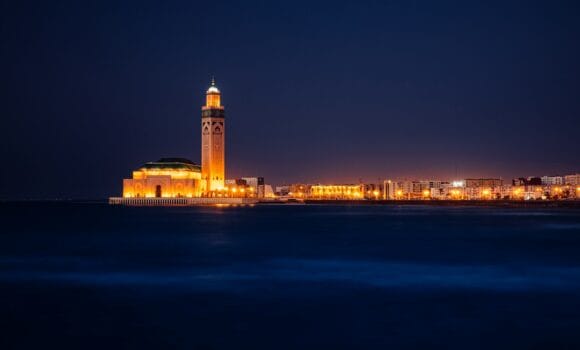
Eventually, all walks lead back to the Hassan II Mosque. Standing at the edge of the Atlantic, this monument defines Casablanca’s skyline. Its 210-meter minaret rises above the water, and its courtyard can hold over 100,000 worshippers.
Built in the late 20th century, the mosque combines advanced engineering with traditional artistry. Zellij mosaics, marble columns, and hand-carved cedar ceilings form a dialogue between faith and craftsmanship. Visitors can join guided tours to explore its vast prayer halls and terraces overlooking the ocean.
The mosque’s surroundings serve as a gathering place for all generations. Children play along the steps, tourists photograph the view, and locals sit quietly on the seawall as the sun fades. The sound of waves blends with the evening call to prayer, creating a moment that unites movement and stillness, the same balance that defines Casablanca itself.
7. Modern Corners and Creative Spirit
Beyond heritage, modern Casablanca continues to evolve. The Anfa district, once an airfield, now hosts business centers and luxury housing projects. Yet, even here, street art and creative studios remind visitors that the city’s pulse comes from its people.
Art galleries like Villa des Arts or L’Uzine host exhibitions, concerts, and workshops that connect Casablanca’s artistic youth with its architectural past. Some of the most compelling murals appear near the tram lines, turning blank walls into storytelling canvases.
Many local initiatives now focus on preserving the Art Deco core while adapting it to new uses, cafés in restored buildings, design shops in old cinemas, and boutique hotels that celebrate the city’s heritage. This blend of conservation and reinvention keeps Casablanca’s identity alive, refusing to freeze it in nostalgia.
Related: Discover Fez: A Journey Through Morocco’s Spiritual Capital
8. Practical Tips for Exploring Casablanca on Foot
- Start early: Morning walks along the Corniche offer the best light and mild weather.
- Wear comfortable shoes: Distances are longer than they appear on the map, especially from the Corniche to downtown.
- Stay hydrated: Local kiosks sell bottled water and fresh juice everywhere.
- Respect prayer times: The Hassan II Mosque has specific visiting hours for non-Muslims.
- Explore side streets: Some of the most beautiful Art Deco façades hide on smaller parallel roads.
- Take the tram if tired: It’s safe, clean, and connects most major districts.
Walking Casablanca allows for spontaneous discoveries.. a mural under a bridge, a baker kneading dough, or a musician rehearsing outside an old theater. Each encounter adds to the city’s mosaic.
9. The Soul of the City
Casablanca is not a city that immediately seeks attention. It reveals itself gradually, through texture and tone. The scent of the ocean, the geometry of Art Deco balconies, the balance between faith and modernity, all merge into one living rhythm.
By the time you finish the walk, you understand that Casablanca is more than Morocco’s economic hub. It is a reflection of the country’s evolution, confident, creative, and open to change while anchored in memory.
Exploring on foot transforms the city from a fast stopover into an experience that stays long after the journey ends. Every turn of the Corniche and every Art Deco doorway speaks of resilience, style, and connection between eras.