
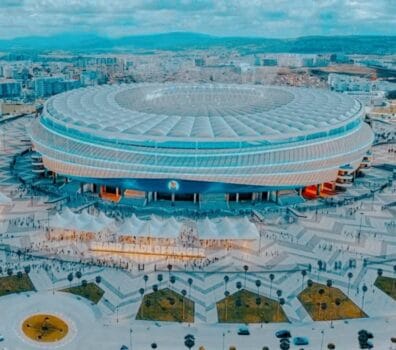
A modern infrastructure project aligned with Morocco’s preparations for AFCON 2025 and the 2030 World Cup
The northern Moroccan city of Tangier has unveiled a massive parking complex with more than 3,000 spaces near the Grand Stadium, a major step forward in its urban modernization strategy and in the city’s readiness to host global sporting events.
The construction is over 95% complete, with official opening scheduled for November 14, 2025, coinciding with the match between Morocco and Mozambique at the renovated Grand Stade de Tanger. The new parking facility lies on the northeast side of the stadium, near Boulevard Moulay Rachid and the Rabat highway, forming part of a broader plan to reorganize access to Tangier’s expanding sports district. (Le360)
Modern and accessible infrastructure
The new complex offers advanced lighting, video surveillance, dedicated areas for persons with disabilities, and multiple entry and exit lanes to prevent congestion during large events. It is designed not only for everyday use but also for high-capacity international fixtures expected over the coming years.
The facility joins a set of specialized zones around the Grand Stadium:
- A VVIP parking area covering 10,000 m² for about 400 vehicles.
- A VIP parking zone with capacity for 600 to 700 cars.
- Several peripheral lots for public and service vehicles.
These improvements collectively raise the stadium’s total parking capacity to a level compatible with FIFA and CAF standards.
Preparing for AFCON 2025 and the 2030 World Cup
The Grand Stade de Tanger, already renovated to meet FIFA 2030 requirements, is one of the key venues in Morocco’s plan to co-host the World Cup alongside Spain and Portugal. In addition, Tangier will serve as one of the main host cities for AFCON 2025, expected to attract tens of thousands of fans from across the continent.
Beyond sports, the project reflects Tangier’s long-term urban vision, easing local traffic, improving accessibility, and enhancing the city’s international profile. The surrounding district is also being equipped with smart surveillance systems, landscaped zones, and improved public transport links, signaling Morocco’s push toward integrated and sustainable development.
A symbol of Morocco’s transformation
This new 3,000-space parking facility is not just about accommodating cars; it’s a visible sign of Morocco’s larger modernization momentum. By investing in public infrastructure around major venues, the country is preparing to welcome the world with efficiency and style, from AFCON 2025 to the 2030 World Cup.
As Morocco positions itself as a hub for sports tourism and global events, Tangier’s new urban projects show what the future of Moroccan cities looks like: organized, connected, and ambitious.
Related:
- Grand Stade de Tangier: AFCON 2025 Matches, Renovation & World Cup Role
- Asilah, Morocco: The White-and-Blue Coastal Gem of Art and History
- Will Rabat Really Get Amphibious Tourist Buses?
- Tangier Joins UNESCO’s Creative Cities: Morocco’s Culture in Motion
- Inside the Kasbah: Views That Made Artists Fall in Love with Tangier