Photo credit: Wikipedia / Creative Commons / CC0 1.0 Universal Public Domain Dedication.
A Stadium Designed for the City and Its People
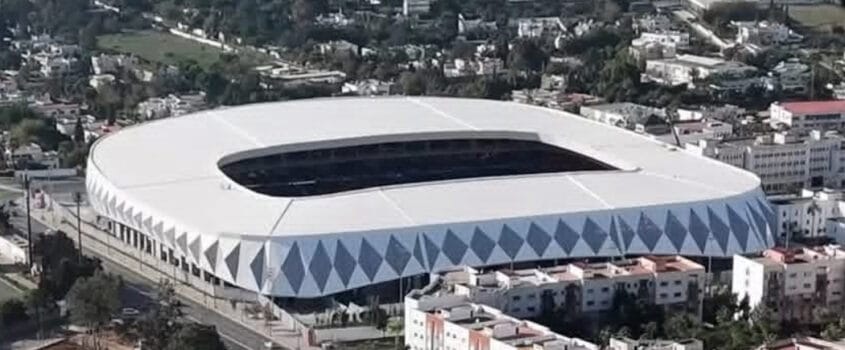
The Prince Moulay El Hassan Stadium is emerging as a true urban stadium, fully connected to its surroundings and integrated into the daily life of Morocco’s capital. Conceived as a contemporary expression of Moroccan culture, the stadium combines glazed terracotta, inspired by ancestral craftsmanship, with advanced modern engineering to create an iconic silhouette on Rabat’s skyline.
Built on the historic site of FUS Rabat, the stadium will offer a capacity of 22,000 seats with no athletics track, bringing spectators closer to the pitch. The surrounding sports facilities are being reorganized to improve overall site flow and coherence. Located at the intersection of two major avenues, the project breaks with the traditional closed-stadium model. Perimeter walls have been removed and replaced with open façades leading onto landscaped public squares that host ticketing areas, shops, and food outlets.
The pitch is set below ground level, allowing the lower tier to blend naturally into the site’s topography. From the forecourts, spectators enter directly into a wide circular concourse offering panoramic views of the field. The arena itself adopts an oval form, carefully inserted into a rectangular volume aligned with Rabat’s urban grid.
Architecture, Sustainability, and AFCON 2025 Matches
The stadium’s outer skin, made of glazed terracotta modules inspired by Berber motifs, serves both aesthetic and environmental purposes. Perforated at upper levels, it promotes natural ventilation, reduces heat accumulation, and reflects daylight. Its slightly luminous white tone enhances thermal comfort while giving the building a refined visual identity.
The roof provides a transition between the rectangular outer shell and the oval bowl. Supported by a suspended radial steel structure, it is covered with wooden panels and photovoltaic membranes, contributing to energy production and thermal regulation. Rainwater collected from the roof is reused for pitch irrigation, reinforcing the stadium’s sustainable design.
Spread across five levels, the stadium includes VIP boxes, official stands, panoramic lounges, media facilities, and command areas. Carefully planned access routes ensure smooth crowd management on matchdays and efficient use throughout the week.
During AFCON 2025, Prince Moulay El Hassan Stadium will host several key fixtures:
| Date | Match | Group / Stage | Kick-off |
| December 24 | Algeria vs Sudan | Group E | 16:00 |
| December 28 | Algeria vs Burkina Faso | Group E | 18:30 |
| December 31 | Equatorial Guinea vs Algeria | Group E | 17:00 |
| January 6 | Group E Winner vs Group D Runner-up | Round of 16 | 17:00 |
With its bold architecture, urban openness, and sustainable approach, Prince Moulay El Hassan Stadium is set to become one of Rabat’s most emblematic sporting landmarks and a central stage of AFCON 2025.
Related: