
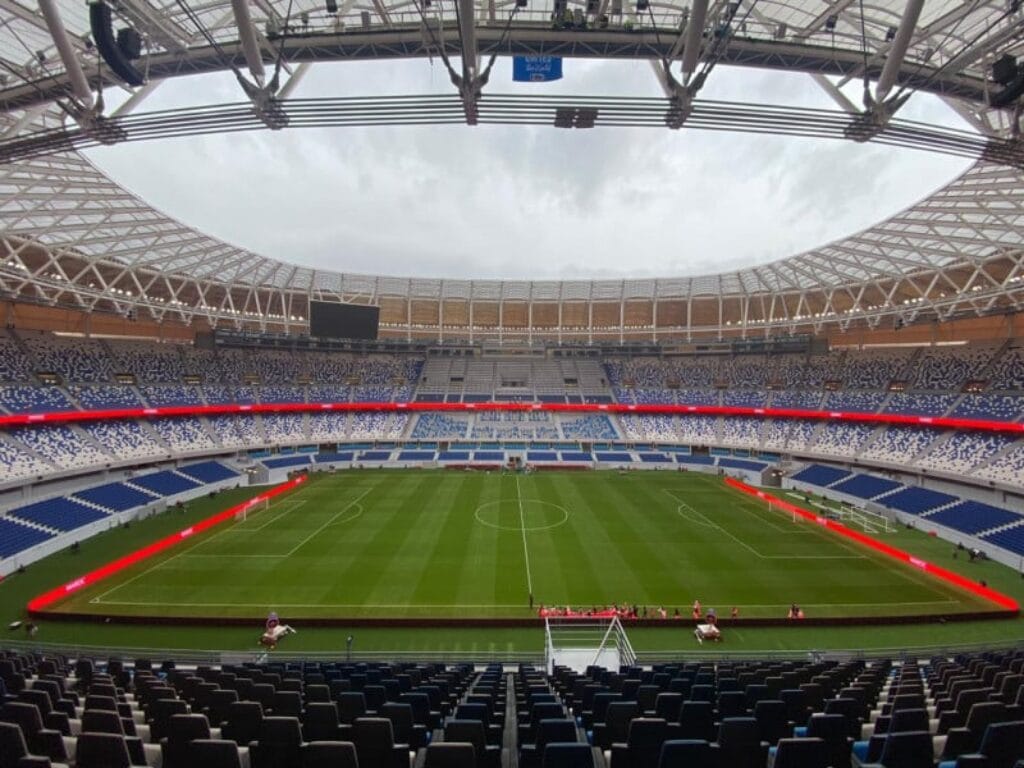
Tangier Grand Stadium Renovation – FIFA 2030 World Cup Ready. Photo Credit: SNRTNews
Several European sports media outlets have recently highlighted the impressive quality of the stadiums prepared by Morocco for the Africa Cup of Nations 2025, drawing direct comparisons with Spanish infrastructure and sparking debate ahead of the 2030 FIFA World Cup.
According to European reports, Morocco’s rapid progress in sports infrastructure is beginning to generate concern in Spain, its co-host alongside Portugal for the 2030 World Cup.
AFCON 2025 as a Strategic Showcase
AFCON 2025 in Morocco is more than a continental football celebration. While Moroccan fans hope to see the Atlas Lions go deep into the tournament, the event also serves as a strategic rehearsal for the much larger challenge of hosting the 2030 World Cup.
Despite a 1–1 draw against Mali in the group stage, Achraf Hakimi and his teammates remain among the favorites to lift the continental trophy. Yet Morocco’s ambitions clearly go beyond sporting results, with broader geopolitical and strategic objectives firmly in sight.
Spain Watching Closely
European outlet Foot Mercato noted that the quality of Morocco’s sports infrastructure has started to raise doubts within Spain, which had long been confident of hosting the biggest matches of the 2030 World Cup, including the final.
While Spain is currently expected to provide 11 stadiums for the tournament, compared to six for Morocco and three for Portugal, the final allocation — particularly for marquee matches — has not yet been officially decided.
Morocco Enters the Race for the Final
In Spain, hopes remain high that the World Cup final will be played at Madrid’s Santiago Bernabéu. However, Morocco is emerging as a serious contender with the ambitious Hassan II Stadium project in Casablanca.
The future venue is expected to have a seating capacity of 115,000 spectators, positioning it as the largest football stadium in the world and a strong candidate to host the tournament’s biggest fixtures.
Spanish Voices Praise Moroccan Infrastructure
Spanish coach Pepe Mel, current head coach of Ittihad Tangier, acknowledged Morocco’s rapid progress in an interview with Cadena SER.
“The stadiums being built in Morocco are just as good as those in Spain,” Mel said. “There is serious work being done to match Spanish infrastructure. The 2030 World Cup is a golden objective for them. They are renovating all stadiums, and some were already modern. Just weeks ago, the Moroccan national team inaugurated the new Tangier stadium.”
Spanish newspaper Marca also visited the Hassan II Stadium construction site, describing it as a venue with unprecedented technological development in Africa and a true engineering giant in world football.
Journalist Álvaro Benito echoed this sentiment, stating: “This proves that Africa is capable of hosting major global events. Morocco is fighting to host big matches and is giving everything it has.”
Healthy Competition Ahead of 2030
While these messages have clearly reached Spanish authorities, Spain remains a country with world-class stadiums, extensive experience in hosting global events, and a highly developed tourism infrastructure.
Nevertheless, AFCON 2025 is reinforcing Morocco’s position as a credible and ambitious co-host for the 2030 World Cup, capable of competing at the highest organizational and infrastructural level.