
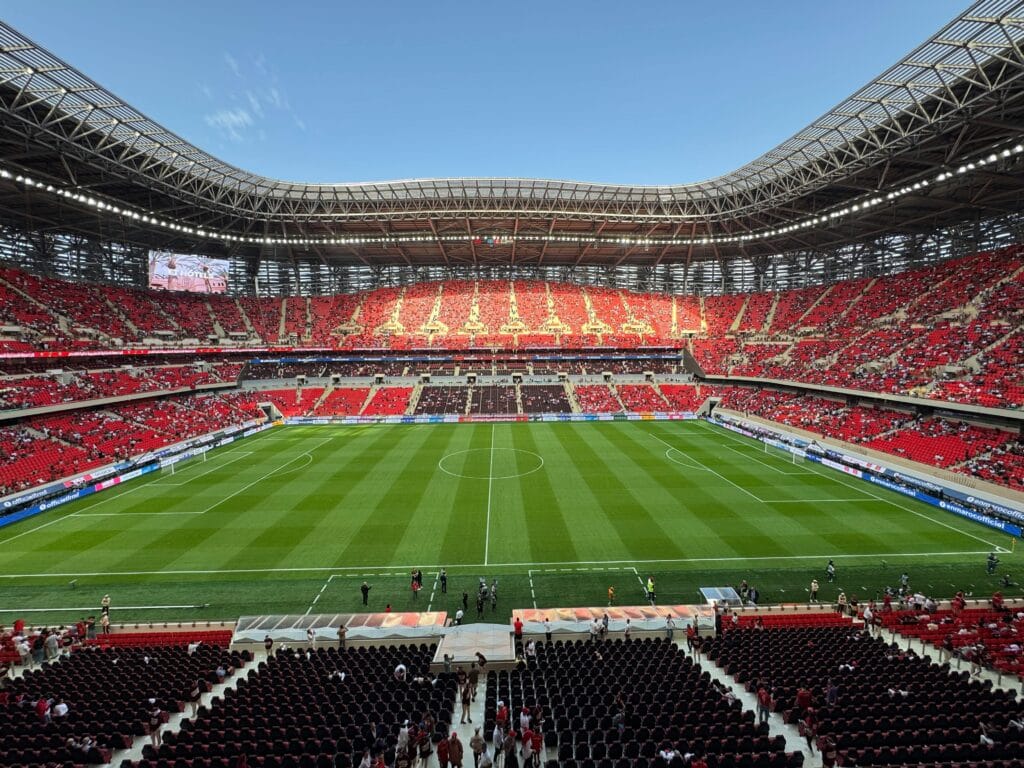
Complexe Sportif Prince Moulay Abdellah (Rabat).Photo Credit: Earth Photart / Pexels
Morocco has prepared nine international-standard stadiums for AFCON 2025.
As AFCON 2025 approaches, Morocco is delivering one of the most ambitious organizational projects in the tournament’s history. From stadium infrastructure to logistics and accommodation, the host nation is aiming for an elite, efficient, and sustainable competition.
The objective is clear: provide African teams with world-class conditions while ensuring long-term urban and sporting impact.
Nine international-standard stadiums in record time
In less than three years, Morocco has prepared nine stadiums meeting CAF and FIFA standards. The strategy focuses on compact competition zones, reduced travel time, and optimized training-to-match logistics.
This approach limits player fatigue and supports high-intensity football throughout the tournament. A detailed overview of all venues is available in our complete guide to AFCON 2025 stadiums in Morocco.
All venues feature modern hybrid pitches, upgraded security systems, covered stands, enhanced VIP areas, and advanced broadcast technology.
Rabat emerges as the strategic heart of AFCON 2025
As the capital of Morocco, Rabat plays a central role in the tournament. Its international airport, proximity to Casablanca, modern rail and road networks, and growing hotel capacity make it a natural logistical hub.
The city will rely on four stadiums: Prince Moulay Abdellah Sports Complex, Prince Héritier Moulay El Hassan Stadium, Al Barid Stadium, and the Olympic Stadium of Rabat. For visitors and supporters, our Rabat travel guide for AFCON 2025 covers transport, accommodation, and matchday tips.
The Prince Moulay Abdellah Sports Complex, rebuilt almost entirely on the site of the historic 1983 stadium, now holds 68,000 seats. Inaugurated on September 4, 2025, it will host the opening match on December 21 and the final on January 18, 2026.
Nearby, the Olympic Stadium of Rabat offers 21,000 seats and will host group-stage and round-of-16 matches, helping balance the tournament schedule.
Host cities across Morocco ready for a continental showcase
Beyond Rabat, all host cities have upgraded their facilities to international standards.
The Grand Stadium of Tangier has been expanded to 75,600 seats, becoming one of Africa’s largest venues. The city’s strategic location and connectivity are detailed in our Tangier travel guide for AFCON 2025.
In Agadir, the Grand Stadium has completed its first renovation phase and will host group and knockout matches. Marrakech’s Grand Stadium combines capacity, comfort, and medical facilities, supported by an annex stadium and a modern media center. Visitors can prepare their stay using our Marrakech travel guide for AFCON 2025.
In Fes, the Sports Complex blends Moroccan architectural identity with modern infrastructure. Casablanca’s iconic Mohammed V Complex will host eight matches and remains one of African football’s most symbolic venues. Discover our Fez Travel Guide for AFCON 2025
All teams housed in five-star hotels, a first in AFCON history
AFCON 2025 also marks a historic first in accommodation standards. All 24 national teams will stay in five-star hotels, reflecting Morocco’s commitment to professionalism and competitive fairness.
Each team will benefit from a dedicated hotel and training facilities, with access to modern gyms, recovery spaces, nutrition services, and medical infrastructure. A full breakdown is available in our article on the hotels hosting all 24 teams during AFCON 2025.
The accommodation budget is estimated at nearly €50 million, supported by partnerships with international hotel brands such as Hyatt and Sofitel.
Transport, airports, and national connectivity
Logistics go beyond stadiums and hotels. Morocco’s airport network plays a key role in managing the expected influx of teams, officials, and supporters.
Major hubs such as Casablanca, Rabat, Marrakech, Tangier, and Agadir have reinforced capacity and operations, as detailed in our analysis of Morocco’s airports and passenger flow for AFCON 2025.
Combined with high-speed rail, tramway systems, and modern highways, this connectivity ensures smooth movement throughout the tournament.
Learning from past mistakes and building for the future
Morocco’s approach reflects lessons learned from previous global tournaments. Unlike cases in Brazil or South Africa, all Moroccan stadiums already have resident clubs and strong local demand.
Venues are located within or near major urban centers, ensuring year-round use and long-term sustainability beyond AFCON 2025.
AFCON 2025 will be more than a football tournament. It will demonstrate Morocco’s ability to deliver a major continental event with efficiency, fairness, and long-term vision, reinforcing its position as a leading host nation for African and global football.