*Photo Credits: frmf.ma
The 2030 FIFA World Cup is already set to be historic. For the first time, it will be co-hosted across six nations and three continents: Morocco, Spain, and Portugal will stage the majority of matches, while Uruguay, Argentina, and Paraguay will host the opening games to honor the tournament’s 100-year anniversary.
But now another idea is on the table, one that could make the centenary edition even bigger. According to reports from Reuters and The Guardian, FIFA has begun internal discussions about expanding the 2030 World Cup to 64 teams instead of 48.
While the proposal is far from confirmed, it has sparked intense debate. For Morocco, which is preparing for its most important football moment in history, the possibility of hosting part of a 64-nation tournament comes with both exciting opportunities and serious challenges.
How the Proposal Emerged
The idea of a 64-team World Cup was raised earlier this year during a FIFA Council meeting. As Reuters reported, Uruguay’s delegate suggested that the centenary edition deserved an expanded format to reflect the tournament’s global importance. FIFA’s official response was cautious, saying it had a duty to “analyze any proposal,” but stressing that nothing had been decided. (Reuters)
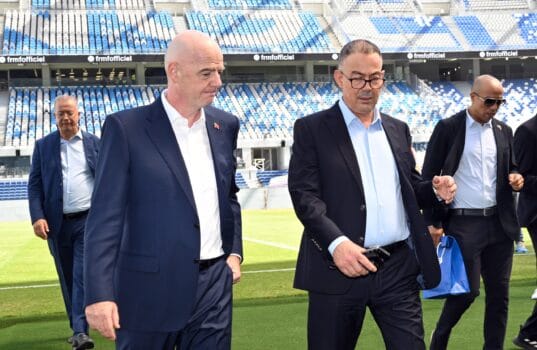
Later in the year, The Guardian revealed that FIFA President Gianni Infantino met with South American football leaders in New York to discuss the idea. At that meeting, CONMEBOL officials pressed for a 64-team format, but many FIFA insiders reportedly expressed skepticism, warning that “such an expansion could damage the quality and prestige of the World Cup.” (The Guardian)
So while the proposal is not dead, it is far from guaranteed. The question is: if FIFA were to approve it, what would it mean for Morocco as one of the tournament’s central hosts?
Opportunities for Morocco and Africa
For Morocco, a 64-team World Cup could be a once-in-a-lifetime chance to showcase itself on an even bigger stage.
More Matches, More Cities
With 64 teams, the total number of games would increase significantly, possibly to 128 matches compared to the 104 expected under the 48-team format. That means Morocco could host more matches across more stadiums, giving cities like Rabat, Marrakech, Agadir, Fès, Tangier, and Casablanca additional global exposure.
Tourism Boom
Every additional team brings its players, staff, and supporters. An expanded World Cup would attract tens of thousands more fans to Morocco, filling hotels, restaurants, and tourist attractions. For a country that already sees football as a driver of tourism, this could be a huge economic windfall.
Stronger African Representation
For decades, African nations have argued that they deserve more places at the World Cup. A 64-team format would almost certainly give Africa extra slots, which could mean 10 or more African teams at the tournament. This would be a powerful moment for the continent, with Morocco at the heart of it as co-host.
Soft Power and Legacy
An expanded World Cup would reinforce Morocco’s global profile, strengthening its role not just as a host nation but as a cultural and sporting bridge between Africa and Europe. It would leave behind upgraded stadiums, better transport networks, and new tourism infrastructure.
The Risks and Challenges
But with big opportunities come big challenges.
Quality of Competition
One of the strongest criticisms, as reported by The Guardian, is that 64 teams could dilute the tournament’s quality. While inclusivity is appealing, it risks creating one-sided matches in the group stage, where top teams might dominate less experienced nations. For fans, the magic of the World Cup lies in its balance of competitiveness and surprise, something that could be lost if the gap between teams becomes too wide.
Tournament Length and Calendar Pressure
Adding more teams means more matches. Unless FIFA shortens the format in other ways, this could extend the World Cup’s length or make scheduling extremely tight. With domestic leagues, continental cups, and player welfare already under pressure, fitting 128 matches into one tournament is a serious challenge.
Infrastructure and Logistics
Morocco is already investing heavily in stadium upgrades and transportation systems for both AFCON 2025 and the 2030 World Cup. Expanding to 64 teams would raise the bar even higher: more stadiums in use, more training facilities needed, more fans to accommodate. While Spain and Portugal can share some of the load, Morocco would still face enormous logistical demands.
Financial Burden vs. Revenue
Yes, more teams mean more tickets sold and potentially higher broadcast revenues. But they also mean higher costs: from security to transport to hospitality. Morocco, as a developing economy compared to its European co-hosts, would need to balance ambition with financial reality.
Why 2030 Is Different
Supporters of the proposal argue that the 2030 World Cup should not be seen as an ordinary tournament. It is the centenary edition, marking 100 years since the first World Cup in Uruguay in 1930.
Expanding to 64 teams, they say, would symbolize the growth of the game and give more nations, especially from Africa and Asia, the chance to participate in football’s most iconic event. It would also fit the idea of a “festival of world football,” stretched across continents and cultures.
Opponents counter that the World Cup’s prestige comes from its difficulty: only the best qualify, and every match feels special. Expanding too far risks turning it into just another oversized tournament.
What It Means for Morocco’s Preparation
Regardless of whether the World Cup has 48 or 64 teams, Morocco has already embarked on an ambitious preparation program.
- Stadiums: Rabat’s Prince Moulay Abdellah, Casablanca’s planned Grand Stade, Marrakech, Agadir, Tangier, and Fès are all being renovated or expanded to meet FIFA standards.
- Transport: High-speed rail links, airport upgrades, and road expansions are underway to handle the expected influx of fans.
- Tourism Infrastructure: Morocco is positioning itself as a football and cultural destination, with the World Cup as the crown jewel in its strategy.
If FIFA approves a 64-team format, Morocco will need to scale up even further. But for a country that has bid multiple times and waited decades to host, the opportunity could be worth the challenge.
Will It Really Happen?
So, will the 2030 World Cup actually expand to 64 teams?
Right now, the answer is uncertain. Reuters reports that FIFA has not committed to any change, and The Guardian notes that insiders remain skeptical. What seems most likely is that FIFA will study the idea as a one-off centenary experiment but stop short of adopting it unless there is widespread support.
Still, the fact that it is being discussed shows how much is at stake. For Morocco, keeping an eye on these developments is essential — because if the decision is made, the Kingdom’s role in football history could become even bigger.
A Bigger Stage, A Bigger Test
The proposal to expand the 2030 World Cup to 64 teams is more than a numbers game. It’s about what kind of tournament FIFA wants the centenary edition to be, a compact celebration of tradition or a massive festival of inclusivity.
For Morocco, the stakes are high. An expanded format could bring unprecedented tourism, global visibility, and African representation. But it could also stretch infrastructure, budgets, and the competitive spirit of the World Cup.
Whether or not FIFA approves the proposal, Morocco’s journey as co-host of the 2030 World Cup is already historic. If the expansion does happen, the Kingdom will find itself not only a co-host but also a central player in the biggest World Cup ever staged.
Related: