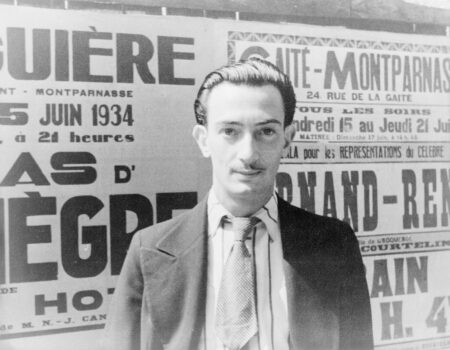
Image credit: Library of Congress / Wikimedia Commons
In the heart of Rabat, within the Andalusian gardens of the National Jewelry Museum, an unexpected artistic dialogue has taken shape, one that bridges Moroccan heritage and European avant-garde art. The exhibition “Dalí Dyali: The Fabric of Dreams” brings together the surreal universe of Salvador Dalí and the timeless elegance of the Moroccan caftan, reimagined through the creative vision of Moroccan designer Zohour Raiss.
This encounter is not a simple fusion of fashion and art. It is a carefully constructed conversation between two worlds: one rooted in centuries-old craftsmanship, the other driven by the imagination and symbolic excess of surrealism.
A Surrealist Lens on a Moroccan Icon
Drawing inspiration from Dalí’s sculptures and visual language, Zohour Raiss translates surrealist motifs into caftans that remain faithful to their Moroccan structure. The silhouettes respect the traditional architecture of the caftan, while the designs venture into dreamlike territories—where reality bends, forms dissolve, and symbolism takes precedence over strict representation.
The result is a collection that does not imitate Dalí, but rather interprets him. Surrealism here becomes a visual vocabulary, woven into fabric, embroidery, and form, without erasing the caftan’s cultural DNA.
Fashion as Cultural and Artistic Expression
Speaking on the sidelines of the exhibition opening at Kasbah of the Udayas, Fatima Zahra Khalifi, curator of the National Jewelry Museum, explained that the exhibition opens a genuine dialogue between the Moroccan caftan and Dalí’s artistic universe.
According to the curator, the exhibition adopts a transversal approach to clothing, treating dress not merely as a functional object, but as a cultural subject and a medium of artistic expression. By stripping the caftan of its purely utilitarian role, it is presented as a symbolic and visual language, capable of carrying meaning, abstraction, and artistic intention.
This approach highlights the interactions between art, craftsmanship, and contemporary creativity, offering new ways to read shapes, materials, and symbols traditionally associated with the caftan.
The Caftan as Living Heritage
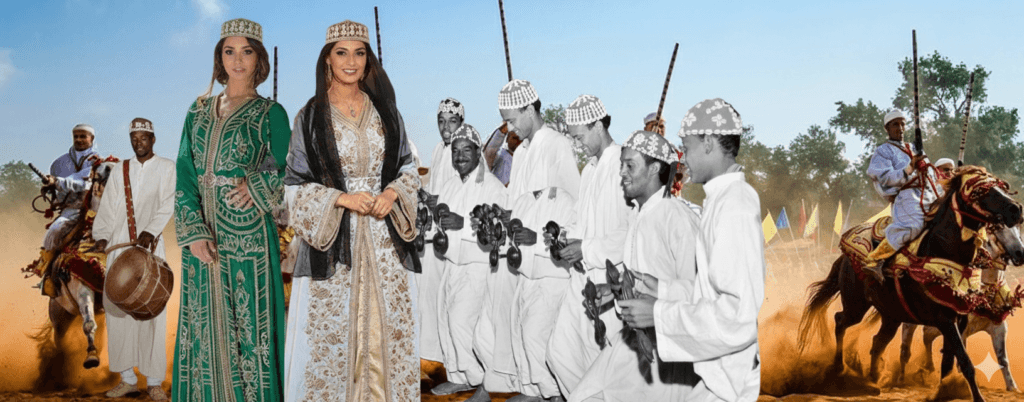
At the core of the exhibition lies a strong affirmation: the Moroccan caftan is not a static relic. It is a living heritage born from deep-rooted artisanal traditions shaped across diverse historical and geographical contexts. Its making relies on specialized techniques of textile treatment, embroidery, and ornamentation—skills passed down through generations.
Yet, as the exhibition demonstrates, the caftan’s historical continuity is largely due to its remarkable ability to adapt. By integrating aesthetic and formal transformations without breaking with its technical and symbolic foundations, the caftan has remained relevant across centuries.
Between Memory and Modernity
While reinterpreted through a surrealist lens, the caftan does not lose its social and cultural functions. It remains closely tied to Moroccan social and ceremonial life, accompanying key moments in family and collective celebrations. As such, it continues to play a representative role, contributing to the construction and transmission of Moroccan cultural identity.
The exhibition underlines that innovation does not negate tradition. On the contrary, drawing inspiration from other artistic imaginaries, such as Dalí’s surrealism, reinforces the caftan’s capacity to evolve while remaining deeply anchored in collective memory.
International Recognition and Contemporary Relevance
The exhibition also recalls the international recognition of the Moroccan caftan, notably its inclusion on UNESCO’s Representative List of the Intangible Cultural Heritage of Humanity. This recognition consecrates a dynamic process based on transmission, reinvention, and innovation, and affirms the caftan’s status as a living heritage shaped by both memory and contemporary practices.
By placing the caftan in dialogue with surrealism, “Dalí Dyali: The Fabric of Dreams” offers more than an exhibition, it proposes a new way of seeing Moroccan heritage. One where tradition is not frozen in time, but constantly reimagined through creative encounters that expand its meaning and global resonance.
In doing so, the Moroccan caftan emerges not only as a garment, but as a canvasca, pable of absorbing dreams, art, and imagination, while continuing to tell a deeply Moroccan story.
Related: