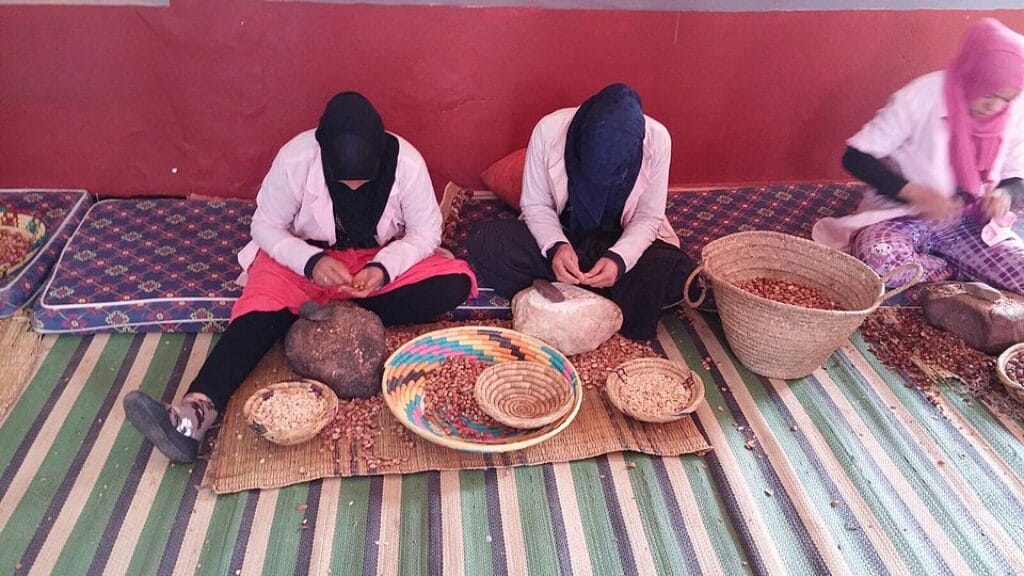
Moroccan Argan oil workers. Photo credit: Orlysi On Wikimedia.org
Agadir is once again placing one of Morocco’s most powerful natural symbols in the spotlight. The fourth edition of the International Argan Tree Fair, running in the city until January 16, highlights the argan tree as a pillar of Morocco’s natural, cultural and economic heritage.
Recognized by UNESCO both as a biosphere reserve and as part of the world’s intangible cultural heritage, the argan ecosystem stands at the crossroads of environmental preservation, rural development and cultural identity. This event fits within the momentum generated by Morocco’s national strategies Generation Green 2020–2030 and Forests of Morocco 2030.
These long-term roadmaps have already delivered tangible results. More than 246,000 hectares of historical argan forest have been rehabilitated, while an additional 10,000 hectares have been planted across the Souss-Massa, Marrakech-Safi and Guelmim-Oued Noun regions. The approach is based on an innovative model of climate-resilient arganiculture designed to protect ecosystems while strengthening local economies.
Organized under the supervision of the Ministry of Agriculture, Maritime Fisheries, Rural Development, Water and Forests, in partnership with the National Agency for the Development of Oasis Zones and the Argan Tree (ANDZOA), the fair celebrates an emblematic tree deeply rooted in Morocco’s history.
Beyond its environmental importance, the argan tree plays a vital social role. It is a cornerstone of economic empowerment for rural communities, particularly women, whose cooperatives have transformed traditional know-how into a driver of financial independence and social inclusion.
The International Argan Tree Fair also serves as a major professional platform. More than 200 exhibitors present argan oil in both its culinary and cosmetic uses, alongside a wide range of artisanal creations sourced from the biosphere reserve. The event offers producers, cooperatives and entrepreneurs valuable opportunities to build partnerships and expand professional networks.
This year’s edition carries a strong continental dimension, with nearly 20 African countries participating through dedicated stands. The fair has become a space for dialogue and cultural exchange, celebrating Africa’s diversity while positioning the argan tree as a shared symbol of resilience and heritage.
Held under the theme “The Argan Tree, a Symbol of Resilience and Adaptation, a Bridge for African Communication”, the event aims to establish Morocco’s argan forest as a reference model for sustainable development in Africa—one that balances ecosystem preservation, women’s empowerment and inclusive economic value creation.
Speaking to the Moroccan Press Agency (MAP), Hou Dahbi, head of statistics, studies and monitoring at ANDZOA, emphasized that the fair also contributes to Agadir’s cultural and economic vitality during the Africa Cup of Nations 2025, with the city serving as one of the tournament’s host venues.
Beyond exhibition stands, visitors can enjoy an immersive program featuring live demonstrations of traditional crafts such as pottery, jewelry making and weaving, as well as culinary show-cooking sessions and family-friendly activities for children.
In Agadir, the argan tree is more than a natural resource. It is a living legacy—one that continues to connect heritage, sustainability and innovation at the heart of Morocco’s development vision.