*Photo Credit: MAP
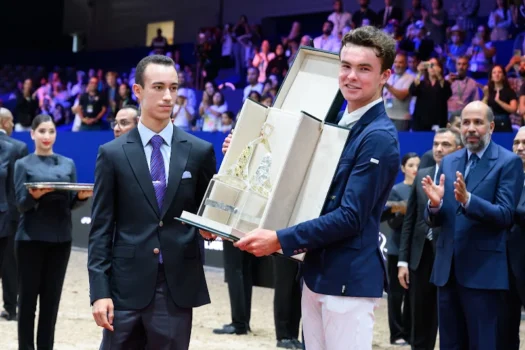
At the Mohammed VI Exhibition Center in El Jadida, Crown Prince Moulay El Hassan recently presented the Mohammed VI Grand Prix in show jumping, closing the four-star international competition that crowned the 14th edition of Morocco’s national league.
For most spectators, it was a graceful royal appearance. But for those who look deeper, the gesture represented something larger, a visible link between Morocco’s ancient equestrian culture and its modern ambitions in international sport.
A Royal Legacy in Motion
Equestrianism in Morocco has always been more than sport. Horses have long symbolized dignity, power, and continuity in Moroccan culture. From the traditional fantasia displays of the plains to the precision of modern show jumping arenas, the horse remains a national icon.
By attending and awarding the Grand Prix, the Crown Prince carried forward a royal tradition that dates back centuries. The Moroccan monarchy has continuously supported the breeding, training, and showcasing of horses as a cultural duty as much as a leisure pursuit.
The presence of the young heir therefore resonates with symbolism, not only confirming the royal family’s ongoing support but also connecting Morocco’s future leadership with its living heritage.
Modern Morocco, Classical Roots
The Mohammed VI Grand Prix forms part of the annual Salon du Cheval d’El Jadida, a festival celebrating Morocco’s equestrian excellence. The event blends sport, art, and commerce, where breeders, riders, and spectators meet under one roof.
This blend of tradition and modernization mirrors Morocco’s broader identity: a country that respects heritage yet moves confidently toward innovation. The Crown Prince’s participation fits this narrative perfectly. It shows that Morocco’s equestrian future is both technically modern and deeply Moroccan.
The country now hosts multiple international competitions recognized by the Fédération Équestre Internationale (FEI). Each event reinforces Morocco’s image as a professional and passionate host capable of meeting global standards without losing cultural authenticity.
Symbolism Beyond the Arena
When Moulay El Hassan stepped into the arena to present the trophy, the image itself spoke volumes. It projected stability, continuity, and ambition. Values that Morocco has long cultivated through sport. The monarchy’s support turns equestrianism into a form of soft power: a way to show the world that Morocco’s elegance extends from architecture and music to sport and hospitality.
It also highlights how Morocco blends royal symbolism with practical national goals. Equestrian events generate tourism, attract sponsorship, and create jobs for trainers, vets, and breeders. By nurturing the sector, Morocco invests not just in culture but in an entire ecosystem of rural and urban opportunity.
More Than a Trophy
The Mohammed VI Grand Prix is therefore not simply a competition. It is a mirror of Morocco’s ability to balance refinement with relevance. The riders who compete here represent years of training and dedication; the royal presence adds gravity and national meaning.
As Morocco prepares for other global events, including AFCON 2025 and the 2030 FIFA World Cup, this royal gesture fits within a consistent pattern: positioning sport as a pillar of identity, diplomacy, and development.
Crown Prince Moulay El Hassan’s elegant act of handing the trophy was, in essence, a message, that Morocco’s strength lies not just in hosting events but in embodying them with purpose, beauty, and heritage.
Related: