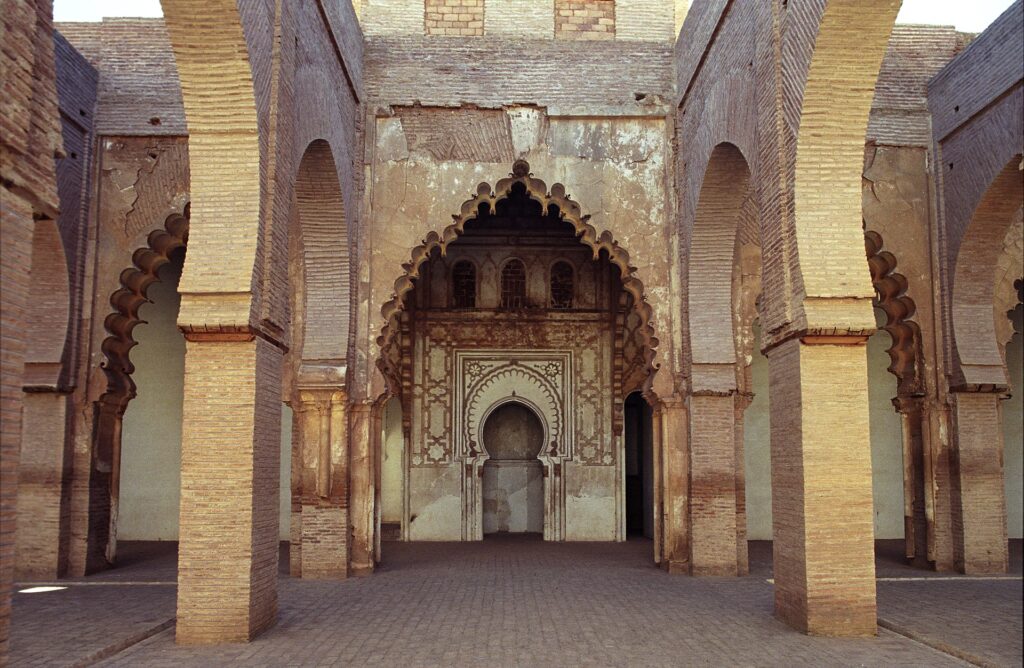
Tinmel Mosque, High Atlas, Morocco. Image Credit: https://commons.wikimedia.org/wiki/User:Jerzystrzelecki
Tinmel Mosque is one of Morocco’s most fascinating yet lesser-known historical treasures. Hidden in the breathtaking landscapes of the High Atlas Mountains, this 12th-century religious monument stands as a powerful reminder of the rise of the Almohad Empire. Located around 100 km south of Marrakech in the province of Al Haouz, the mosque combines deep spiritual history, remarkable architecture, and dramatic mountain scenery.
Although centuries of abandonment once threatened its survival, the mosque has endured the passage of time. Restored in 1991 with support from the ONA Foundation, Tinmel Mosque is today considered a remarkable example of Almohad architecture and a rare Islamic monument in Morocco that is open to non-Muslim visitors.
A Historic Almohad Monument in the High Atlas
Tinmel Mosque dates back to the 12th century during the powerful Almohad dynasty. The monument was constructed around 1153–1154 under the rule of Sultan Abd al-Mu’min, successor of the Almohad founder Mohammed Ibn Tumart.
For centuries, the mosque remained hidden in the mountains, surrounded by traditional Berber villages and rugged valleys. Despite periods of abandonment, its stone walls and earth-based mortar structure survived the harsh mountain climate.
In 1995, Tinmel Mosque was added to the UNESCO Tentative World Heritage List, highlighting its exceptional cultural and historical significance.
Architecture: A Masterpiece of Hispano-Maghrebi Islamic Art
The architectural style of Tinmel Mosque reflects the refined simplicity of Almohad architecture, closely related to iconic monuments such as:
- The Koutoubia Mosque in Marrakech
- The Hassan Tower in Rabat
- The Giralda in Seville
Constructed primarily from brick, stone, lime, and earth mortar, the mosque displays the characteristic ochre tones of the High Atlas landscape.
The structure forms a rectangular layout measuring approximately 48 meters by 43 meters. Inside, the prayer hall is organized into several naves aligned toward Mecca. Although parts of the cedar wood ceiling have disappeared, some fragments still remain, offering a glimpse of the mosque’s former grandeur.
The mihrab, which indicates the direction of prayer, has been carefully restored. Visitors can admire elegant arches, floral capitals, and geometric decorations typical of Islamic art during the Almohad period.
A Spectacular Journey Through the High Atlas
Visiting Tinmel Mosque is not only a historical experience but also an unforgettable journey through Morocco’s stunning mountain landscapes.
Travelers typically reach Tinmel by driving along the famous Tizi n’Test mountain pass, one of the most scenic roads in Morocco. The route winds through dramatic valleys, traditional villages, and rugged mountain slopes.
Suddenly, as the road climbs higher, the historic village of Tinmel appears. Just 50 meters from the village center, the mosque rises on a hill at an altitude of around 1,230 meters.
The open-sky prayer hall creates a mystical atmosphere. Sunlight flows through the arches, illuminating the ancient stone walls while birds nest within the structure, including colorful European Rollers.
This unique setting makes Tinmel Mosque one of Morocco’s most atmospheric heritage sites.
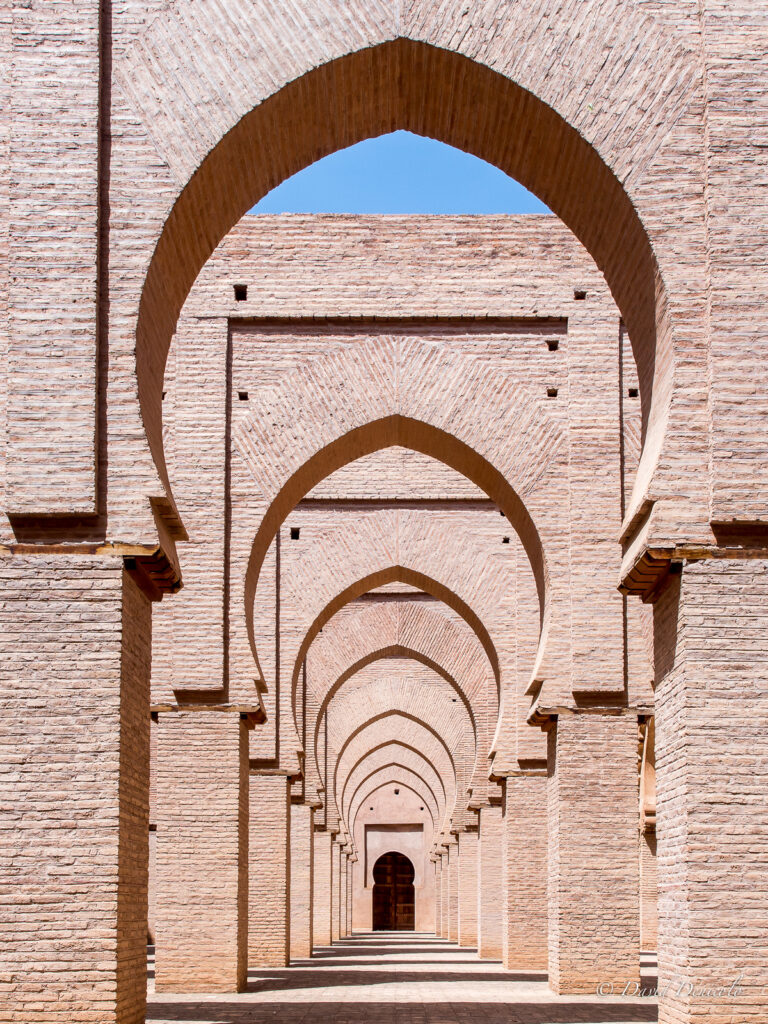
The Door Inside Tinmel Mosque, XII sec, Morocco. Image Credit:https://www.flickr.com/photos/davdenic/
Tinmel: Spiritual Center of the Almohad Empire
The history of Tinmel is inseparable from the story of Mohammed Ibn Tumart, the religious scholar who founded the Almohad movement.
After returning from a pilgrimage to Mecca, Ibn Tumart began preaching reformist religious ideas. He strongly criticized the ruling Almoravid dynasty, which he believed had become corrupt and decadent.
In 1121, Ibn Tumart proclaimed himself the Mahdi, a spiritual leader destined to restore religious purity. His teachings attracted many followers but also made him a threat to the Almoravid rulers.
In 1122, he fled to the remote mountains of the High Atlas and established a stronghold in Tinmel. The village quickly became the headquarters of the Almohad movement, functioning both as a military base and a spiritual center.
Although Ibn Tumart died before achieving his goal of overthrowing the Almoravids, his disciple Abd al-Mu’min succeeded in expanding the Almohad empire. In 1147, he conquered Marrakech and established an empire stretching across North Africa and into Andalusia.
Throughout this vast empire, Tinmel remained the symbolic heart of Almohad power.
FAQ: Tinmel Mosque
Where is Tinmel Mosque located?
Tinmel Mosque is located in the High Atlas Mountains in the Al Haouz province of Morocco, about 100 km south of Marrakech along the Tizi n’Test road.
Why is Tinmel Mosque historically important?
The mosque was built during the Almohad dynasty and served as the spiritual center of the movement that eventually created one of the most powerful empires in North Africa and Andalusia.
Can non-Muslims visit Tinmel Mosque?
Yes. Tinmel Mosque is one of the rare historical mosques in Morocco that has been open to non-Muslim visitors, allowing travelers to explore its architecture and history.
Is Tinmel Mosque a UNESCO World Heritage Site?
The mosque has been included on UNESCO’s Tentative List since 1995 due to its historical and architectural importance.
What makes Tinmel Mosque unique?
Its remote mountain location, Almohad architectural style, and its role in the founding of the Almohad Empire make Tinmel Mosque one of Morocco’s most fascinating historical sites.