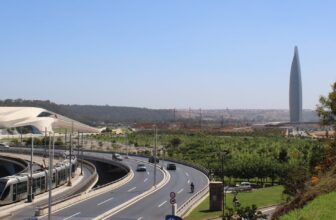
Photo by Earth Photart via Pexels
Morocco is executing one of the most ambitious infrastructure programs in its modern history as it prepares to co-host the FIFA World Cup 2030 alongside Spain and Portugal. The national strategy extends far beyond sports venues. It integrates transport networks, airports, renewable energy systems, logistics hubs, and large urban redevelopment projects that support Morocco’s long-term development vision.
The scale of the transformation reflects Morocco’s broader economic strategy. Major investments across rail, aviation, highways, stadiums, and tourism infrastructure aim to strengthen national connectivity while positioning the country as a major gateway between Europe, Africa, and the Atlantic world. These initiatives form part of a coordinated development agenda aligned with Morocco’s Vision 2030 and its ambition to host major global events.
Several infrastructure agencies lead this transformation, including the National Railway Office, the National Airports Office, regional development authorities, and the Ministry of Equipment and Water. Together they are executing a multi-sector program valued at tens of billions of dollars that will reshape Morocco’s economic geography before the 2030 tournament.
Morocco’s Infrastructure Strategy Behind the 2030 World Cup
The 2030 World Cup provides a catalyst for investments that Morocco has already prioritized in its national development strategy. Transport modernization, logistics expansion, and tourism infrastructure upgrades all form part of a long-term vision that extends beyond the tournament itself.
Government officials created a dedicated coordination framework called “Morocco 2030” to accelerate the delivery of strategic projects linked to the tournament. This structure oversees stadium construction, airport expansions, rail upgrades, and urban development programs across several host cities. The goal is to ensure that infrastructure built for the World Cup remains economically useful long after the event concludes. Source
The development program focuses on six main host cities that already play central roles in Morocco’s economic network. Casablanca, Rabat, Tangier, Marrakech, Agadir, and Fez are undergoing large-scale modernization of transport links, tourism capacity, and sports infrastructure to handle the expected flow of international visitors.
Railway Expansion: Building a National High-Speed Network
Kenitra to Marrakech High-Speed Rail Extension
Rail modernization represents one of the most significant components of Morocco’s World Cup infrastructure strategy. The National Railway Office launched a major expansion program valued at approximately 96 billion Moroccan dirhams, equivalent to about 10.3 billion dollars, to expand and modernize the country’s rail network before 2030. Source
The centerpiece of this plan is the extension of the high-speed rail line from Kenitra to Marrakech via Rabat and Casablanca. Once completed, the new 430-kilometer corridor will allow trains to reach speeds of up to 350 kilometers per hour while reducing travel time between Tangier and Marrakech to roughly two hours and forty minutes. This corridor will connect several of Morocco’s main World Cup host cities and significantly improve domestic mobility. Source
In addition to building new infrastructure, the railway program includes large fleet acquisitions. The railway authority signed agreements worth about 29 billion dirhams to purchase 168 new trains from international manufacturers. These include high-speed double-deck trains capable of carrying more than 600 passengers at speeds above 300 kilometers per hour. Source
Long-Term Rail Connectivity Goals
The railway strategy also aligns with Morocco’s longer-term transport objectives. Authorities aim to expand the national rail network to reach 43 cities by 2040, providing rail access to approximately 87 percent of the population. This expansion would transform the rail network into a backbone of national mobility while supporting economic corridors between major industrial and tourism centers. Source
Further feasibility studies are also exploring future extensions toward Agadir and Essaouira, which would strengthen connectivity to Morocco’s southern Atlantic coast and major tourism zones. Source
Readers interested in the broader transformation of Morocco’s rail system can explore Morocco’s railway revolution toward 2030, which examines how these projects fit into the national transport strategy.
Airport Expansion and the “Airports 2030” Aviation Strategy
Morocco’s aviation infrastructure is also undergoing a major upgrade through the national “Airports 2030” program led by the National Airports Office. This initiative focuses on expanding airport capacity, modernizing passenger terminals, and strengthening Morocco’s role as a regional aviation hub.
The government launched an investment program valued at approximately 28 billion dirhams, or about 2.8 billion dollars, aimed at expanding airport infrastructure across the country. Source
Once implemented, the strategy will increase Morocco’s total airport capacity from about 38 million passengers to roughly 80 million passengers annually by 2030. Source
Major upgrades are planned for key airports in Casablanca, Marrakech, Agadir, and Tangier. Casablanca’s Mohammed V International Airport will increase capacity to more than 23 million passengers annually, while Marrakech and Agadir will also expand significantly to support tourism flows during the tournament. Source
Beyond passenger growth, the aviation program aims to strengthen Morocco’s connectivity with Europe, West Africa, and the Middle East while supporting the expansion of Royal Air Maroc’s international network.
Stadium Construction and Sports Infrastructure
Sports infrastructure represents another central component of Morocco’s World Cup preparations. The government has committed significant funding to construct new stadiums and modernize existing facilities across the six host cities.
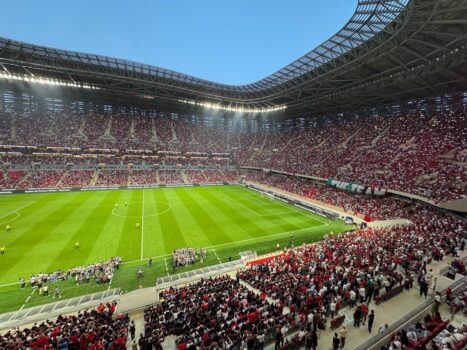
The most ambitious project is the Grand Stade Hassan II near Casablanca, designed to accommodate approximately 115,000 spectators. Once completed, it is expected to become the largest football stadium in the world and a centerpiece venue for the 2030 tournament. Source
Across the country, Morocco is renovating and upgrading multiple stadiums while expanding training facilities and football academies. Overall stadium investments are estimated at around 1.4 billion dollars across several venues. Source
These upgrades also support the Africa Cup of Nations hosted by Morocco in 2025, which serves as a large-scale operational test before the World Cup.
For more insights into how football events are driving national investment, see how AFCON 2025 and World Cup 2030 are fueling Morocco’s construction boom.
Urban Development and Tourism Infrastructure
Hosting the World Cup requires more than stadiums and transport networks. Morocco is also investing heavily in tourism infrastructure, hospitality capacity, and urban development across its main cities.
Plans include the construction of roughly 200 new hotels nationwide, adding approximately 15,000 additional rooms to accommodate the projected increase in visitors during the tournament and the following decade. Source
Urban redevelopment projects in Casablanca, Rabat, Tangier, and Marrakech include improved public transport corridors, pedestrian zones, and tourism infrastructure around historic districts. These initiatives aim to enhance visitor experience while improving daily mobility for residents.
The logistics and hospitality sector also benefits from the expansion of economic zones and logistics platforms that support international trade and tourism flows. These zones strengthen Morocco’s position as a gateway between Europe and Africa.
Why the Infrastructure Program Matters Beyond the World Cup
Although the 2030 World Cup serves as a key deadline for many projects, Morocco’s infrastructure investments follow a broader national strategy focused on long-term economic growth. The country aims to strengthen its position as a logistics hub connecting Europe, West Africa, and the Atlantic economy.
Improved transport connectivity reduces travel times between economic centers while supporting tourism and regional integration. Modern airports strengthen Morocco’s role as a global aviation gateway, while expanded rail networks improve internal mobility and reduce reliance on road transport.
These projects also encourage foreign investment and industrial development by improving logistics reliability and reducing transportation costs across key economic corridors.
According to economic analysts, the World Cup infrastructure program could accelerate Morocco’s modernization by attracting international investment and reinforcing its long-term development trajectory. Source
Conclusion: A Strategic Infrastructure Transformation
The infrastructure projects connected to Morocco’s preparations for the 2030 World Cup represent one of the largest coordinated development programs in the country’s history. Rail expansion, airport modernization, stadium construction, and tourism infrastructure upgrades together form a comprehensive blueprint for national transformation.
While the tournament will last only a few weeks, the infrastructure being built today will shape Morocco’s economic geography for decades. Faster transport networks, expanded tourism capacity, and modern logistics corridors are expected to strengthen the country’s role as a regional hub linking Europe, Africa, and the Atlantic world.
In practice, the World Cup acts as an accelerator for projects already embedded in Morocco’s long-term development strategy. Once completed, this infrastructure network will extend far beyond the needs of football, supporting economic growth, trade integration, and national mobility well into the 2030s.
Sources
Reuters – Morocco launches $10 billion rail expansion plan
Reuters – Morocco to double airport capacity by 2030
Morocco World News – Airports 2030 aviation program
Arab News – Morocco train acquisition program
Hespress – Morocco 2030 coordination institution
The Guardian – Morocco infrastructure and stadium plans
The Arab Weekly – Stadium investment overview
Bladi – Infrastructure investments linked to World Cup 2030
MIPA Institute – Economic implications of hosting the 2030 FIFA World Cup