Photo credit: Wikimedia Commons (CC BY-SA 4.0) (Edited)
As the countdown to the 2026 FIFA World Cup accelerates, attention is turning not only to stadiums and host cities, but also to one of the tournament’s most symbolic elements: the official match ball. Designed by Adidas, the ball for the upcoming World Cup is named Trionda, a model that blends symbolism, design identity, and technical innovation.
Why Is the Ball Called Trionda?
The name Trionda is directly linked to the historic format of the 2026 World Cup, which will be co-hosted by three countries: the United States, Mexico, and Canada. The name reflects the idea of unity and collaboration between the three host nations, marking a first in World Cup history.
This symbolic approach follows Adidas’ long-standing tradition of giving World Cup balls names that reference geography, culture, or the spirit of the host tournament.
Design and Visual Identity
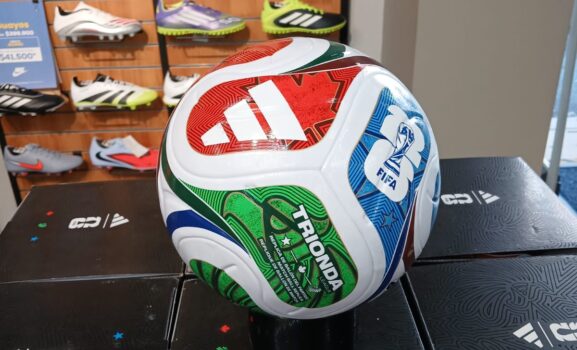
Visually, Trionda features a predominantly white base, allowing its graphic elements to stand out clearly during play and broadcast. The ball is accented with red, green, and blue tones, inspired by the national colors of the three host countries.
Dynamic patterns flow across the surface, designed to evoke movement, speed, and energy, key themes associated with modern football. The clean yet expressive design aligns with Adidas’ recent philosophy of combining minimalism with strong storytelling.
Technical Construction and Performance
From a performance perspective, Trionda adopts a four-panel construction, a design approach reminiscent of the Brazuca ball used at the 2014 World Cup. This structure is intended to enhance aerodynamic stability, improve touch consistency, and offer greater control during high-speed play.
While Adidas has not yet disclosed every technical detail, the ball is expected to incorporate advanced surface texturing and bonded panel technology, continuing the brand’s focus on precision, predictability, and elite-level performance.
More Than a Ball
Beyond its technical role, Trionda represents the identity of the 2026 World Cup itself, multinational, modern, and globally connected. As with past editions, the ball is set to become a cultural icon, featured not only on the pitch but also in fan collections, street football, and global marketing campaigns.
With Trionda, Adidas continues its legacy of turning the World Cup ball into a symbol that captures both the spirit of the tournament and the evolution of the game.
Related: