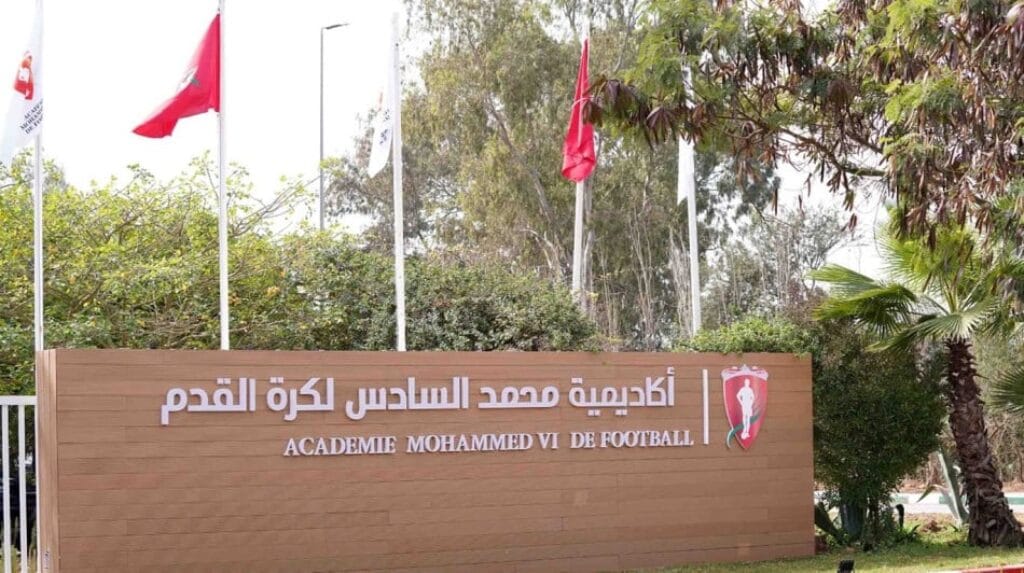
As the host nation of the 2025 Africa Cup of Nations (CAN 2025), Morocco has become the driving force of African football. At the heart of this rise stands a strategic institution: the Mohammed VI Football Academy (AMF), based in Salé. In just a few years, it has become one of the most advanced football academies in Africa and a crucial talent source for Morocco’s national teams.
Inaugurated in 2010 near Rabat, the academy welcomes 121 young players aged 12 to 18 this year. These promising talents are recruited across the entire country, forming a powerful foundation for Morocco’s football ambitions—both for CAN 2025 and the 2030 FIFA World Cup, which Morocco will co-host with Spain and Portugal.
A Life-Changing Opportunity for Young Moroccan Talent
Every year, Tarik El Khazri, head of recruitment at the academy, travels thousands of kilometers throughout Morocco to identify the most promising young players. For many of them, the academy represents a life-changing opportunity.
“When a young player joins the academy, everything is taken care of—food, accommodation, schooling, medical care,” he explains to AFP. Around 90% of the students come from modest or poor families, and the academy is fully funded by King Mohammed VI, who personally supports its operations.
Spread over more than 17 hectares, the AMF features:
- a dozen high-quality football pitches
- professional locker rooms
- modern classrooms
- strength and conditioning rooms
- recreation lounges with games and consoles
- multiple dormitories
- a large refectory
- a three-floor medical center
- a swimming pool
- an on-site mosque
To learn more about the academy’s broader impact, see:
How the Mohammed VI Academy Became Morocco’s Football Powerhouse
Scouting and Development: A Long-Term Strategy
The academy relies on a wide network of local scouting cells that identify young talents from the age of six or seven. They are then developed physically, technically, and mentally over several years.
On an outdoor pitch, players aged 17 and 18 warm up with a classic “toro” drill—two players in the middle trying to intercept the ball from teammates circling around them.
French coach Laurent Cauger, who has been at the academy for seven years, notes that all these young players share one ambition: to succeed in football and transform their lives.
“I’ve seen extremely difficult family situations,” he explains. “When a player manages to build a career in football, it can save an entire family.”
Still, doubts are part of the journey. Cauger recounts the case of Yassir Zabiri, now a Moroccan U20 international and a member of the team that won the U20 World Cup in October—Morocco’s first-ever world title in that age category.
Before his 15th birthday, Zabiri played with older teammates but struggled for playing time and feared he might not be retained. His perseverance ultimately paid off.
An Expanding List of Professional Graduates
According to Tarik El Khazri, the academy has already produced:
- 26 players who became starters in Morocco’s Ligue 1
- around 30 players who currently play in Europe
- at least five potential candidates for the 2026 World Cup and the 2030 World Cup
One of the academy’s brightest success stories is Youssef En-Nesyri, who made his professional debut at 19 thanks to then-national coach Hervé Renard. Today, En-Nesyri plays for Fenerbahçe and remains one of the pillars of Morocco’s historic run to the 2022 World Cup semifinals.
For more on how international media sees this football revolution, read:
Spanish Media: Mohammed VI Academy Behind Morocco’s Football Rise
Balancing Football and Education
The daily routine at the academy is intense and structured. The day begins at 07:00, with classes starting at 08:15, followed by morning training. After lunch, the players return to class before a second training session in the afternoon, then a study hour, and finally dinner.
All students follow the national education curriculum and wear a standardized uniform marked “AMF”.
Education remains essential. As Fetiha, deputy head of the Education Department, explains, “When the national team plays, it’s impossible to keep them focused—they are still very young.”
Despite challenges, academic success remains a top priority. According to director Abderrazak El Rhomari, the academy has maintained a 100% baccalaureate success rate for ten consecutive years.
“Football is a risky career,” he says. “One injury can change everything. But with a diploma, they always have a future.”
A Cornerstone of Morocco’s Football Ambition
As Morocco prepares to host CAN 2025, the Mohammed VI Football Academy stands as a symbol of long-term vision and investment. It is not only shaping the next generation of Moroccan champions but also helping establish the Kingdom as a footballing power in Africa and beyond.