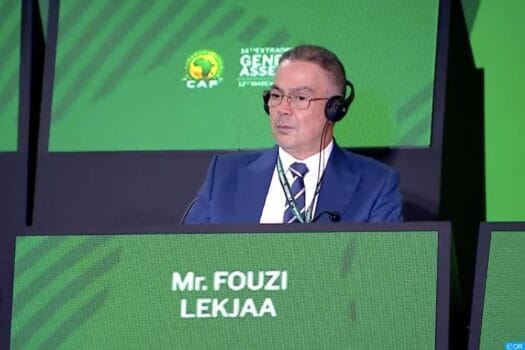
Photo Credit: CAF Media
On October 6, 2025, during the 47th Ordinary General Assembly of the Confederation of African Football (CAF) in Kinshasa, member federations witnessed a remarkable transformation, the institution’s finances have never looked better. At the center of this revival stands Fouzi Lakjaâ, the Moroccan official whose financial leadership has reshaped the future of African football.
A Model of Sound Financial Governance
Since Fouzi Lakjaâ assumed leadership of CAF’s Finance Committee, the organization’s treasury has undergone an impressive turnaround. The latest accounts presented in Kinshasa reveal a record surplus of $39.5 million, a stunning contrast to the deficits of previous years. CAF’s reserves have now reached $312.9 million, compared to only a few tens of millions before Lakjaâ’s reforms.
Revenue Growth and Fiscal Discipline
This success comes from a dual strategy: increased revenues and controlled spending. Sponsorship now accounts for 35% of total income, reflecting the growing interest of international brands in African football. On the spending side, 45% of expenditures were allocated to prize money and 20% to football development across the continent.
A New Era for African Football
CAF’s newly secured financial stability has attracted 16 top-tier sponsors, restoring confidence in the institution. This liquidity has also allowed the increase of prize money for continental competitions. The CAF Champions League winner will now receive $4 million, while from next season, clubs participating in the preliminary rounds of both the Champions League and the Confederation Cup will receive a fixed bonus of $100,000.
Such progress confirms that the reform strategy launched in 2021 continues on a sustainable and upward trajectory. CAF is not only catching up but aligning itself with the global standards of football management.