Estimated reading time: 4 minutes
As the countdown to the FIFA World Cup 2026 enters its final days, artificial intelligence models are offering an intriguing glimpse into Morocco’s potential journey in North America. Based on recent performances, squad depth, player statistics and thousands of tournament simulations, the latest projections suggest that the Atlas Lions could once again be among the tournament’s surprise contenders.
Following a convincing 4-0 victory over Madagascar and a competitive 1-1 draw against Norway, Morocco’s preparations have attracted growing attention from analysts and predictive models. The question now is whether Mohamed Ouahbi’s squad can build on the historic achievements of Qatar 2022 and perhaps challenge for another deep World Cup run.
Why AI Models Are Optimistic About Morocco
The latest simulations incorporate several factors that currently work in Morocco’s favor:
- Recent performances in international friendlies.
- FIFA World Ranking position.
- Squad age profile and depth.
- Defensive and attacking efficiency metrics.
- Historical performance trends.
- Individual player quality.
With Morocco currently ranked among the world’s elite teams and possessing one of the strongest squads in its history, the data suggests the Atlas Lions are entering the tournament in a stronger position than many previous World Cups.
Recent Results Strengthen Morocco’s Outlook
| Match | Result | Key Takeaway |
|---|---|---|
| Morocco vs Madagascar | 4-0 Win | Attacking efficiency |
| Morocco vs Norway | 1-1 Draw | Defensive resilience against European opposition |
The victory over Madagascar showcased Morocco’s offensive variety, with goals coming from multiple attacking players. Meanwhile, the draw against Norway provided valuable evidence that the team can compete physically and tactically against elite European opposition.
Morocco’s Projected Goal Output
One of the most striking findings from the simulations concerns Morocco’s attacking potential.
Unlike the 2022 World Cup team, which relied heavily on defensive organization and counterattacks, the current squad possesses significantly greater attacking depth.
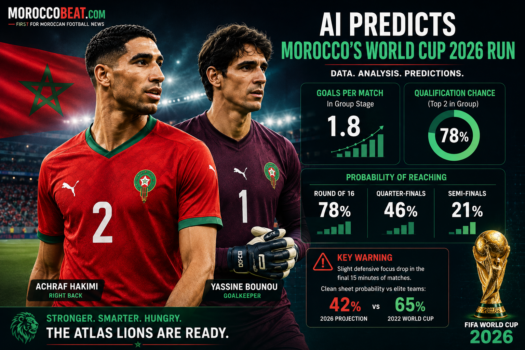
The models project Morocco to average approximately 1.8 goals per match during the group stage.
Average goals scored per match: 1.8
Expected attacking improvement compared to Qatar 2022: Significant
The presence of players such as Brahim Diaz, Ismael Saibari, Soufiane Rahimi, Ayoub El Kaabi and Bilal El Khannouss provides Morocco with multiple ways to break down opponents.
The Importance of Morocco’s Defensive Core
Despite the focus on attacking improvement, Morocco’s defensive foundation remains one of the team’s greatest strengths.
Yassine Bounou continues to provide world-class reliability in goal, while Achraf Hakimi remains one of the most influential full-backs in international football.
The simulations suggest that Morocco’s defensive organization remains strong enough to compete against elite opposition, although some concerns remain regarding concentration levels during the final stages of matches.
The Main Warning Sign Identified by AI
The data highlights one recurring vulnerability: defensive concentration in the final quarter of matches.
This issue was visible during the recent draw against Norway, where Morocco conceded a late equalizer after controlling much of the game.
According to the projections, small lapses in concentration against top-tier opponents could reduce Morocco’s probability of keeping a clean sheet.
| Defensive Metric | Qatar 2022 | 2026 Projection |
|---|---|---|
| Clean Sheet Probability vs Elite Teams | 65% | 42% |
The coaching staff will likely focus on maintaining defensive discipline throughout the full 90 minutes before the tournament begins.
World Cup 2026 Simulation Results
Based on 10,000 tournament simulations, the AI models provide the following probabilities for Morocco’s potential World Cup journey.
| Tournament Stage | Probability |
|---|---|
| Reach Round of 16 | 78% |
| Reach Quarter-Finals | 46% |
| Reach Semi-Finals | 21% |
These figures underline just how highly Morocco is regarded by predictive models entering the competition.
Can Morocco Repeat the Qatar 2022 Miracle?
Few teams have ever managed to replicate a historic World Cup breakthrough. However, Morocco enters the 2026 edition with advantages that did not exist four years ago.
The Atlas Lions now possess greater tournament experience, improved squad depth and a higher FIFA ranking. Many of the players who inspired the semi-final run in Qatar are still present, while a new generation of talents has strengthened the squad.
Rather than being viewed as outsiders, Morocco now arrives at the World Cup as a respected member of football’s elite.
What Success Would Look Like for Morocco
According to the simulations, advancing from Group C remains the most likely outcome. Beyond that, much will depend on injuries, matchups and performance under pressure.
Reaching the quarter-finals would further confirm Morocco’s status among the world’s strongest national teams. Another semi-final appearance would establish the Atlas Lions as one of the defining international football stories of the modern era.
Regardless of the final outcome, the projections reinforce a simple reality: Morocco enters the FIFA World Cup 2026 with realistic ambitions of competing deep into the tournament.
Related Posts
- Morocco’s Complete Preparation Schedule for the FIFA World Cup 2026
- 2026 FIFA World Cup Schedule, Qualified Teams and Complete Fixtures
- Inside Morocco’s World Cup 2026 Base Camp in New Jersey
- Ayyoub Bouaddi Officially Chooses Morocco Ahead of World Cup 2026
- Why Morocco Is the Most Successful Arab Team in FIFA World Cup History