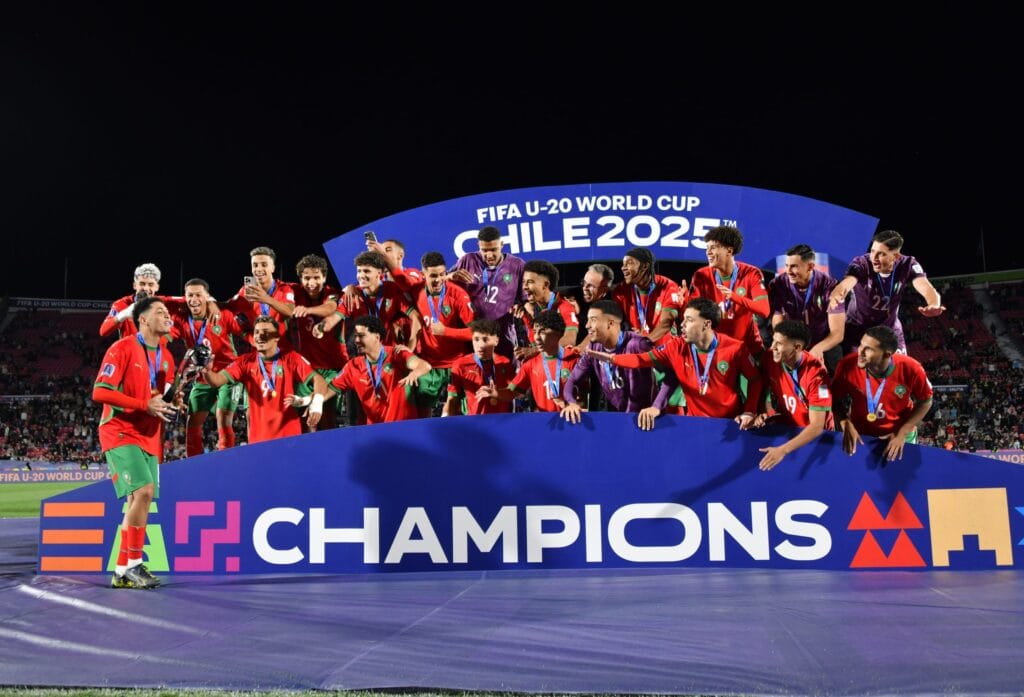
Morocco U20 World Cup Champion. Photo Credit: FRMF
World titles at youth level, an Arab Cup triumph, a flawless qualification for the 2026 World Cup and standout performances across all international stages: 2025 confirmed that Moroccan football is no longer enjoying a golden moment, but building a lasting dynasty.
Some years fade quietly, others redefine a nation’s sporting trajectory. For Moroccan football, 2025 belongs firmly to the latter category. Not because of isolated victories, but because success spread across every level of the game, men, women, youth, futsal and clubs. Match after match, tournament after tournament, Morocco did not merely win. It imposed a clear footballing identity built on structure, continuity and ambition.
The U20 World Cup Triumph: A Historic Turning Point
The true turning point came in September 2025 in Chile, during a highly competitive FIFA U20 World Cup. Without noise or excess hype, Morocco progressed steadily, displaying tactical intelligence, collective discipline and mental strength. In the final against Argentina, the Lion Cubs showed no fear. They controlled the match, struck decisively and lifted Morocco’s first-ever U20 World Cup trophy.
This triumph was not a surprise. FIFA itself highlighted the result as the culmination of long-term investment in youth development, coaching and player progression. Morocco didn’t just win a trophy, it validated an entire footballing model.
A Golden Generation That Delivered Everywhere
The U20 title was only part of a remarkable year for Morocco’s youth teams. At the FIFA U17 World Cup in Qatar, the Moroccan U17s reached the quarter-finals after pushing Brazil to the brink, falling only in the dying seconds. Their performance confirmed Morocco’s ability to compete without inferiority complexes against global giants.
In women’s football, Morocco hosted the FIFA U17 Women’s World Cup, marking another milestone. Facing elite nations like Brazil, Italy and North Korea, the tournament showcased Morocco’s growing influence in women’s football, both competitively and organizationally.
Meanwhile, Morocco’s women’s futsal team made history by qualifying for the World Cup and advancing past the group stage in their first-ever appearance, a testament to rapid development and fearless ambition.
Arab Cup Glory Built on Collective Strength
Later in the year, the Arab Cup became a true test of Morocco’s maturity. In a physically demanding and tactically tight competition, the Atlas Lions relied on defensive solidity, composure and collective discipline. Match after match, they absorbed pressure, controlled tempo and struck when opportunities appeared.
The final against Jordan was tense and exhausting, but Morocco prevailed after extra time, securing a title that reflected mental resilience more than flamboyance, the hallmark of a team built to win tournaments.
Moroccan Clubs Step onto the Global Stage
Morocco’s dominance extended beyond national teams. AS FAR’s women’s team delivered a landmark performance at the FIFA Women’s Club World Cup, defeating Asia’s champions with authority. Their victory confirmed that Moroccan clubs can now compete confidently beyond Africa.
A Perfect Road to the 2026 World Cup
The senior national team completed a flawless qualification campaign for the 2026 World Cup. Eight matches, eight victories, minimal goals conceded and complete control throughout. There was no panic, no fragility — only a team fully aware of its strengths.
This consistency proves that Morocco’s historic 2022 World Cup run was not an anomaly, but the foundation of a long-term project fueled by elite youth development.
2025: The Year Moroccan Football Became a Reference
What defines 2025 is not the number of trophies, but the coherence behind them. Every success connects to the next, revealing a football ecosystem capable of performing across all categories and disciplines.
Morocco has stopped surprising, it now sets standards. As 2026 approaches, the Kingdom stands prepared for even greater challenges, with depth, structure and ambition firmly in place. The next chapter promises to be even bigger.