
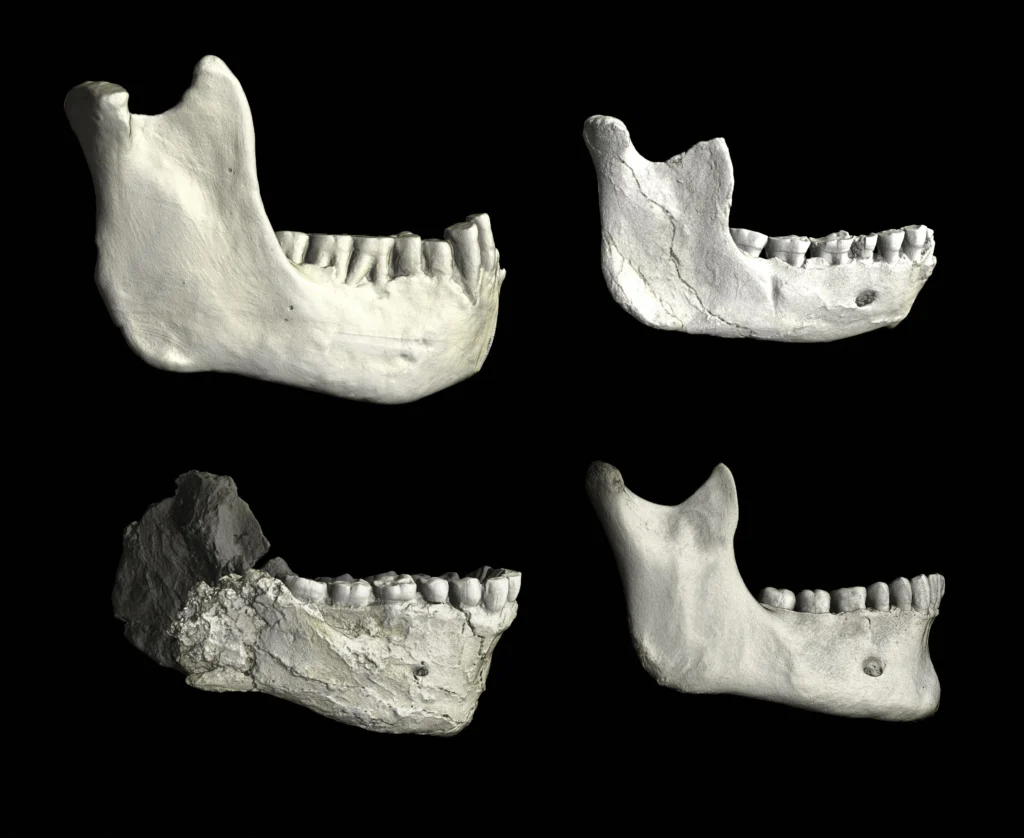
773,000-year-old human fossils in Morocco. Photo Credit: AFP
Morocco continues to play a key role in understanding human origins.
New human fossils dated to 773,000 years have been discovered near Casablanca, providing rare and precise insights into early human evolution in Africa.
Major discovery near Casablanca
The fossils were uncovered at the Thomas I quarry, part of the well-known Casablanca prehistoric complex.
The discovery was announced by Morocco’s Ministry of Youth, Culture, and Communication as part of the
Morocco-France research program “Prehistory of Casablanca.”
The excavation is conducted through a long-standing institutional partnership between Morocco’s
National Institute of Archaeological Sciences and Heritage (INSAP) and the French archaeological mission in Casablanca,
supported by the French Ministry for Europe and Foreign Affairs.
Exceptionally preserved human remains
The fossil material includes several human mandibles belonging to two adults and one child, along with dental
and post-cranial remains. According to the international research team, these fossils combine archaic traits
associated with Homo erectus and more derived anatomical features closer to modern humans.
This combination offers valuable evidence about transitional phases in human evolution and helps clarify
how early human populations developed in North Africa.
Unprecedented dating precision
Using high-resolution magnetostratigraphic analysis, researchers were able to date the fossils with exceptional accuracy.
The sediment layers recorded the Matuyama-Brunhes magnetic reversal, a globally recognized event dated to
773,000 years ago.
This makes the Thomas I site one of the most precisely dated locations in the world to have yielded hominin remains, strengthening its scientific importance on a global scale.
What this means for human evolution
Researchers emphasize that these remains can now be placed reliably within the deep history of African human populations.
They reinforce the idea that Africa, and Morocco in particular, played a central role in the emergence of the Homo sapiens lineage.
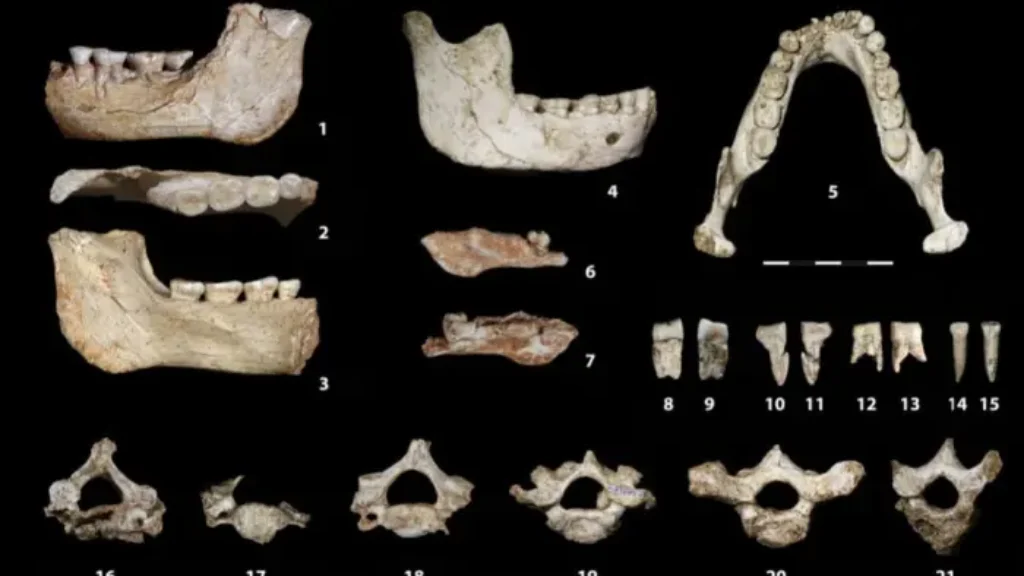
773,000-year-old human fossils in Morocco. Photo Credit: AFP
The study was co-directed by Abderrahim Mohib (INSAP), Rosalia Gallotti (University of Montpellier Paul Valéry and LabEx Archimède), and Camille Daujeard (French National Museum of Natural History and CNRS).
The full scientific analysis of the fossils was published in the journal Nature on January 7, 2026, marking a major milestone for prehistoric research in Morocco.