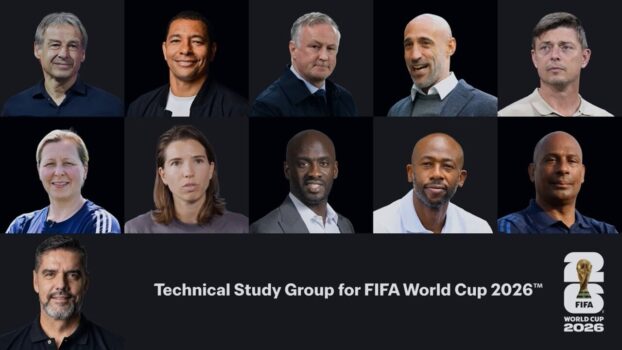
FIFA has officially unveiled the full composition of its new Technical Study Group responsible for analyzing all 104 matches of the FIFA World Cup 2026.
Presented as a historic first in the competition’s history, the initiative aims to provide supporters, national teams, coaches, and players with the most advanced tactical analysis and performance data ever produced during a FIFA World Cup.
Arsène Wenger Leads FIFA’s Technical Project
The group will operate under the leadership of Arsène Wenger, FIFA’s Chief of Global Football Development.
Operational management will be handled by former Swiss goalkeeper Pascal Zuberbühler and FIFA Head of Football Performance and Trends Analysis Tom Gardner.
The panel will bring together several former international players and experienced coaches from different continents.
Full Technical Study Group Members
- Otto Addo
- Tobin Heath
- Jürgen Klinsmann
- Jayne Ludlow
- Michael O’Neill
- Gilberto Silva
- Jon Dahl Tomasson
- Paulo Wanchope
- Aron Winter
- Pablo Zabaleta
According to FIFA, the mission of the group will be to identify tactical developments, analyze trends in modern football, and better understand the evolution of the game during the tournament.
Advanced Real-Time Match Analysis
The Technical Study Group will operate between Miami, Dallas, and Manchester.
It will rely on analysts, data specialists, and engineers capable of processing thousands of live data points collected from six different camera angles during every match.
FIFA says this system will generate the most detailed tactical and performance analysis ever created for a World Cup competition.
Artificial Intelligence and Augmented Reality
The organization confirmed that the project will integrate advanced “augmented intelligence” technologies in football analysis.
This system combines human expertise with large-scale data processing to deliver more detailed tactical insights and performance metrics.
During and after matches, supporters will be able to access:
- Augmented reality tactical visuals
- Advanced performance indicators
- Interactive match analysis
- Real-time tactical breakdowns
- Detailed post-match summaries
Fans to Access FIFA Analysis in Real Time
For the first time in FIFA World Cup history, supporters will be able to follow the Technical Study Group’s analysis live throughout the competition.
FIFA confirmed that tactical content and detailed reports will be shared through:
- FIFA social media platforms
- FIFA Technical Study Group channels
- The FIFA Technical Resource Centre YouTube channel
The initiative aims to make football analysis more accessible to the global public while helping fans better understand modern tactical evolution.
Arsène Wenger Highlights Football Evolution
According to Arsène Wenger, the Technical Study Group will help identify football trends and contribute to the future development of the game.
He emphasized FIFA’s objective of combining technical expertise with advanced data analysis in order to improve understanding of football at the highest level.
FIFA also sees the project as an educational tool for future generations of players, coaches, and analysts.
Technical Group to Select FIFA Awards Winners
In addition to its analytical responsibilities, the Technical Study Group will also help determine the winners of several individual awards presented at the end of the tournament.
The panel will contribute to evaluating player performances throughout the World Cup before selecting recipients for FIFA’s official tournament honors.
The Largest FIFA World Cup Ever
The FIFA World Cup 2026 will feature:
- 48 national teams
- 104 matches
- 16 host cities
- Three host countries
The tournament begins on June 11, 2026, in Mexico City and concludes on July 19, 2026, at the New York New Jersey Stadium.