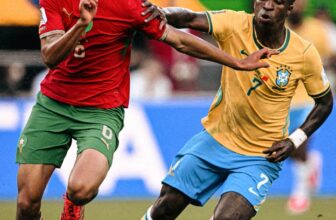
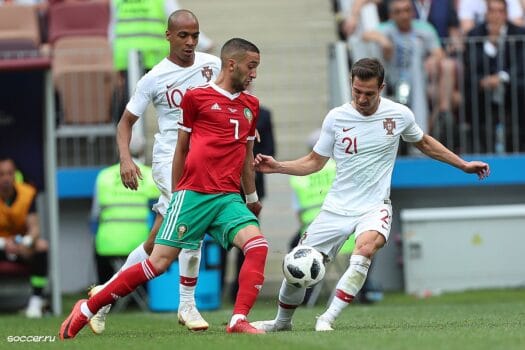
“Portugal vs Morocco match action” © soccer.ru / Wikimedia Commons, licensed under CC BY-SA 3.0.
Morocco’s head coach Walid Regragui has announced his 28-man squad for the Africa Cup of Nations 2025, which the Kingdom will host. Drawn into Group A alongside Mali, Zambia, and Comoros, the Atlas Lions are favorites to go deep in the competition.
While the list is strong, it also includes some notable omissions that have sparked discussion. Beyond selections, the absence of certain experienced and influential players reflects a deeper strategic approach. These four players missed the final cut for a variety of reasons, ranging from fitness concerns to tactical preferences.
Hakim Ziyech: Game Time Matters Most
The most widely discussed absence is Hakim Ziyech, a player with extensive experience at top European clubs. After returning to Morocco by joining Wydad Casablanca, Ziyech is still in a rehabilitation and re-conditioning phase following a prolonged absence from competitive action.
Although technically gifted and capable of creating opportunities from midfield or wide areas, he has not yet accumulated sufficient competitive minutes to convince the technical staff that he is ready for a demanding tournament. With attacking options like Brahim Díaz, Ayoub El Kaabi, Youssef En-Nesyri, Soufiane Rahimi, Ilias Akhomach, Abdessamad Ezzalzouli, Eliesse Ben Seghir, and Chemsdine Talbi, the competition in forward and creative spots has been intense.
Ziyech’s exclusion thus reflects a pragmatic decision based on current match readiness, not a lack of respect for his qualities.
Sofiane Diop: A Promising Start, but Still on the Sidelines
Sofiane Diop was among the players who featured in Morocco’s most recent friendly fixtures, earning his first cap in a match against Uganda last November. Despite that debut and his technical strengths, Diop did not make the final squad.
The midfield area is particularly competitive, and Regragui appears to have prioritized players with specific profiles — balance between defensive responsibility and transitional effectiveness — over emerging talents still building their international resumes.
Today, Diop’s absence underlines not a lack of ability, but rather the narrow margins at the highest level of national team selection.
Sofiane Boufal: Experience Left Watching from Home
Another notable omission is Sofiane Boufal, a forward who has been a regular part of Morocco’s setup in recent years. After seeking playing time in Europe with Union Saint-Gilloise, Boufal hoped to re-establish himself ahead of the tournament.
Despite his reputation and experience, he did not secure a place among the chosen attackers. The coaching staff appears to have prioritized forwards with recent consistent club form and tactical profiles better aligned with Regragui’s system, particularly in pressing and defensive transition phases.
Boufal’s absence signals a broader shift toward stricter fitness and tactical criteria in the final selection.
Mohamed Rabie Hrimat: Domestic Star Without a National Call
A perhaps more surprising exclusion is Mohamed Rabie Hrimat, a highly respected midfielder in Moroccan domestic football. Born in Rabat and currently captain of AS FAR Rabat, Hrimat has built a strong reputation through consistent performances in the Botola Pro.
Hrimat came through the youth ranks at FUS Rabat and later played for Kénitra AC before joining AS FAR in 2020. At AS FAR he has been a key figure, contributing to the club’s successes and standing out both in domestic league play and cup competitions.
He is also known for his leadership and was selected in the Morocco A’ national programme, representing local-based players and winning the African Nations Championship (CHAN) in 2025.
This achievement, along with his recognition as one of the top performers in the Botola Pro, underlined his value, but it was not enough to secure a place in the main national team squad. In this case, the omission reflects a tactical choice: Regragui’s midfield selection emphasizes calculated balance between athleticism, international experience, and specific match roles.
Hrimat’s absence, therefore, should not be seen as a refutation of his quality, but rather the outcome of extremely tight competition in central midfield within the national setup.
What These Absences Tell Us About Morocco’s Strategy
The athletes omitted from the AFCON 2025 squad represent a mix of high-profile talent and domestic excellence. Their exclusion highlights several strategic priorities:
Physical readiness and current competitive rhythm are weighed heavily at the national team level.
Tactical balance across midfield and attacking positions is prioritized over individual reputation.
Competition depth in the Atlas Lions pool means that small differences in form or fit can determine inclusion.
While it is always disappointing for players excluded from major tournaments, these choices reflect a coherent coaching approach aimed at maximizing efficiency, reliability, and adaptability on the continental stage.
Looking Ahead
AFCON 2025 will be played in Morocco under intense public scrutiny and expectation. With a squad that combines experienced internationals with dynamic young talents, the Atlas Lions are structured to compete at all stages.
Discussion will continue around those left out, particularly figures like Ziyech and Hrimat, whose quality is clearly recognised nationwide. However, football is ultimately decided on the pitch.
As the tournament unfolds, the depth of Morocco’s roster and the tactical clarity of its selections will determine how far the Lions can go in their quest for continental glory on home soil.
Related: